Personal boundaries
心理边界
Personal boundaries are what a person is and is not willing to accept from others: the limits they set to protect their time, energy, body and emotions.[2][3]
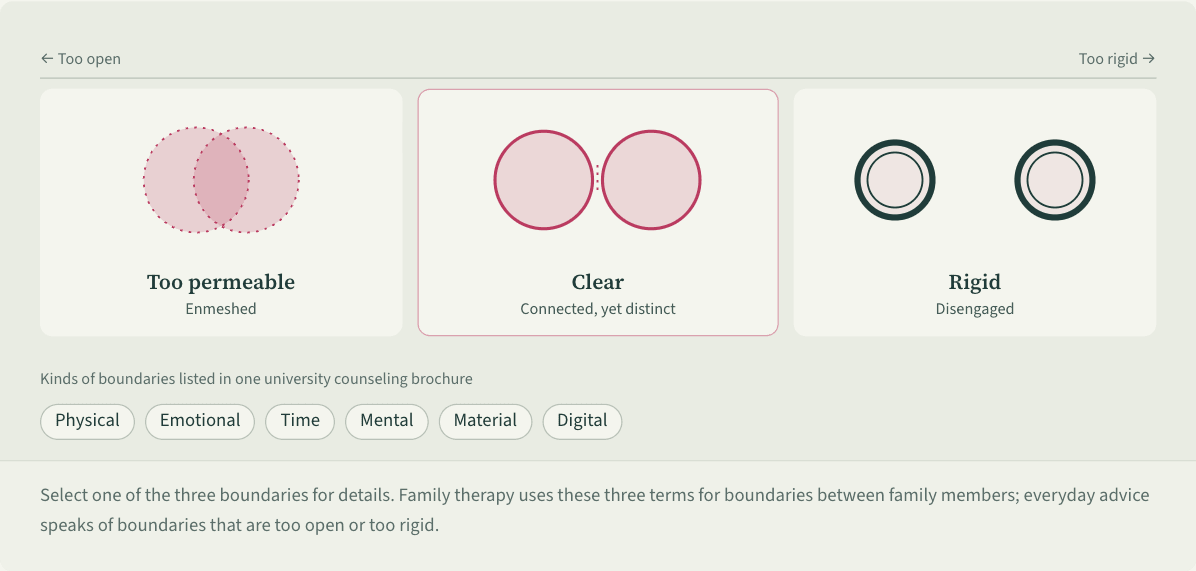
Top to bottom: from too open to too rigid.
Kinds of boundaries listed in one university counseling brochure
- Physical
- Emotional
- Time
- Mental
- Material
- Digital
Under an axis running from too open to too rigid, three small panels each show two circles standing for two people. Too permeable (enmeshed): the circles overlap heavily, with dotted outlines. Clear: the circles sit close without overlapping, with solid outlines and a thin dotted line between them. Rigid (disengaged): the circles sit far apart, with thick double outlines. Below, six kinds of boundary from one university counseling brochure: physical, emotional, time, mental, material, digital.
 Save as image (PNG)
Key points
- Family therapist Minuchin (1974) used boundaries for the rules of taking part in a family subsystem; they can be clear, too permeable (enmeshed) or rigid (disengaged).[1]
- Very open boundaries make it hard to say no; very rigid ones make closeness hard. Healthy boundaries balance openness with limits that feel secure.[2]
- One university counseling brochure lists six kinds: physical, emotional, time, mental (thoughts and values), material and digital boundaries.[3]
- Signs of weak boundaries include saying yes when you mean no and feeling responsible for others’ emotions. Suggested steps: use “I” statements, be direct, and expect pushback.[3]
An example
Ms. Wang’s colleague often sends work messages at night and expects a quick reply. After deciding what she can accept, she tells him, “For messages after 8 p.m., I’ll reply when I’m back at work the next day.” He is annoyed at first, then starts contacting her within those hours.
Misreadings and limits
In everyday talk, “boundaries” are often treated as fixed rules or a reason to keep people away. In practice, a person’s limits differ by relationship and situation, and family therapists treat overly rigid boundaries as a problem just as they do overly diffuse ones.[1][2]
Sources
- 1 Compagnone, P., & Jean, C. (2011). Systemic analysis of group affiliation: Clinical uses of the SAGA. The Signal (World Association for Infant Mental Health), October–December 2011, 9–13. View source
- 2 University of Toledo Counseling Center (n.d.). Identifying your boundaries. University of Toledo, Student Affairs. View source
- 3 Tennessee Tech Center for Counseling and Mental Health Wellness (n.d.). Healthy boundaries [Brochure]. Tennessee Technological University. View source
Last checked against sources: October 26, 2026