Nonviolent Communication
非暴力沟通
Nonviolent Communication (NVC) is a method developed by Marshall Rosenberg for expressing yourself and understanding others through four components: observations, feelings, needs and requests.[1][2]
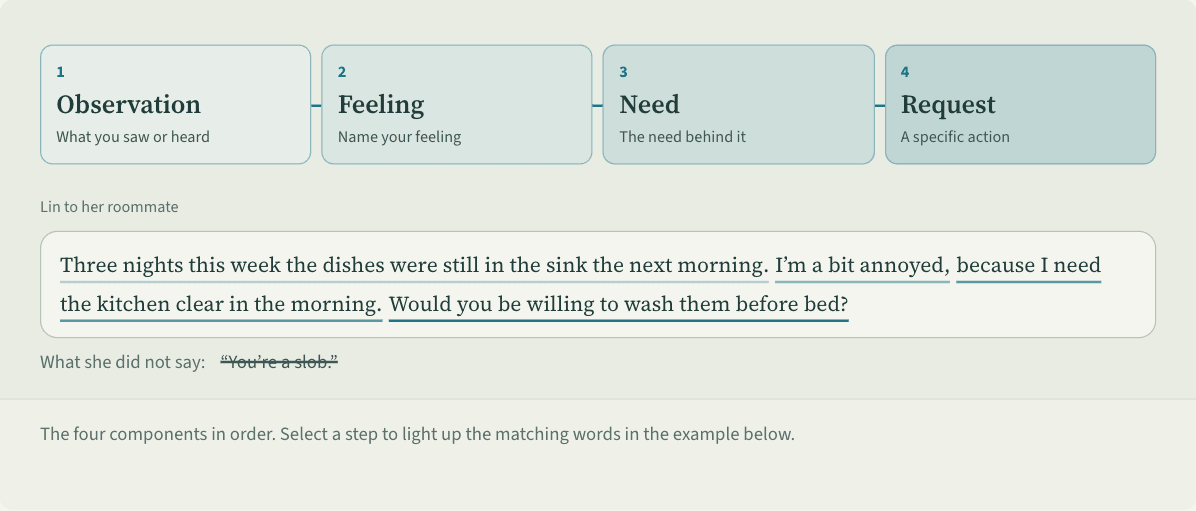
Three nights this week the dishes were still in the sink the next morning.I’m a bit annoyed,because I need the kitchen clear in the morning.Would you be willing to wash them before bed?
What she did not say: “You’re a slob.”
Four connected cards in order: 1 Observation (what you saw or heard), 2 Feeling, 3 Need (the need behind it), 4 Request (a specific action). Below, Lin’s words to her roommate are split into four parts, one per card: “Three nights this week the dishes were still in the sink the next morning.” “I’m a bit annoyed,” “because I need the kitchen clear in the morning.” “Would you be willing to wash them before bed?” A last line shows what she did not say, “You’re a slob,” struck through.
 Save as image (PNG)
Key points
- Step one describes only what you saw or heard, without evaluation, such as “you were late three times this week” rather than “you’re never on time.”[1]
- Step two names your feeling. Rosenberg stresses taking responsibility for your own feelings rather than blaming them on the other person.[1]
- Step three names the need behind the feeling. The book includes lists of basic feelings and needs that people share, for practice.[1]
- The last step is a request: asking the other person for a specific action that would make life better for both of you.[1]
An example
Lin tells her roommate, “Three nights this week the dishes were still in the sink the next morning. I’m a bit annoyed, because I need the kitchen clear in the morning. Would you be willing to wash them before bed?” She does not say “you’re a slob.”
Misreadings and limits
NVC is widely taught, but evidence on its effects is limited. Two integrative reviews found that most studies used quasi-experimental pre/post, qualitative or mixed-methods designs rather than randomized controlled trials, and the authors acknowledge methodological flaws.[3][4]
Sources
- 1 Rosenberg, M. B. (2003). Nonviolent communication: A language of life (2nd ed.). PuddleDancer Press. View source
- 2 卢森堡, M.(阮胤华 译) (2018). 非暴力沟通. 华夏出版社. View source
- 3 Yang, J. W., & Kim, S. (2016). Integrative review of nonviolent communication intervention studies. Perspectives in Nursing Science, 13(1), 36–47. doi:10.16952/pns.2016.13.1.36
- 4 Pereira, J. S., & Durgante, H. B. (2025). Interventions in nonviolent communication to promote empathy: Integrative review. Revista Brasileira em Promoção da Saúde, 38, 1–14 (article 16464). doi:10.5020/18061230.2025.16464
Last checked against sources: October 26, 2026