Intersectionality
交叉性
Intersectionality describes how multiple forms of discrimination, such as racism and sexism, combine and overlap, producing complex, cumulative effects.[1] Kimberlé Crenshaw introduced the idea in a 1989 article in the University of Chicago Legal Forum.[1]
- 1977 The Combahee River Collective statement, one of the earliest expressions of the idea
- 1989 Crenshaw introduces the term in the University of Chicago Legal Forum
- 2017 APA’s Multicultural Guidelines put intersectionality in their title
- 2023 APA’s Inclusive Language Guide, 2nd edition, defines the term
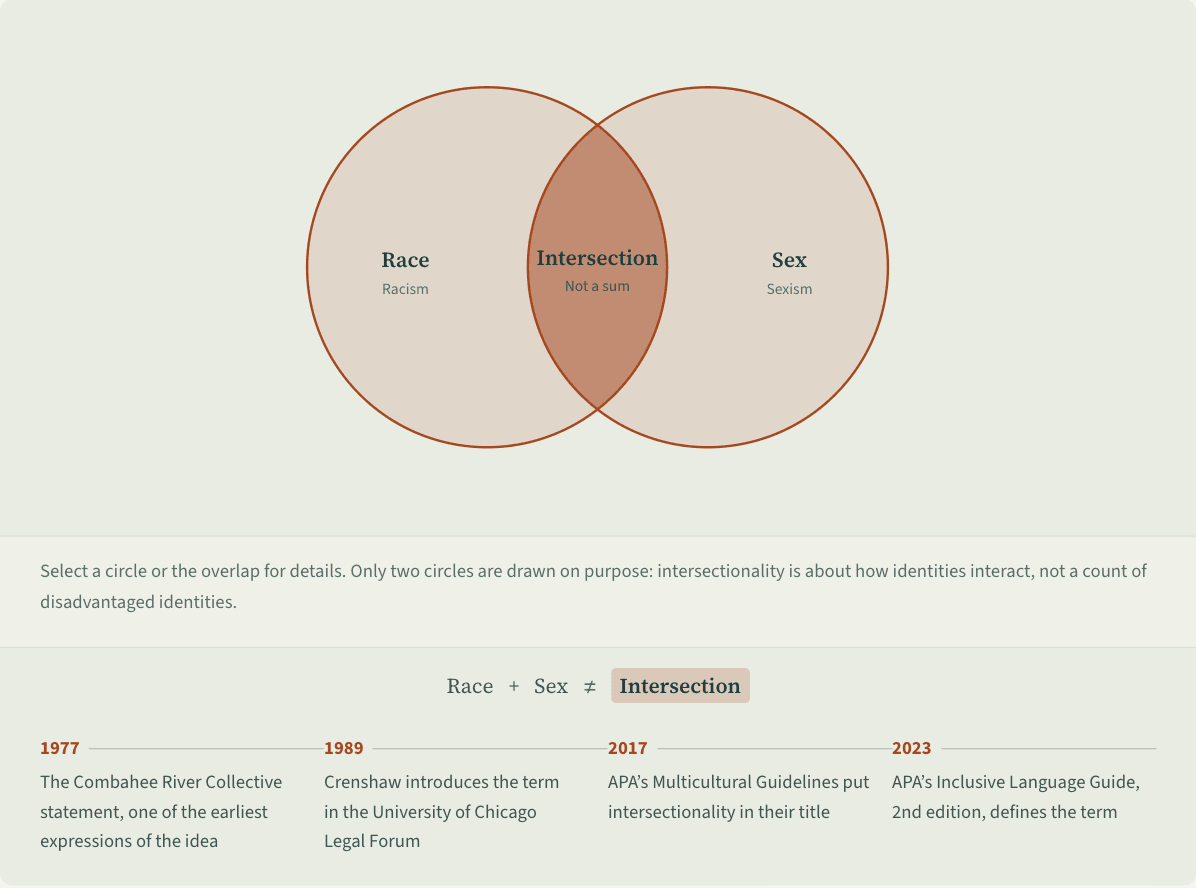
Two overlapping circles: race (racism) on the left, sex (sexism) on the right, and the overlap labeled “intersection: not a sum.” Selecting a part shows details: looking at race alone or sex alone misses what happens at the intersection (Black women and White women are both women yet are not treated the same), and the intersection is not racism plus sexism. Below, “race + sex ≠ intersection” and a timeline: the 1977 Combahee River Collective statement, Crenshaw introducing the term in 1989, APA’s 2017 Multicultural Guidelines with intersectionality in the title, and the 2023 APA Inclusive Language Guide, 2nd edition, defining it.
 Save as image (PNG)
Key points
- Its central claim is that effects do not simply add up: the experience of Black lesbian women is not necessarily the sum of racism, sexism and heterosexism.[2]
- Sharing one identity does not mean sharing the same experience: Black women and White women are both women, yet their experiences differ.[2]
- Related terms such as social location and positionality describe where a person stands, by race, ethnicity and other statuses, within systems of power.[1][2]
- The American Psychological Association’s 2017 Multicultural Guidelines put intersectionality in their title and state that treating identities as separate, summable factors goes against the concept.[3]
An example
Ms. Wang, an older immigrant woman, keeps getting turned down for jobs. Looking only at gender or only at immigration status misses part of the picture: some employers hold assumptions specifically about older immigrant women that no single identity would reveal.
Misreadings and limits
A common misreading treats intersectionality as a tally in which more marginalized identities simply add up to more oppression. The concept is about how identities interact and change one another’s meaning, not about summing them.[3] It also covers privilege as well as disadvantage.[2]
Sources
- 1 American Psychological Association (2023). Inclusive language guide (2nd ed.). American Psychological Association. View source
- 2 American Psychological Association (2024). Intersectionality. APA Style: Bias-free language. View source
- 3 American Psychological Association (2017). Multicultural guidelines: An ecological approach to context, identity, and intersectionality. American Psychological Association. View source
Last checked against sources: October 26, 2026