Active listening
积极倾听
Active listening means attending to what a speaker says and the feelings behind it, restating their meaning in your own words, and holding back judgment and unrequested advice. Carl Rogers and Richard Farson set out the approach for managers in a 1957 essay.[1]
“I’ve been working late every night, and my proposal keeps getting sent back.”
Do
Avoid
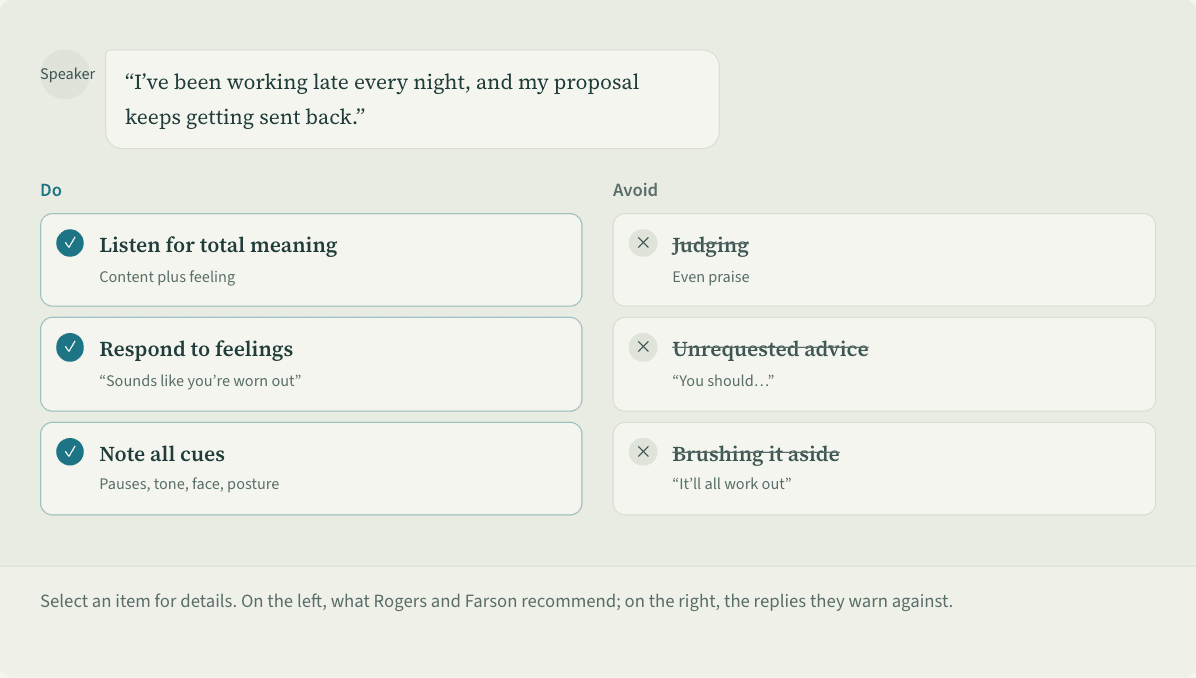
At the top, a speech bubble: “I’ve been working late every night, and my proposal keeps getting sent back.” Below, two columns of cards: “Do” with three checked cards and “Avoid” with three crossed-out cards.
 Save as image (PNG)
Key points
- Rogers and Farson named three habits: listen for total meaning (content plus feeling), respond to feelings, and note all cues, such as hesitation, tone, facial expression and posture.[1]
- They advised against passing judgment, even favorable judgment, against advice nobody asked for, and against brushing concerns aside with reassurance like “it will all work out.”[1]
- One experiment broke it into three parts: engaged nonverbal responses such as nodding, nonjudgmental paraphrasing, and questions that invite the speaker to say more.[3]
- In an experiment with 115 college students, active listening left speakers feeling more understood than advice or simple acknowledgment did, but their satisfaction was similar to receiving advice.[3]
An example
Jay says he has been working late every night and his proposal keeps getting sent back. Instead of offering a fix, Lin says, “Sounds like you’re worn out, and you feel the effort isn’t being seen.” Jay nods and goes on to say that what really worries him is his year-end review.
Misreadings and limits
Active listening is not the same as parroting. In one experiment, a paraphrase on its own made the listener seem more likable but did not make speakers feel better understood.[2] Researchers also note that couples rarely listen this way during real arguments.[3]
Sources
- 1 Rogers, C. R., & Farson, R. E. (1957). Active listening. Industrial Relations Center, University of Chicago. View source
- 2 Weger, H., Jr., Castle, G. R., & Emmett, M. C. (2010). Active listening in peer interviews: The influence of message paraphrasing on perceptions of listening skill. International Journal of Listening, 24(1), 34–49. doi:10.1080/10904010903466311
- 3 Weger, H., Jr., Castle Bell, G., Minei, E. M., & Robinson, M. C. (2014). The relative effectiveness of active listening in initial interactions. International Journal of Listening, 28(1), 13–31. doi:10.1080/10904018.2013.813234
Last checked against sources: October 26, 2026