OARS
OARS 技巧
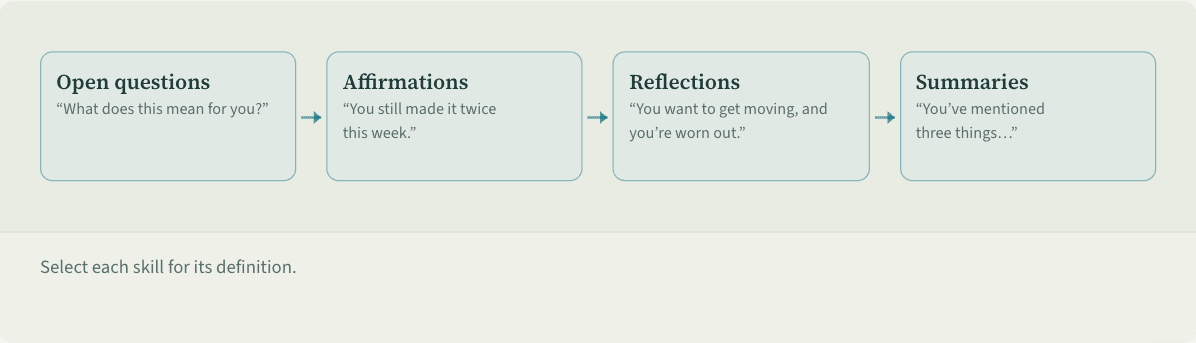
OARS is an acronym for four basic person-centered communication skills in Motivational interviewing: open questions, affirmations, reflections, and summaries.[1][2]
Four cards side by side, open questions, affirmations, reflections and summaries, each with an example line.
 Save as image (PNG)
Key points
- An open question gives the person broad latitude and choice in how to answer, in contrast to a closed question.[1][2]
- An affirmation values a positive attribute or behavior of the person, for example by recognizing a specific effort or intention.[1][2]
- A reflection is a statement that mirrors the meaning, stated or implied, of what the person said; a summary is a reflection that pulls together two or more of their statements.[1][2]
- In one trial, a style built on reflective listening drew about twice as much change talk and half as much resistance as a persuasive style.[3]
An example
Lin says, “I keep meaning to exercise, but I’m wiped out after work.” The listener reflects, “You really want to get moving, and your current schedule leaves you drained,” then asks which time of day would be easiest to start with (an open question).
Misreadings and limits
OARS is often treated as if it were MI itself. These are general person-centered skills that mainly build the relationship; MI theory adds a technical part, selectively evoking and reinforcing Change talk.[3]
Sources
- 1 Miller, W. R., & Rollnick, S. (2013). Motivational interviewing: Helping people change (3rd ed.). Guilford Press. View source
- 2 Motivational Interviewing Network of Trainers (2024). Glossary of motivational interviewing terms (English/Spanish/Portuguese). Motivational Interviewing Network of Trainers (MINT). View source
- 3 Miller, W. R., & Rose, G. S. (2009). Toward a theory of motivational interviewing. American Psychologist, 64(6), 527–537. doi:10.1037/a0016830
- 4 Miller, W. R., & Rollnick, S. (n.d.). 动机式访谈法:帮助人们改变(郭道寰、王韶宇、江嘉伟 译). 华东理工大学出版社,ISBN 978-7-5628-3755-8. Chinese edition of [1], chapter 6; the Chinese terms on this page follow its glossary.
Last checked against sources: October 26, 2026