Empathy
共情
Empathy is feeling and understanding another person’s emotional state while recognizing that the feeling belongs to them, not to you.[1] In counseling, it refers to the therapist’s sensitive understanding of a client’s thoughts, feelings and struggles.[2]
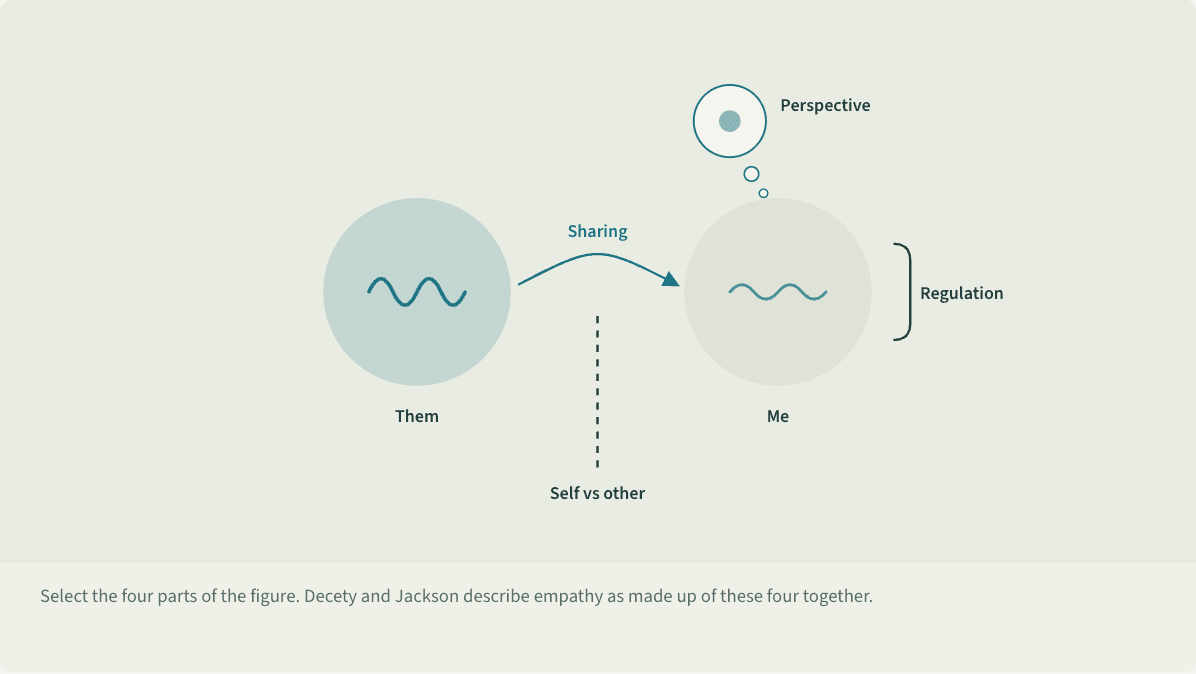
A circle on the left for them, with a wavy line for their emotion; a circle on the right for me, with a smaller wave. An arrow from them to me is labeled sharing; a dashed vertical line between the circles is labeled self vs other; a thought bubble above me is labeled perspective; a bracket at my right is labeled regulation.
 Save as image (PNG)
Key points
- Decety and Jackson break empathy into four parts: sharing the other’s emotion, keeping self and other distinct, flexibly taking their perspective, and regulating one’s own emotion.[1]
- One way scholars separate empathy from sympathy: sympathy responds only to another’s suffering, while empathy also shares their joy and can motivate helping.[3]
- A meta-analysis of 82 samples covering 6,138 clients found that therapist empathy was positively correlated with client outcome (r = .28).[2]
An example
Ms. Wang mentions that her mother is in the hospital, and her voice tightens. Instead of saying “don’t worry,” her coworker Lin says, “Working all day and then going to the hospital every evening must be weighing on you.” Ms. Wang relaxes and starts to say more.
Misreadings and limits
In Chinese, empathy should not be written 移情. Zhu Guangqian used that word for empathy in the 1930s, but a major Chinese psychology dictionary later standardized 共情.[3] In psychotherapy, 移情 means transference: a client redirects feelings about important people, such as parents, onto the therapist.[4]
Sources
- 1 Decety, J., & Jackson, P. L. (2004). The functional architecture of human empathy. Behavioral and Cognitive Neuroscience Reviews, 3(2), 71–100. doi:10.1177/1534582304267187
- 2 Elliott, R., Bohart, A. C., Watson, J. C., & Murphy, D. (2018). Therapist empathy and client outcome: An updated meta-analysis. Psychotherapy, 55(4), 399–410. doi:10.1037/pst0000175
- 3 陈军 (2019). 共情神经科学:探索亲社会行为、利他主义和道德的生物学基础. 学习与探索, 2019(7). View source
- 4 广东科技学院心理健康教育与辅导中心 (2018). 著名的心理治疗方法. 广东科技学院心理辅导中心. View source
Last checked against sources: October 26, 2026