Ericksonian hypnosis
艾瑞克森催眠
What is Ericksonian hypnosis?
Ericksonian hypnosis is the style of hypnosis and therapy developed by the American psychiatrist Milton H. Erickson (1901–1980). It relies on indirect, open-ended suggestion, stories and metaphor, and treats the client’s habits, beliefs and even resistance as resources for change.[1][2]
What testing found
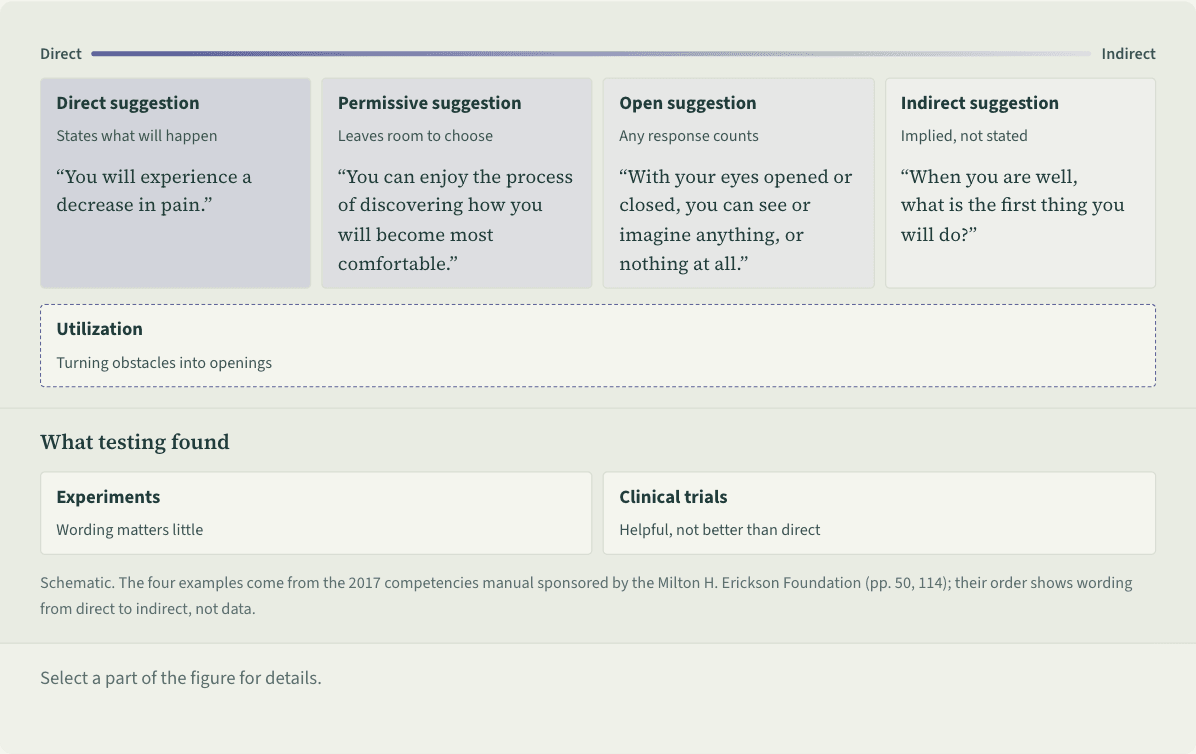
Schematic. The four examples come from the 2017 competencies manual sponsored by the Milton H. Erickson Foundation (pp. 50, 114); their order shows wording from direct to indirect, not data.
Schematic. Along the top runs an axis from direct to indirect with four cards, each with an example: direct suggestion, “You will experience a decrease in pain”; permissive suggestion, “You can enjoy the process of discovering how you will become most comfortable”; open suggestion, “With your eyes opened or closed, you can see or imagine anything or nothing at all”; indirect suggestion, “When you are well, what is the first thing you will do?” Below the axis, a card for utilization: to a client who will not speak, the therapist says that sitting in silence, many important thoughts will come to mind. Two evidence cards at the bottom: experiments, where direct or indirect wording made little difference to responses on hypnosis tests; and clinical trials, where in 8 randomized trials Ericksonian hypnosis beat waitlists or usual care, matched other treatments and showed no edge over direct hypnosis.
 Save as image (PNG)
This figure image is licensed CC BY 4.0: reuse it with credit and a link back to this page. How to reuse
Key points
- Traditional suggestions are direct commands such as “You will feel calm.” An Ericksonian version might be “You might begin to notice a growing sense of calm,” leaving the response to the client.[1][2]
- Utilization treats whatever the client brings, symptoms and resistance included, as a resource. To a client who will not talk, the therapist might say that sitting in silence lets important thoughts surface.[1]
- Experiments find that whether a suggestion is worded directly or indirectly makes little difference to responses on hypnosis tests, and the best-controlled pain studies show no advantage for indirect wording.[3]
- A 2026 meta-analysis of 8 randomized trials (676 people) found it beat waitlists or usual care and matched treatments such as CBT, but showed no clear edge over direct hypnosis.[2]
An example
In her first relaxation session, Lin keeps opening her eyes to check the wall clock and feels she is failing. Rather than ask her to close them, the therapist says, “You can keep watching that clock, the second hand ticking along, and you may notice your breathing slow with it.” Her habit becomes her point of focus.
Misreadings and limits
A popular claim is that indirect suggestion is more powerful than direct commands, reaches even people who are hard to hypnotize, and depends on the hypnotist’s skill. Two reviews found no evidence for these claims.[3][4] The recent meta-analysis rests on few, small trials that could not be fully blinded, so expectancy may inflate the benefit.[2]
Sources
- 1 Short, D. (Series Ed.), Zeig, J. K., & Miller, S. D. (2017). Principles and core competencies of Ericksonian therapy: 2017 research and teaching manual (CCET-1). Milton H. Erickson Foundation & Milton H. Erickson Institute of Phoenix. View source
- 2 Çınaroğlu, M., Yılmazer, E., & Noyan Ahlatcıoğlu, E. (2026). Ericksonian hypnotherapy: A systematic review and meta-analysis of RCTs. Psychiatry International, 7(1), 16. doi:10.3390/psychiatryint7010016
- 3 Lynn, S. J., Neufeld, V., & Maré, C. (1993). Direct versus indirect suggestions: A conceptual and methodological review. International Journal of Clinical and Experimental Hypnosis, 41(2), 124–152. doi:10.1080/00207149308414543
- 4 Matthews, W. J. (2000). Ericksonian approaches to hypnosis and therapy: Where are we now?. International Journal of Clinical and Experimental Hypnosis, 48(4), 418–426. doi:10.1080/00207140008410370
Last checked against sources: October 27, 2026