Neuro-linguistic programming (NLP)
神经语言程序学(NLP)
What is neuro-linguistic programming (NLP)?
Neuro-linguistic programming (NLP; not natural language processing) is a set of communication and change techniques Richard Bandler and John Grinder drew in the 1970s from watching therapists such as Fritz Perls, Milton Erickson and Virginia Satir.[1][2] It holds that each person favors one sense and that matching it builds rapport.[2]
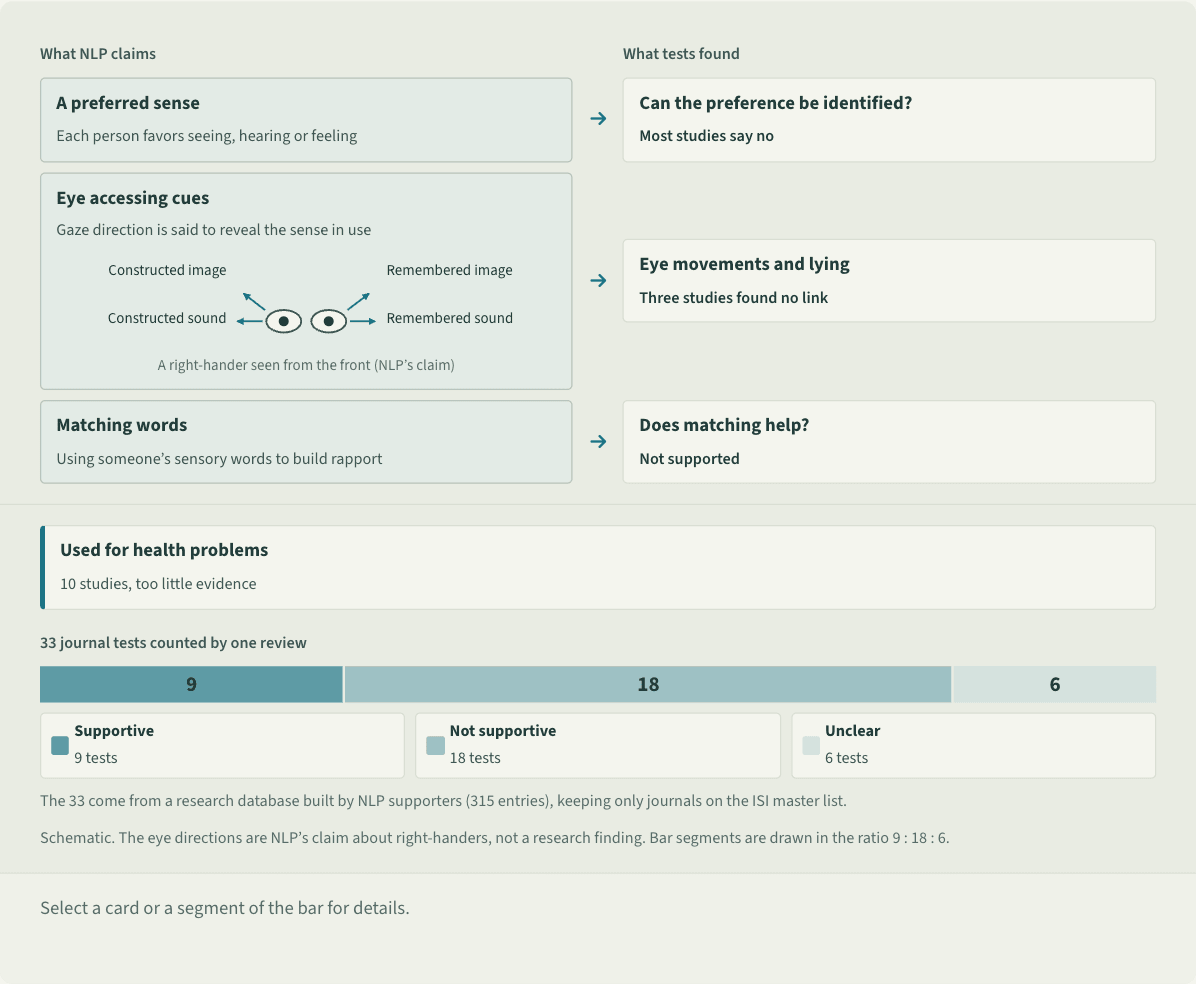
33 journal tests counted by one review
The 33 come from a research database built by NLP supporters (315 entries), keeping only journals on the ISI master list.
Schematic. The eye directions are NLP’s claim about right-handers, not a research finding. Bar segments are drawn in the ratio 9 : 18 : 6.
Schematic. Three rows of cards; in each, an NLP claim on the left points to the test result on the right. Row one: each person favors one representational system, such as visual, auditory or kinesthetic; result: neither eye movements nor self-report identify such a preference, and most studies do not support it. Row two: eye accessing cues, with a front-view sketch of eyes marking NLP’s claim that a right-hander looking to their own upper right is constructing an image, upper left remembering one, right constructing a sound and left remembering one; result: three 2012 studies (32 people, 50 judges, 52 videos) found no link between eye movements and lying. Row three: matching someone’s sensory words builds rapport; result: not supported. Below, a card: a systematic review of health outcomes found only 10 studies, with 4 of 5 randomized trials showing no difference. At the bottom, a segmented bar: of 33 journal tests, 9 supportive, 18 not supportive, 6 unclear.
 Save as image (PNG)
This figure image is licensed CC BY 4.0: reuse it with credit and a link back to this page. How to reuse
Key points
- NLP holds that people process experience through visual, auditory, kinesthetic and other “representational systems,” favoring one that shows in their words (“I see what you mean”) and eye movements.[1][2]
- NLP says right-handers glance up-right when imagining and up-left when remembering, later taken as a lie cue. Early tests did not support this,[1][3] nor did three 2012 lie-detection studies.[3]
- A review of 33 tests in indexed journals counted 9 supportive, 18 non-supportive and 6 unclear, the non-supportive ones better designed; matching clients’ sensory words did not improve rapport.[1]
- A systematic review found just 10 studies of health outcomes; 4 of 5 randomized trials showed no difference from controls. The authors call this thin evidence, not proof of no effect.[2]
An example
At a sales workshop, Jay is told that a client who glances up to the right while answering is probably making it up. The next day Ms. Wang glances that way while replying to his quote, and he nearly decides she is lying. Later he reads that studies found no such difference between liars’ and truth-tellers’ eye movements.[3]
Misreadings and limits
A common misreading treats NLP as evidence-based, or assumes words and eye movements can sort people into visual or auditory types. One review concludes the research contradicts claims of an empirical basis;[1] another notes that some techniques overlap with established ones, such as “anchoring” with classical conditioning.[2]
Sources
- 1 Witkowski, T. (2010). Thirty-five years of research on neuro-linguistic programming. NLP Research Data Base. State of the art or pseudoscientific decoration?. Polish Psychological Bulletin, 41(2), 58–66. doi:10.2478/v10059-010-0008-0
- 2 Sturt, J., Ali, S., Robertson, W., Metcalfe, D., Grove, A., Bourne, C., & Bridle, C. (2012). Neurolinguistic programming: A systematic review of the effects on health outcomes. British Journal of General Practice, 62(604), e757–e764. doi:10.3399/bjgp12X658287
- 3 Wiseman, R., Watt, C., ten Brinke, L., Porter, S., Couper, S.-L., & Rankin, C. (2012). The eyes don’t have it: Lie detection and neuro-linguistic programming. PLoS ONE, 7(7), e40259. doi:10.1371/journal.pone.0040259
Last checked against sources: October 28, 2026