Hypnosis
催眠
What is hypnosis?
The American Psychological Association’s Division 30 defined hypnosis in 2014 as a state of consciousness involving focused attention and reduced peripheral awareness, with an enhanced capacity to respond to suggestion.[1] A hypnotic induction is the procedure used to bring it about; hypnotherapy is its use to treat a medical or psychological problem.[1]
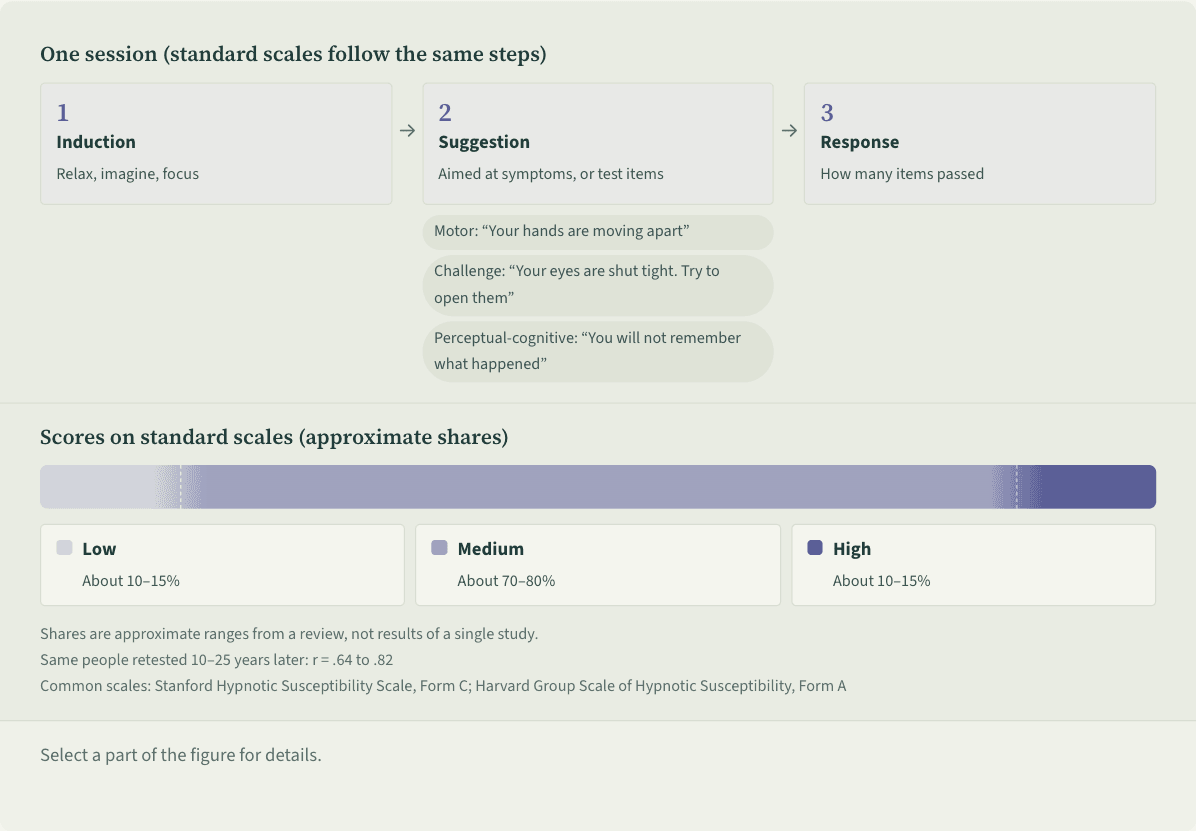
One session (standard scales follow the same steps)
-
- Motor: “Your hands are moving apart”
- Challenge: “Your eyes are shut tight. Try to open them”
- Perceptual-cognitive: “You will not remember what happened”
Scores on standard scales (approximate shares)
Shares are approximate ranges from a review, not results of a single study.
Same people retested 10–25 years later: r = .64 to .82
Common scales: Stanford Hypnotic Susceptibility Scale, Form C; Harvard Group Scale of Hypnotic Susceptibility, Form A
Two parts. At top, three boxes linked by arrows from left to right: induction (relaxing, picturing a calm scene, focusing); suggestion (in treatment, aimed at symptoms, such as feeling less anxious; on scales, three kinds: direct motor, such as your hands are moving apart; motor challenge, such as your eyes are shut tight, try to open them; perceptual-cognitive, such as you will not remember what happened); response (each suggestion is scored as passed or failed against set criteria, and the number passed is the score). At bottom, a horizontal band in three segments: low hypnotizability about 10–15% of people, medium about 70–80%, high about 10–15%. A note below says retests of the same people 10 to 25 years apart correlate .64 to .82, and that common scales include the Stanford Hypnotic Susceptibility Scale, Form C, and the Harvard Group Scale of Hypnotic Susceptibility, Form A.
 Save as image (PNG)
This figure image is licensed CC BY 4.0: reuse it with credit and a link back to this page. How to reuse
Key points
- A session has two phases: an induction that helps the person relax, picture a calm scene and focus, then suggestions aimed at their symptoms, such as feeling less anxious.[2]
- Hypnotized people are not asleep, and the professional society stresses that they stay in control and cannot be made to do what they do not want;[2] responses can still feel involuntary.[3]
- Hypnotizability varies: about 10–15% of people score high on standard scales, 10–15% low and the rest in between. Retests 10 to 25 years apart correlate .64 to .82.[3]
- In an overview of 49 meta-analyses, evidence was strongest for medical procedures and pain; irritable bowel syndrome effects were mostly small to medium; only 2 of 6 smoking effects were significant.[4]
An example
Ms. Wang is tense about having a wisdom tooth pulled. Her dentist has her slow her breathing and picture herself lying on a beach, then suggests “with each breath out, your jaw loosens a little more.” She can still hear the instruments and knows she can open her eyes at any time; her attention is on the dentist’s words.
Misreadings and limits
Evidence varies by condition and its overall quality is limited: only 9 of the 49 meta-analyses were rated high quality, about two thirds of effects showed substantial heterogeneity, head-to-head comparisons with established treatments were rare, and fewer than half the reviews reported on harms.[4] On recovering memories, see Hypnosis and memory; on direct versus indirect wording, see Ericksonian hypnosis.
Sources
- 1 Society of Psychological Hypnosis, Division 30 of the American Psychological Association (2014). Definition and description of hypnosis. About Division 30. American Psychological Association. View source
- 2 Society of Psychological Hypnosis, Division 30 of the American Psychological Association (n.d.). Hypnosis: What it is and how it can help you feel better [Client brochure]. American Psychological Association, Division 30 (PDF). View source
- 3 Barnier, A. J., Terhune, D. B., Polito, V., & Woody, E. Z. (2022). A componential approach to individual differences in hypnotizability. Psychology of Consciousness: Theory, Research, and Practice, 9(2), 130–140. doi:10.1037/cns0000267
- 4 Rosendahl, J., Alldredge, C. T., & Haddenhorst, A. (2024). Meta-analytic evidence on the efficacy of hypnosis for mental and somatic health issues: A 20-year perspective. Frontiers in Psychology, 14, 1330238. doi:10.3389/fpsyg.2023.1330238
Last checked against sources: October 27, 2026