Solution-focused brief therapy
焦点解决短期治疗
A goal-directed, short-term talking therapy. Rather than analyzing what caused a problem, the therapist asks the client to describe the future they want and looks for exceptions (times the problem was absent or milder) and existing resources to build solutions from.[1][2]
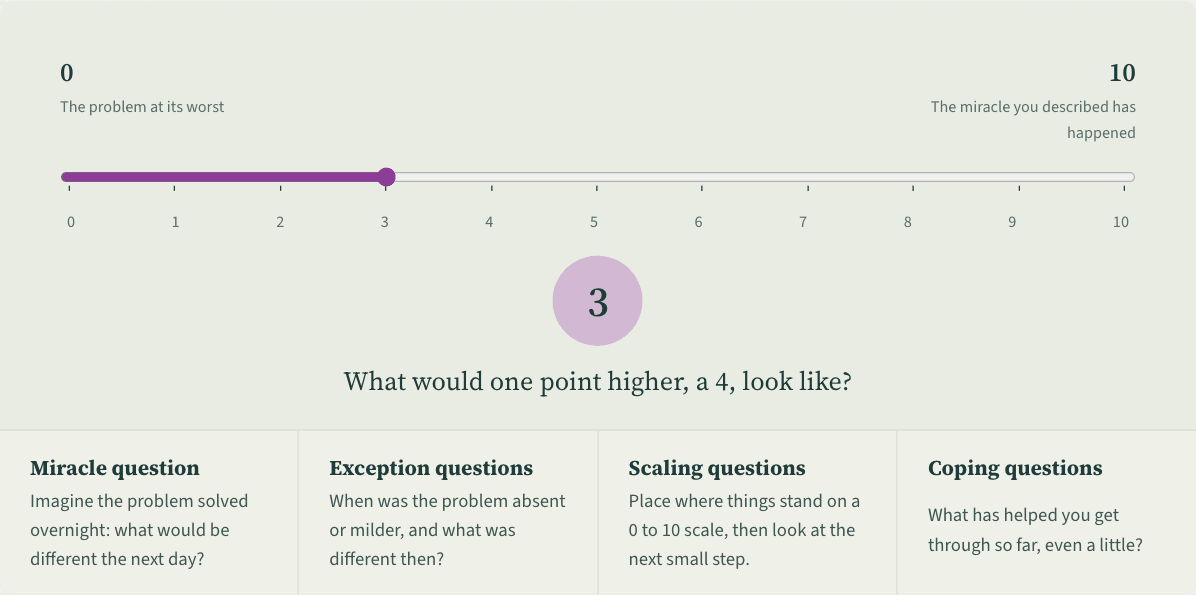
What would one point higher, a 4, look like?
- Miracle question Imagine the problem solved overnight: what would be different the next day?
- Exception questions When was the problem absent or milder, and what was different then?
- Scaling questions Place where things stand on a 0 to 10 scale, then look at the next small step.
- Coping questions What has helped you get through so far, even a little?
A 0 to 10 slider, with the problem at its worst at the left and the miracle at the right. The current score is shown with the question: what would one point higher look like? Below, four cells list the miracle question, exception questions, scaling questions and coping questions.
 Save as image (PNG)
Key points
- SFBT was developed from the late 1970s by Steve de Shazer, Insoo Kim Berg and colleagues at the Brief Family Therapy Center in Milwaukee, building on observation of real sessions.[1][2]
- Typical tools are the Miracle question, exception questions, scaling questions (0 = the problem at its worst, 10 = the miracle) and questions about how the client has coped.[2]
- Treatment is usually short: reported averages run from about 3 to 6 sessions, and all 3 studies that compared length found it used fewer sessions than the alternative.[2][3]
- A systematic review of 43 controlled studies found significant benefit in 74% and positive trends in 23%, with the strongest evidence for adult depression.[3]
An example
Jay has put off his thesis for a month. Instead of asking why, the counselor asks about a recent day when he did write a little and what was different that day. She then asks him to rate things from 0 to 10 and describe what one point higher would look like.
Misreadings and limits
Solution-focused does not mean skipping over problems: the treatment manual says therapists are not “problem phobic” and do acknowledge the client’s situation.[2] The evidence is broad but uneven. Many studies are small or nonrandomized, so findings in some areas are still preliminary.[3]
Sources
- 1 de Shazer, S., Berg, I. K., Lipchik, E., Nunnally, E., Molnar, A., Gingerich, W. J., & Weiner-Davis, M. (1986). Brief therapy: Focused solution development. Family Process, 25(2), 207–221. View source
- 2 Beauchemin, J., De Jong, P., Eads, R., Franklin, C., González-Suitt, K., Guyton, N., Kim, J. S., Langer, S., Lee, M. Y., & Yates, H. T. (2025). Solution focused therapy treatment manual for working with individuals (3rd ed.). Solution Focused Brief Therapy Association (SFBTA Research Committee). View source
- 3 Gingerich, W. J., & Peterson, L. T. (2013). Effectiveness of solution-focused brief therapy: A systematic qualitative review of controlled outcome studies. Research on Social Work Practice, 23(3), 266–283. doi:10.1177/1049731512470859
Last checked against sources: October 26, 2026