Hypnosis and memory
催眠与记忆
Can hypnosis recover lost memories?
Hypnosis and memory covers attempts to retrieve or enhance memories through hypnosis and the research testing them. Hypnotic suggestion does not reliably make recall more accurate; it increases false recollections and makes people more confident in true and false memories alike.[1][2]
Recall accuracy
Effect size d (positive: hypnotized group more accurate) · No difference = 0
Data: Steblay and Bothwell (1994), meta-analysis of 24 studies
Hypnosis also increases
The three effects on the right show direction only; the source gives no numbers to plot.
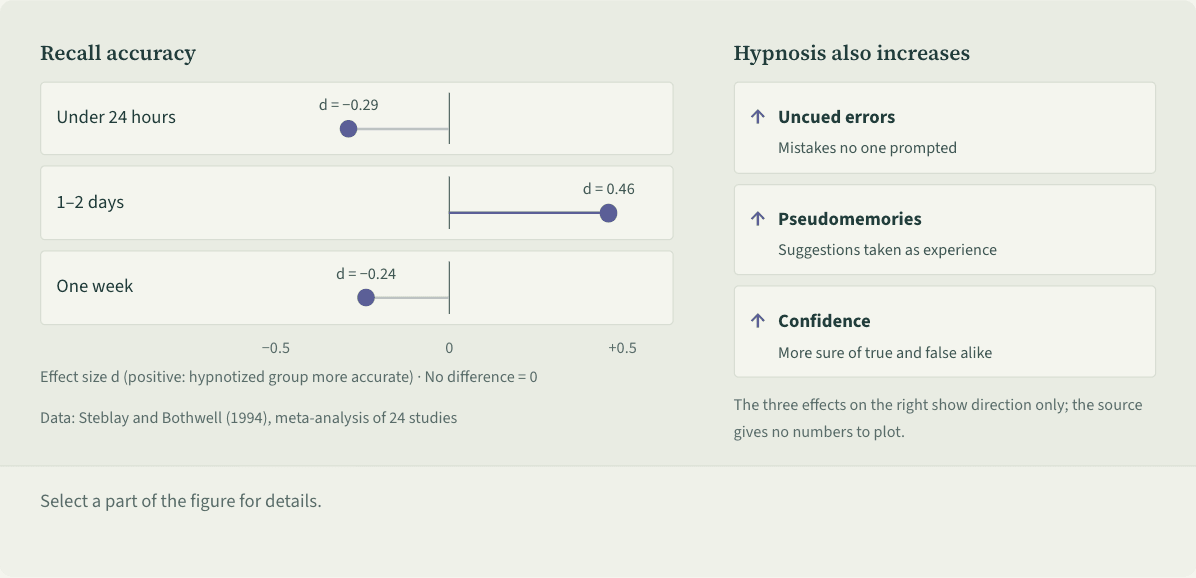
On the left, a dot plot. The horizontal axis is effect size d, with a vertical line at zero meaning no difference and positive values meaning the hypnotized group was more accurate. Three rows: under 24 hours, d = −0.29, left of zero; 1 to 2 days, d = 0.46, right of zero; one week, d = −0.24, left of zero. Data from Steblay and Bothwell’s 1994 meta-analysis of 24 studies. On the right, three cards each with an upward arrow: more uncued errors, more pseudomemories, higher confidence in recall accuracy, with a note that these show direction only, not numbers.
 Save as image (PNG)
This figure image is licensed CC BY 4.0: reuse it with credit and a link back to this page. How to reuse
Key points
- In a meta-analysis of 24 studies, hypnosis improved recall accuracy after a 1–2 day delay but lowered it after delays under 24 hours or of a week.[2]
- In the same analysis, hypnotized participants made more uncued errors, showed more pseudomemories and were more confident that their recall was accurate.[2]
- Age regression can feel compelling, but it does not restore childlike thinking or revive past memories;[1] the “past lives” people describe follow the expectations the hypnotist conveys.[3]
- By 1987 a number of US states excluded hypnotically refreshed testimony. The Supreme Court accepted the risks of confabulation and inflated confidence but ruled a defendant’s own testimony cannot be banned outright.[4]
An example
Jay sees a car hit someone and drive off; he remembers only that it was dark. A friend urges hypnotic regression to “get the plate back.” Under hypnosis he recites a plate number with total conviction. The number may be right or may be filled in by imagination, and his certainty does not make it more likely correct.
Misreadings and limits
Many claim hypnosis can unearth repressed childhood trauma or past lives because the experience feels vivid and emotional. Yet how far people believe in a “past life” depends on their views of reincarnation and on how the hypnotist frames it; hypnotizability predicts only how intense it feels.[3] Kihlstrom urges that hypnosis not be used to enhance memory in clinical or forensic work.[1]
Sources
- 1 Kihlstrom, J. F. (1997). Hypnosis, memory and amnesia. Philosophical Transactions of the Royal Society of London. Series B: Biological Sciences, 352(1362), 1727–1732. doi:10.1098/rstb.1997.0155
- 2 Steblay, N. M., & Bothwell, R. K. (1994). Evidence for hypnotically refreshed testimony: The view from the laboratory. Law and Human Behavior, 18(6), 635–651. doi:10.1007/BF01499329
- 3 Spanos, N. P., Menary, E., Gabora, N. J., DuBreuil, S. C., & Dewhirst, B. (1991). Secondary identity enactments during hypnotic past-life regression: A sociocognitive perspective. Journal of Personality and Social Psychology, 61(2), 308–320. doi:10.1037/0022-3514.61.2.308
- 4 Supreme Court of the United States (1987). Rock v. Arkansas, 483 U.S. 44. Legal Information Institute, Cornell Law School. View source
Last checked against sources: October 27, 2026