Stream of consciousness
意识流
What is the stream of consciousness in psychology?
The stream of consciousness is William James’s 1890 description, in The Principles of Psychology, of conscious life as a continuous, ever-changing flow like a river rather than a chain of separate pieces.[1][2] He also called it the stream of thought or of subjective life.[1]
Flights and perchings
Five characters
Schematic. The river’s shape and the dots’ positions and spacing carry no data.
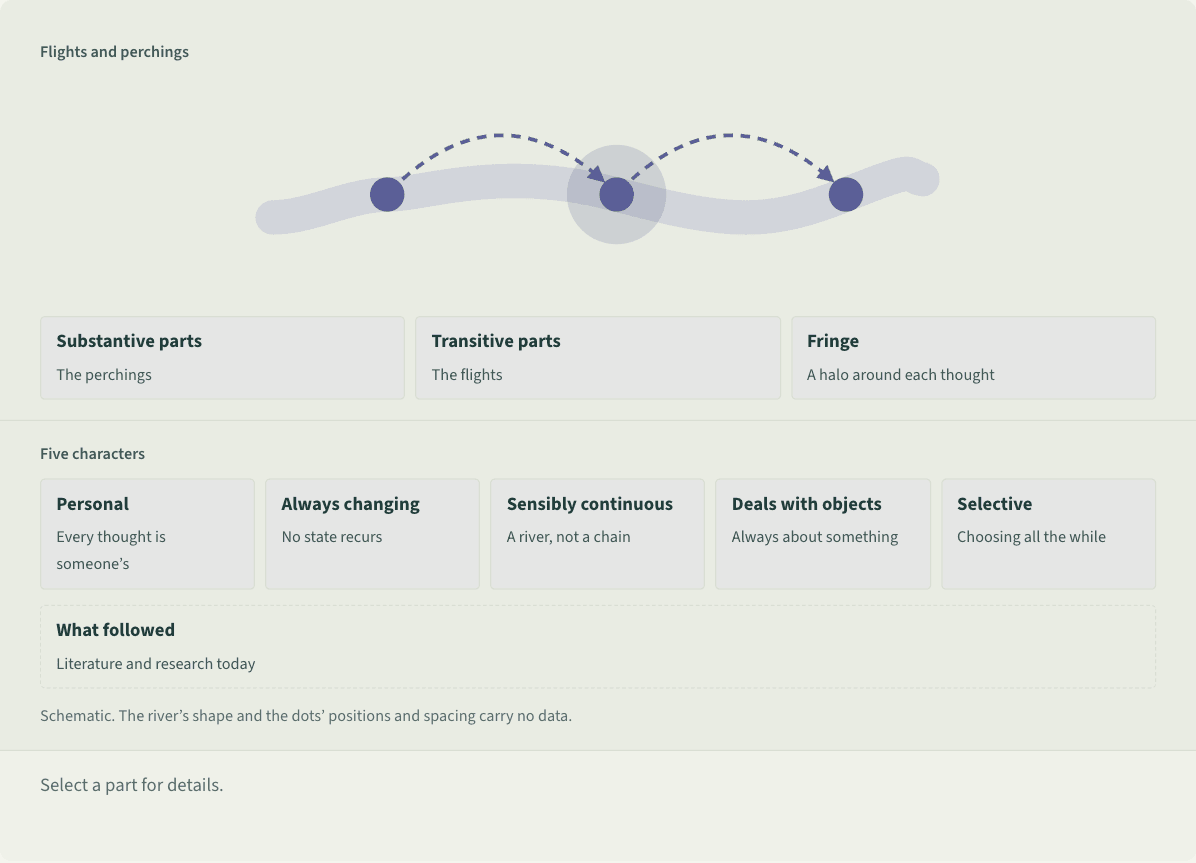
Schematic. A wavy river runs from left to right with three dots on it; a dashed arrow arcs from each dot to the next, and the middle dot has a faint halo. Below the river are three buttons: substantive parts, transitive parts, fringe. Further down, labeled five characters, are five buttons: personal, always changing, sensibly continuous, deals with objects, selective. At the bottom is a dashed card: what followed.
 Save as image (PNG)
This figure image is licensed CC BY 4.0: reuse it with credit and a link back to this page. How to reuse
Key points
- James listed five characters: thought belongs to a personal consciousness, is always changing, feels continuous, deals with objects beyond itself, and keeps choosing some parts over others.[1]
- Thought, James wrote, alternates like a bird between perchings and flights: substantive parts, usually images one can dwell on, and transitive parts, relations that vanish when stopped for inspection.[1]
- The idea of consciousness as a stream became highly influential in early 20th-century modernist writing, such as that of James Joyce, Marcel Proust and Virginia Woolf.[2]
- Researchers on spontaneous thought borrow James’s stream to study how thoughts unfold over time, often with experience sampling: asking people partway through a task what is on their mind.[3]
An example
At a party, Jay wants to introduce an old classmate, but the name is on the tip of his tongue. A friend suggests two names and he says “no” at once, though he still cannot recall the right one. James described this: the gap left by a forgotten name is not empty, and it rejects wrong guesses.
Misreadings and limits
The stream of consciousness is often taken to mean aimless, drifting thought. James used “thinking” for every form of consciousness and stressed that it keeps selecting and rejecting all the while.[1] Mind-wandering is only one part of the stream:[4] see Mind-wandering.
Sources
- 1 James, W. (1890). The principles of psychology, Vol. 1, Chapter IX: The stream of thought. H. Holt and Company, pp. 224–290 (as reproduced in Classics in the History of Psychology). View source
- 2 American Psychological Association (2018). Stream of consciousness. APA dictionary of psychology (updated April 19, 2018). View source
- 3 Andrews-Hanna, J. R., Irving, Z. C., Fox, K. C. R., Spreng, R. N., & Christoff, K. (2018). The neuroscience of spontaneous thought: An evolving, interdisciplinary field. In K. C. R. Fox & K. Christoff (Eds.), The Oxford handbook of spontaneous thought. Oxford University Press (preprint: arXiv:1704.02533). doi:10.1093/oxfordhb/9780190464745.013.33
- 4 宋晓兰, 王晓, & 唐孝威 (2011). 心智游移:现象、机制及意义. 心理科学进展, 19(4), 499–509. View source
Last checked against sources: October 28, 2026