Altered states of consciousness
意识状态改变
What is an altered state of consciousness?
An altered state of consciousness is a marked departure in subjective experience or mental functioning from one’s ordinary waking state, noticeable to the person or an observer and usually temporary and reversible.[1][2] Psychiatrist Arnold Ludwig popularized the term in 1966.[2]
Common routes in (Vaitl and colleagues, 2005)
How to describe it
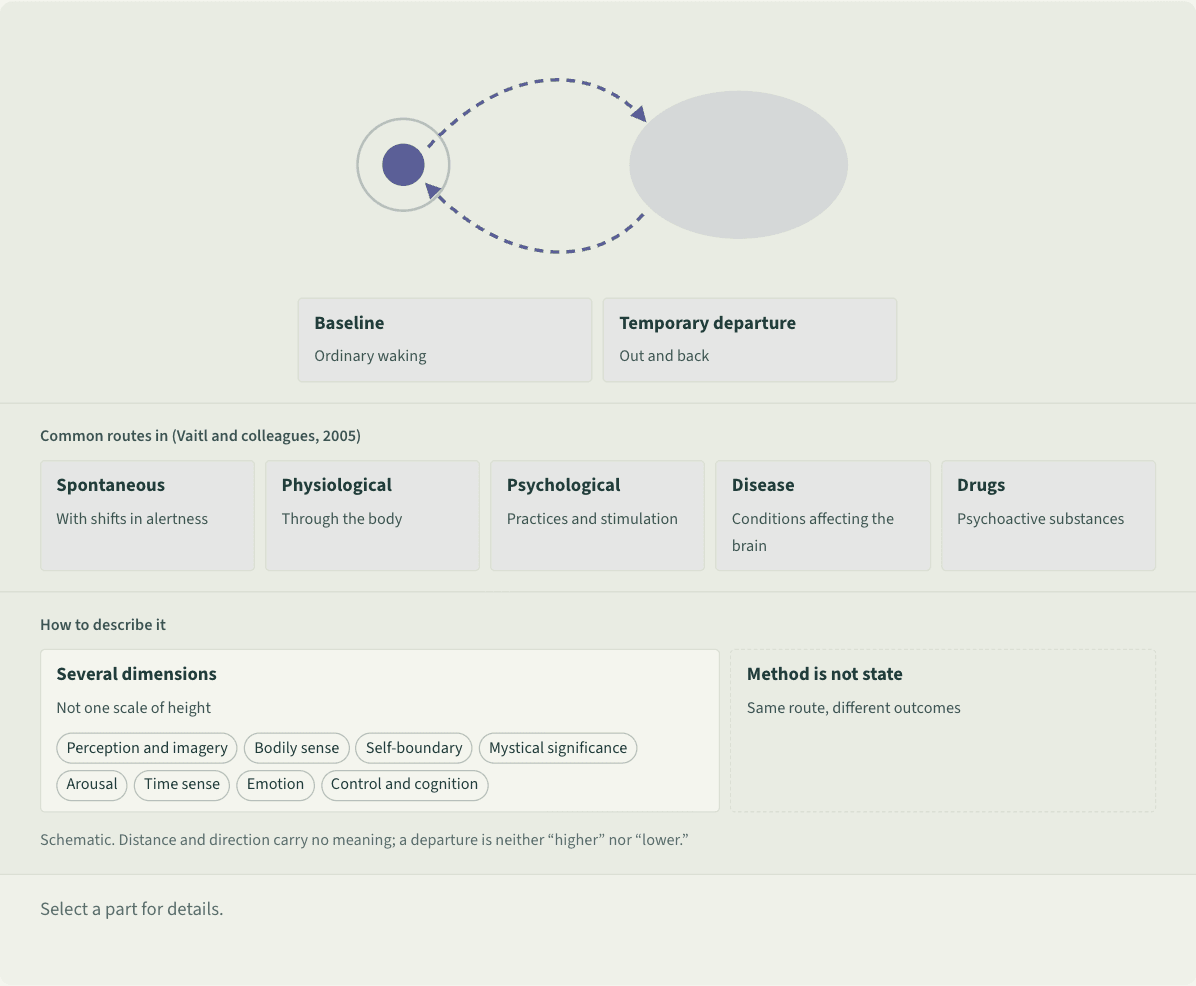
Schematic. Distance and direction carry no meaning; a departure is neither “higher” nor “lower.”
Schematic. At top left is a solid dot labeled baseline; a dashed arrow leaves it, loops round a pale region on the right and returns, labeled temporary departure. Below, labeled common routes in (Vaitl and colleagues, 2005), are five buttons: spontaneous, physiological, psychological, disease, drugs. At the bottom, labeled how to describe it, are two cards: several dimensions, listing eight tags (perception and imagery, bodily sense, self-boundary, mystical significance, arousal, time sense, emotion, control and cognition), and method is not state.
 Save as image (PNG)
This figure image is licensed CC BY 4.0: reuse it with credit and a link back to this page. How to reuse
Key points
- “Altered” is relative to a baseline, usually one’s ordinary waking state. Tart argued that the change is not just some functions running higher or lower but a new overall pattern.[2][4]
- Vaitl and colleagues sort inductions into five domains: spontaneous (drowsiness, daydreaming, sleep), physiological (such as starvation), psychological (sensory deprivation, meditation, Hypnosis), disease and drugs.[2]
- A method is not a state: meditation or hypnosis does not always produce an altered state, and different routes can lead to similar states, as sedatives and exhaustion both bring drowsiness.[2]
- Researchers often describe these states along several dimensions rather than one scale of “level.” A 2025 review grouped recurring features into eight clusters, such as perception and imagery, self-boundaries and time sense.[2][3]
An example
Riding a night bus home, Ms. Wang drifts toward sleep, and the voices around her blend with her own thoughts into something half like a dream. She jolts awake and takes a few seconds to realize that her own state had changed, not anything on the bus.
Misreadings and limits
Altered states are often equated with “higher” consciousness. Some schools, such as transpersonal psychology, hold that view,[1] but Tart stressed that “altered” means only different, not better.[4] Bayne and Carter note that the psychedelic state brings more vivid imagery yet poorer attention and memory, so it is neither higher nor lower.[3]
Sources
- 1 American Psychological Association (2018). Altered state of consciousness (ASC). APA dictionary of psychology (updated April 19, 2018). View source
- 2 Fort, L. D., Costines, C., Wittmann, M., Demertzi, A., & Schmidt, T. T. (2025). Classification schemes of altered states of consciousness. Neuroscience & Biobehavioral Reviews, 175, 106178. doi:10.1016/j.neubiorev.2025.106178
- 3 Bayne, T., & Carter, O. (2018). Dimensions of consciousness and the psychedelic state. Neuroscience of Consciousness, 2018(1), niy008. doi:10.1093/nc/niy008
- 4 Tart, C. T. (1975). States of consciousness (Chapter 5: Discrete states of consciousness). E. P. Dutton (web edition, 1997, published by permission of the author). View source
Last checked against sources: October 28, 2026