Selective attention
选择性注意
What is selective attention?
Selective attention is the ability to pick out some of the stimuli around us for processing while tuning out distractions.[1] Following one conversation at a noisy party is the classic case, which researchers call the “cocktail party problem.”[1][2]
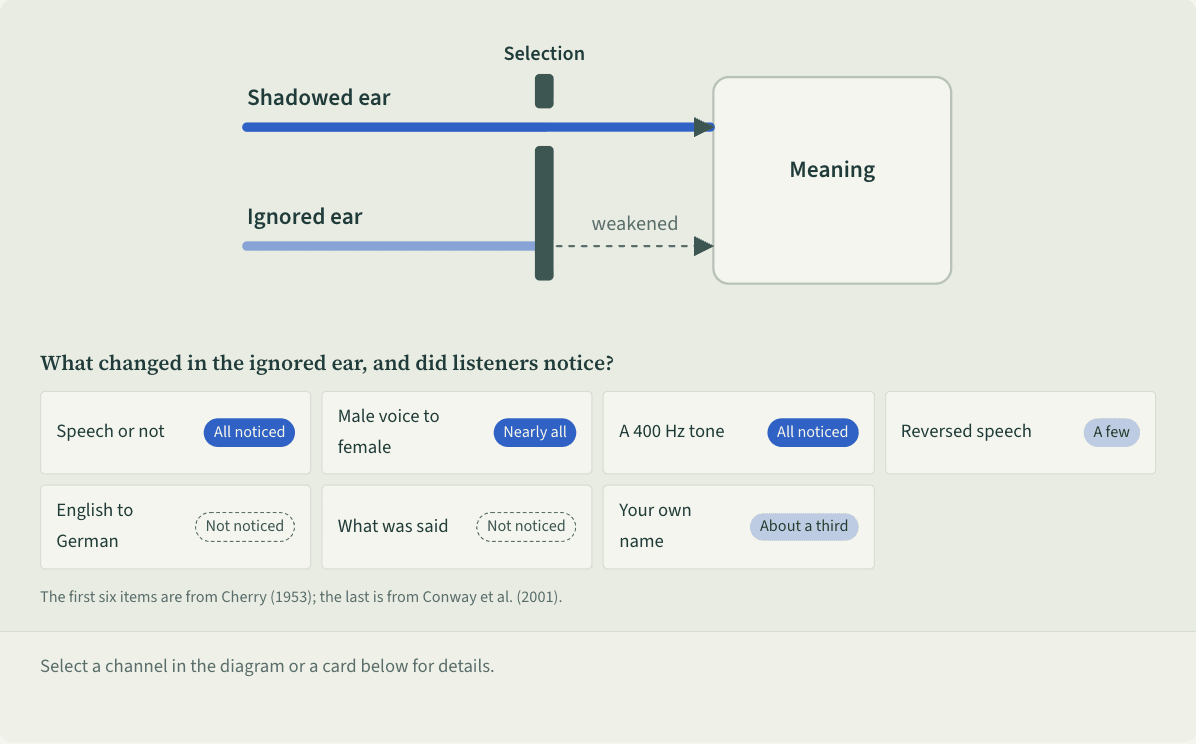
What changed in the ignored ear, and did listeners notice?
The first six items are from Cherry (1953); the last is from Conway et al. (2001).
Top, a schematic of two channels running left to right. The upper one, the shadowed ear, is a thick line that passes the central selection point into a box labelled meaning. The lower one, the ignored ear, becomes a thin dashed line after the selection point, labelled weakened. Below, seven cards list changes in the ignored ear and whether listeners noticed: speech or not, all noticed; male to female voice, nearly all; a 400 Hz tone, all; reversed speech, a few; English to German, not noticed; what was said, not noticed; their own name, about a third.
 Save as image (PNG)
This figure image is licensed CC BY 4.0: reuse it with credit and a link back to this page. How to reuse
Key points
- Cherry (1953) had people repeat a message heard in one ear. They recalled no words from the other ear and missed its switch to German, but noticed a male voice turn female.[2]
- Broadbent (1958) likened attention to a filter that lets one channel through by physical features such as ear or pitch and blocks the rest before its meaning is analyzed.[1]
- When Treisman swapped the stories between the ears, listeners followed the story to the wrong ear. She proposed that unattended input is weakened, not blocked, so important items still get through.[1]
- Vision works the same way: 46% of viewers counting basketball passes missed a person in a gorilla suit or carrying an umbrella who walked through the scene, an effect called inattentional blindness.[3]
An example
At a noisy staff dinner, Lin follows every word her colleague says. When someone at the next table mentions her name, she turns at once. Asked what that table had been talking about, she cannot say.
Misreadings and limits
People often say you will always hear your own name in a crowd. In the classic studies only about 33% of listeners heard it in the ignored ear. Listeners with high working memory capacity, who block distraction better, heard it 20% of the time; those with low capacity, 65%.[4]
Sources
- 1 Friedrich, F. (2026). Attention. In R. Biswas-Diener & E. Diener (Eds.), Noba textbook series: Psychology. DEF publishers. View source
- 2 Cherry, E. C. (1953). Some experiments on the recognition of speech, with one and with two ears. The Journal of the Acoustical Society of America, 25(5), 975–979. doi:10.1121/1.1907229
- 3 Simons, D. J., & Chabris, C. F. (1999). Gorillas in our midst: Sustained inattentional blindness for dynamic events. Perception, 28(9), 1059–1074. doi:10.1068/p281059
- 4 Conway, A. R. A., Cowan, N., & Bunting, M. F. (2001). The cocktail party phenomenon revisited: The importance of working memory capacity. Psychonomic Bulletin & Review, 8(2), 331–335. doi:10.3758/BF03196169
Last checked against sources: October 27, 2026