Multi-store memory model
记忆多重存储模型
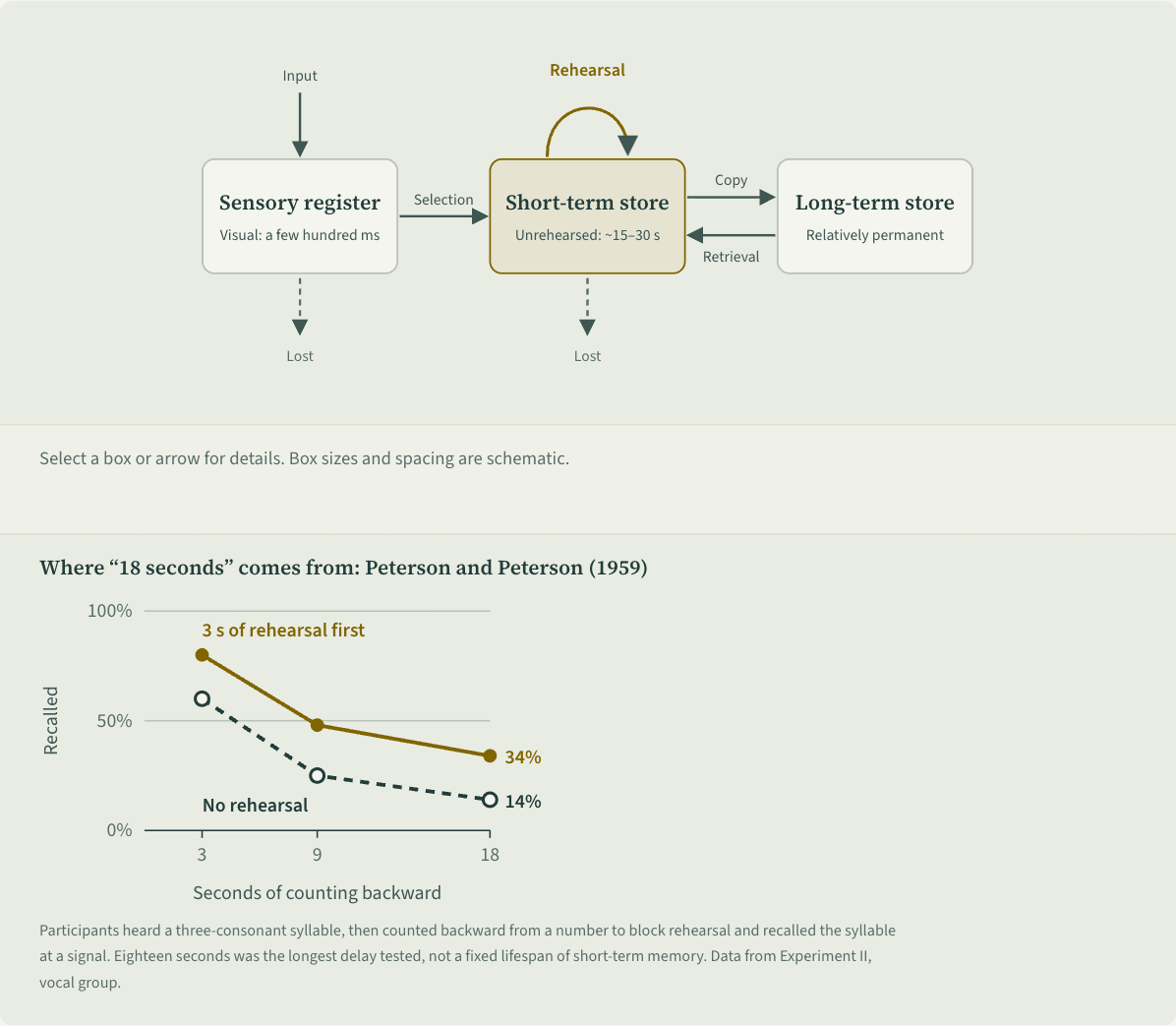
Proposed by Atkinson and Shiffrin in 1968: information first enters a sensory register, selected items pass to a short-term store, and control processes such as rehearsal copy them into a relatively permanent long-term store, from which they can later be retrieved.[1]
Where “18 seconds” comes from: Peterson and Peterson (1959)
Participants heard a three-consonant syllable, then counted backward from a number to block rehearsal and recalled the syllable at a signal. Eighteen seconds was the longest delay tested, not a fixed lifespan of short-term memory. Data from Experiment II, vocal group.
Top: three boxes, left to right on wide screens and top to bottom on phones: sensory register, short-term store, long-term store. Input enters the sensory register, labeled “visual: a few hundred ms”; an arrow labeled “selection” leads to the short-term store, labeled “unrehearsed: about 15–30 s,” which has a looping “rehearsal” arrow. An arrow labeled “transfer (copy)” runs from the short-term to the long-term store and one labeled “retrieval” runs back; the long-term store is labeled “relatively permanent.” Arrows labeled “lost” leave the sensory register and the short-term store. Bottom: a line chart from Peterson and Peterson (1959), Experiment II, vocal group. After 3, 9 and 18 seconds of counting backward, 60%, 25% and 14% of syllables were recalled with no rehearsal time, and 80%, 48% and 34% after 3 seconds of rehearsal aloud.
 Save as image (PNG)
Key points
- By their estimates, a visual image fades from the sensory register within several hundred milliseconds, unrehearsed items leave the short-term store within about 15–30 seconds, and long-term storage is relatively permanent.[1]
- It separates fixed structure (the stores) from control processes that people choose to use, such as coding, rehearsal and search strategies; most of the 1968 chapter studies the latter.[1][3]
- The often-quoted “18 seconds” comes from Peterson and Peterson (1959). With rehearsal blocked by counting backward, 18 seconds was their longest delay; recall had fallen to about 15%.[2]
- Baddeley and Hitch’s (1974) working memory model, which splits short-term memory into several parts, is often presented as a revision or a rival.[3][4]
An example
On the phone, Lin hears a six-digit code and repeats it under her breath while looking for a pen. Once it is written down she stops repeating it, and it is soon gone. Her childhood address she still knows decades later. The code was held in short-term memory by rehearsal; the address is in long-term memory.
Misreadings and limits
Textbooks often draw it as a one-way pipeline with fixed numbers such as “18 seconds.” The original stresses that information flows both ways between short- and long-term memory, and its decay times are rough estimates.[1][3] Waugh and Norman (1965) also found that short-term forgetting depended mainly on how many new items intervened, not on seconds.[3]
Sources
- 1 Atkinson, R. C., & Shiffrin, R. M. (1968). Human memory: A proposed system and its control processes. In K. W. Spence & J. T. Spence (Eds.), The psychology of learning and motivation (Vol. 2, pp. 89–195). Academic Press. doi:10.1016/S0079-7421(08)60422-3
- 2 Peterson, L. R., & Peterson, M. J. (1959). Short-term retention of individual verbal items. Journal of Experimental Psychology, 58(3), 193–198. doi:10.1037/h0049234
- 3 Malmberg, K. J., Raaijmakers, J. G. W., & Shiffrin, R. M. (2019). 50 years of research sparked by Atkinson and Shiffrin (1968). Memory & Cognition, 47(4), 561–574. doi:10.3758/s13421-019-00896-7
- 4 Spielman, R. M., Jenkins, W. J., & Lovett, M. D. (2020). 8.1 How memory functions. Psychology 2e. OpenStax. View source
Last checked against sources: October 26, 2026