Forgetting curve
遗忘曲线
The forgetting curve traces how retention declines over time: quickly at first, then more and more slowly. It comes from Hermann Ebbinghaus’s experiments on himself, published in 1885, which measured memory by how much time relearning saved.[1][2]
Forgetting after one learning session
Ebbinghaus 1885 Murre & Dros 2015
Relearning on six successive days
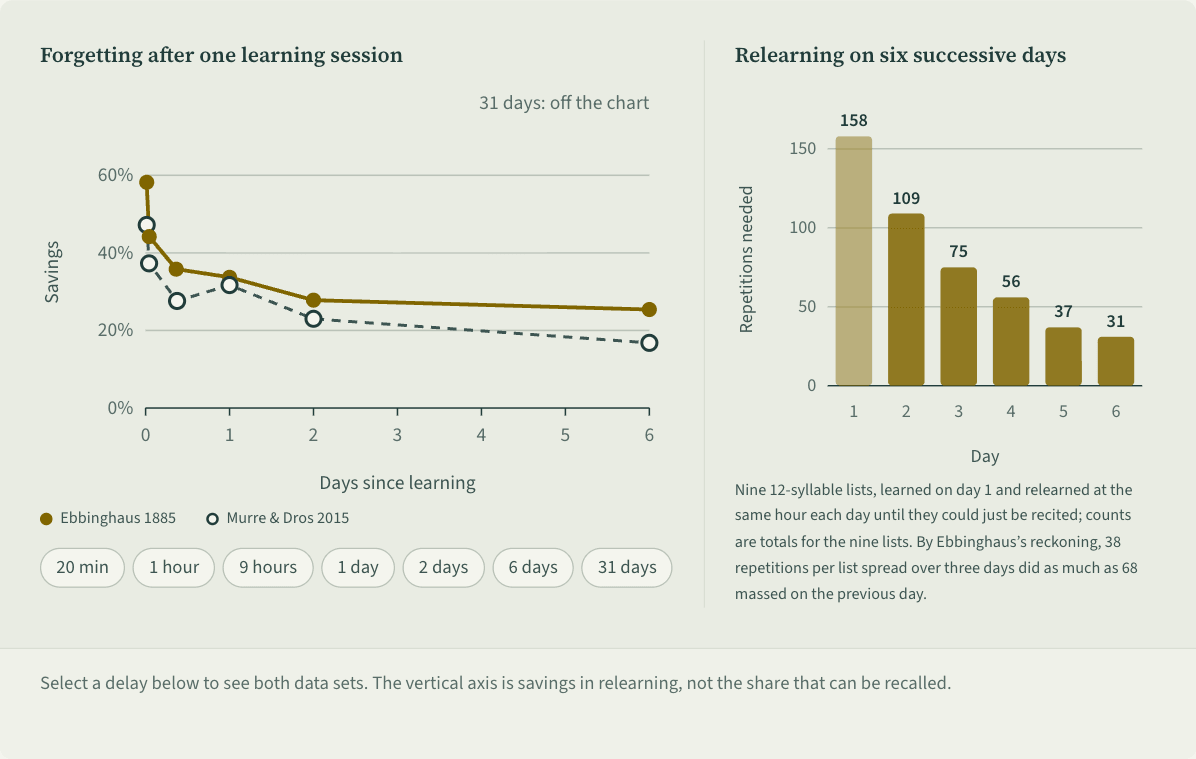
Nine 12-syllable lists, learned on day 1 and relearned at the same hour each day until they could just be recited; counts are totals for the nine lists. By Ebbinghaus’s reckoning, 38 repetitions per list spread over three days did as much as 68 massed on the previous day.
Left: days 0 to 6 since first learning on the horizontal axis, savings on the vertical. Ebbinghaus’s 1885 data as filled dots: about 19 minutes 58%, about 1 hour 44%, about 8.8 hours 36%, 1 day 34%, 2 days 28%, 6 days 25%. Murre and Dros’s 2015 data as open dots: 20 minutes 47%, 1 hour 37%, 9 hours 28%, 1 day 32%, 2 days 23%, 6 days 17%. Both lines fall steeply within the first day, then level off. The 31-day values (21% and 4%) are off the chart and available from the buttons. Right: a bar chart of the total repetitions needed to learn nine 12-syllable lists to the point of recital on six successive days: 158, 109, 75, 56, 37 and 31.
 Save as image (PNG)
Key points
- Ebbinghaus was his own subject. He learned lists of 13 nonsense syllables, relearned them after a delay, and scored retention as the share of the original learning time saved.[1]
- Savings were about 44% after an hour, 34% after a day, 25% after six days and 21% after 31 days: the steepest drop came in the first hours.[1][2]
- Murre and Dros’s 2015 replication produced a similar curve. In both, the one- or two-day points sit above a smooth curve, possibly because of sleep, which remains unproven.[2]
- Ebbinghaus concluded that repetitions spread over days probably beat massed ones. A meta-analysis of 317 experiments supports this; the longer material must be kept, the longer the best gap.[1][3]
An example
On Monday Lin memorizes 30 Spanish words. On Tuesday she can recall only some of them, but one pass through the list brings most back quickly. She then reviews for a few minutes each day, and by Saturday she needs far fewer passes.
Misreadings and limits
A common reading is “after a day you remember only a third.” Savings measure how much relearning time is saved, not how much can be recalled, and the two can differ widely.[2] The curve also comes from one person learning nonsense syllables, and a single-subject design cannot show how far it generalizes.[2]
Sources
- 1 Ebbinghaus, H. (1885/1913). Memory: A contribution to experimental psychology (H. A. Ruger & C. E. Bussenius, Trans.). Teachers College, Columbia University. Chapters VII–VIII, Classics in the History of Psychology. View source
- 2 Murre, J. M. J., & Dros, J. (2015). Replication and analysis of Ebbinghaus’ forgetting curve. PLOS ONE, 10(7), e0120644. doi:10.1371/journal.pone.0120644
- 3 Cepeda, N. J., Pashler, H., Vul, E., Wixted, J. T., & Rohrer, D. (2006). Distributed practice in verbal recall tasks: A review and quantitative synthesis. Psychological Bulletin, 132(3), 354–380. doi:10.1037/0033-2909.132.3.354
Last checked against sources: October 26, 2026