Thought record
思维记录表
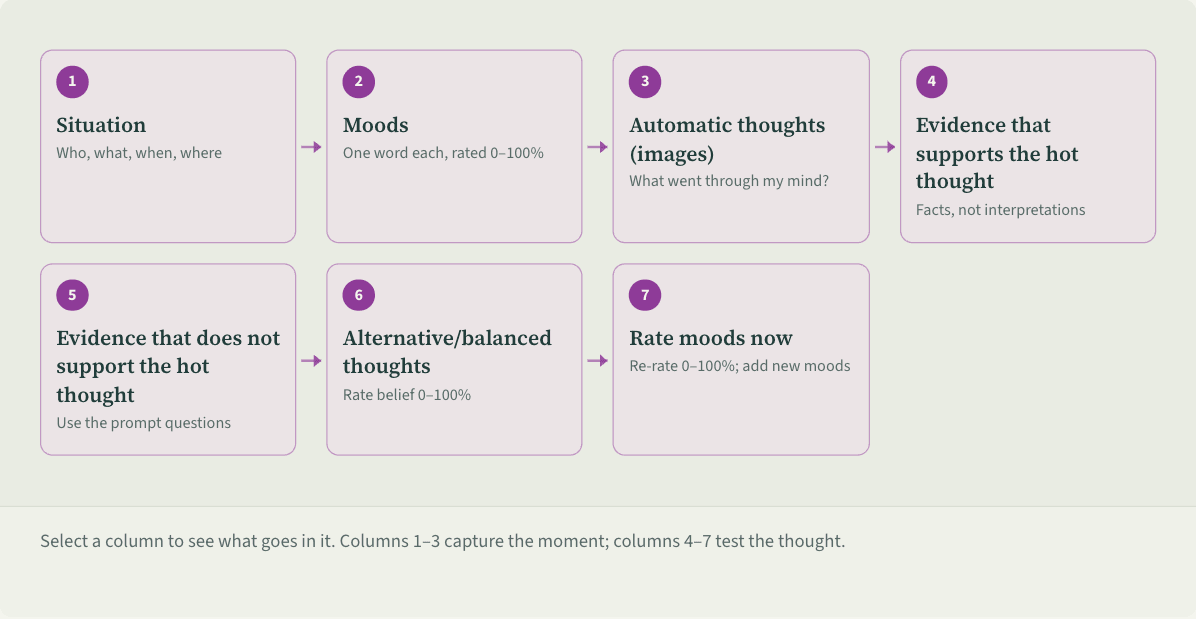
A structured worksheet used in Cognitive behavioral therapy. The person records a situation, their moods and automatic thoughts, then circles one “hot thought,” weighs the evidence for and against it, writes an alternative or balanced thought and re-rates their moods.[1][3]
Seven numbered boxes joined by arrows: 1 Situation, 2 Moods, 3 Automatic thoughts (images), 4 Evidence that supports the hot thought, 5 Evidence that does not support the hot thought, 6 Alternative/balanced thoughts, 7 Rate moods now. Each box has a short cue underneath, such as “Facts, not interpretations.” Selecting a box shows what goes in that column.
 Save as image (PNG)
Key points
- The version in Mind Over Mood has seven columns: situation; moods (0–100%); automatic thoughts; evidence that supports the hot thought; evidence that does not; alternative/balanced thoughts; moods re-rated.[1]
- Columns 1–3 capture the moment: situation, moods and thoughts. Columns 4–7 are for cognitive restructuring: the person circles one “hot thought” and gathers facts, not interpretations, about it.[1][3]
- Christine Padesky designed the form in the late 1970s (copyright 1983). It was the first thought record to include evidence columns and an alternative/balanced thought column.[2]
- In a randomized study of 91 non-clinical participants split across three conditions, a single thought-record session improved beliefs, anxiety and behavior more than a control intervention.[4]
An example
Jay’s manager cuts him off in a meeting. That evening Jay fills in a thought record: the situation, “angry 80%” and the thought “He looks down on me.” As evidence for, he lists the interruption; against, that the manager asked for his figures afterward. He writes a balanced thought and re-rates his anger: 40%.
Misreadings and limits
Writing thoughts down is only half the tool: in the seven-column format, the testing happens in columns 4–7.[3] Nor is it always the most effective option. In a randomized comparison, behavioral experiments had a small edge, changing the target belief sooner and more broadly.[4]
Sources
- 1 Greenberger, D., & Padesky, C. A. (2016). Worksheet 9.2: Thought record. Mind over mood: Change how you feel by changing the way you think (2nd ed.), Guilford Press. Form copyright 1983 by Christine A. Padesky. View source
- 2 MindOverMood.com (2023). Note about 7 column thought record. Mind Over Mood (official website of the book by D. Greenberger & C. A. Padesky). View source
- 3 Padesky, C. A., & Greenberger, D. (2020). The clinician's guide to CBT using Mind over mood (2nd ed.). Guilford Press. View source
- 4 McManus, F., Van Doorn, K., & Yiend, J. (2012). Examining the effects of thought records and behavioral experiments in instigating belief change. Journal of Behavior Therapy and Experimental Psychiatry, 43(1), 540–547. doi:10.1016/j.jbtep.2011.07.003
Last checked against sources: October 26, 2026