Cognitive behavioral therapy
认知行为治疗
A family of structured talking therapies built on the premise that automatic thoughts in specific situations, and the beliefs behind them, help keep emotional distress and problem behavior going, so changing how a person thinks and acts can reduce distress.[2][3]
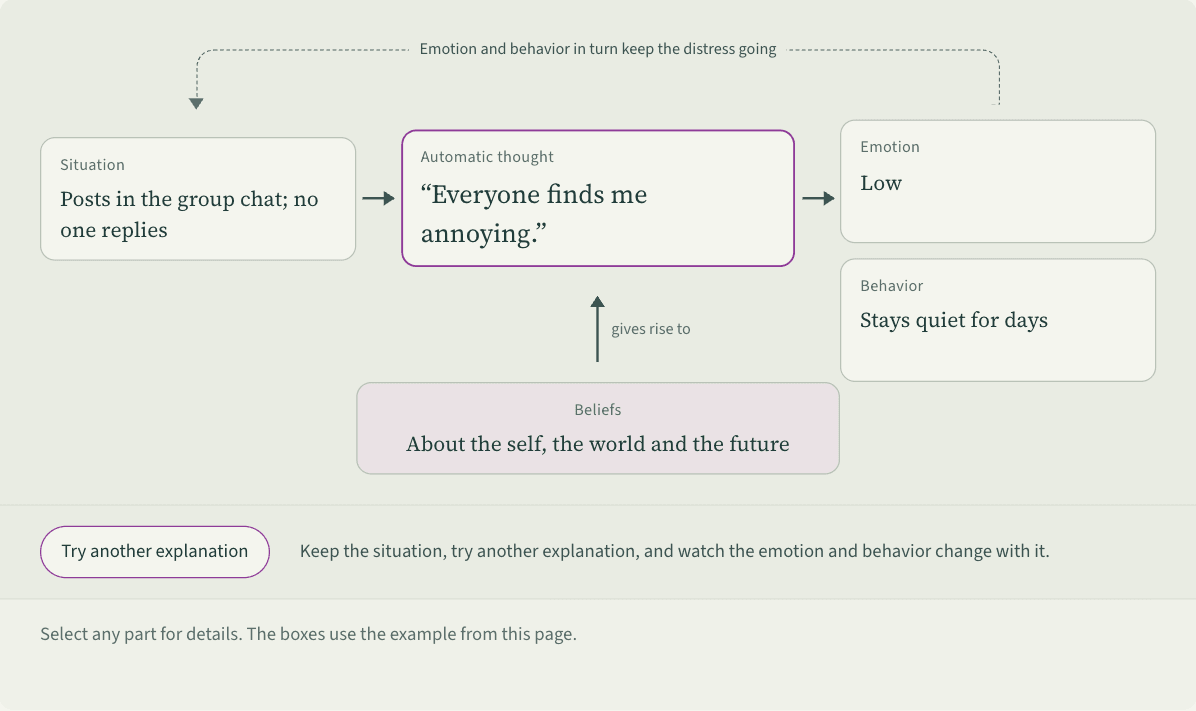
A diagram. From left to right: “Situation: posts in the group chat, no one replies,” “Automatic thought: everyone finds me annoying,” and, stacked on the right, “Emotion: low” and “Behavior: stays quiet for days,” joined by arrows. Below the automatic thought sits a box, “Beliefs: about the self, the world and the future,” with an arrow pointing up to the thought. A dashed line loops from the emotion and behavior back to the situation, labeled “Emotion and behavior in turn keep the distress going.” Pressing “Try another explanation” changes the thought to “People may be busy and haven’t seen it yet,” the emotion to “a bit disappointed, but not as low” and the behavior to “asks one question next time”; the situation stays the same.
 Save as image (PNG)
Key points
- It grew out of Aaron Beck’s cognitive therapy for depression, set out in a 1979 treatment manual. Modern CBT combines cognitive, behavioral and emotion-focused techniques.[1][2]
- In Beck’s model, beliefs about the self, the world and the future produce automatic thoughts in specific situations, which then shape emotions and behavior.[2]
- A course usually runs 5 to 15 sessions with practice in between. The NHS lists it as a recommended treatment for depression, anxiety, PTSD, eating disorders and more.[3]
- A review covering 106 meta-analyses found the strongest support for anxiety disorders, somatoform disorders, bulimia, anger control problems and general stress.[2]
An example
Lin posts in a group chat, gets no replies and thinks, “Everyone finds me annoying.” She feels low and stays quiet for days. In CBT she logs the situation, thought, feeling and action on a thought record, looks for other explanations with her therapist, and agrees to ask the group one question next time to see what happens.
Misreadings and limits
Well supported does not mean best for everything. The same review found weaker or mixed evidence for bipolar disorder, schizophrenia and personality disorders, results often similar to other psychotherapies, and many meta-analyses with small samples or weak control groups.[2]
Sources
- 1 Beck, A. T., Rush, A. J., Shaw, B. F., & Emery, G. (1979). Cognitive therapy of depression. Guilford Press. View source
- 2 Hofmann, S. G., Asnaani, A., Vonk, I. J. J., Sawyer, A. T., & Fang, A. (2012). The efficacy of cognitive behavioral therapy: A review of meta-analyses. Cognitive Therapy and Research, 36(5), 427–440. doi:10.1007/s10608-012-9476-1
- 3 NHS (2025). Overview: Cognitive behavioural therapy (CBT). NHS website (last reviewed 28 March 2025). View source
Last checked against sources: October 26, 2026