Ambivalence
矛盾心态
In Motivational interviewing, ambivalence is the simultaneous presence of competing motivations for and against a change.[1][3] Miller and Rollnick treat it as a common problem on the way to change, and MI was designed to address it.[1]
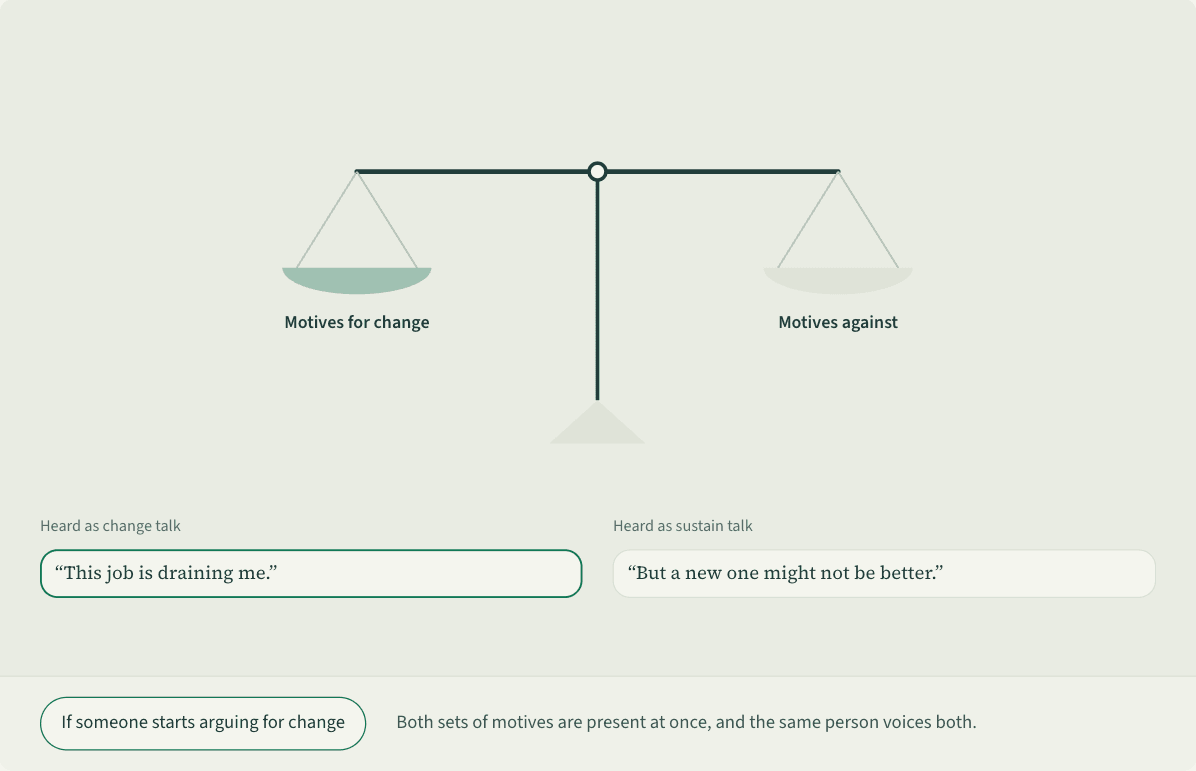
Heard as change talk
“This job is draining me.”
Heard as sustain talk
“But a new one might not be better.”
“And honestly, it’s not that bad right now.”
A balance scale: the left pan holds motives for change, the right pan motives against, with a line of speech under each: “This job is draining me” and “But a new one might not be better.” Pressing “If someone starts arguing for change” adds a “You should quit!” arrow over the left pan; the scale tips right and a new line appears on the right: “And honestly, it’s not that bad right now.”
 Save as image (PNG)
Key points
- Ambivalence shows up in speech: statements favoring change are Change talk, statements favoring the status quo are sustain talk, and the same person voices both.[1][3]
- Arguing for change tends to backfire. In MI research, a persuasive, confronting style drew more resistance, and pushing against resistance evoked further defense of the status quo.[2]
- MI therefore aims for the person, not the counselor, to voice the reasons for change, an idea its authors link to cognitive dissonance and self-perception theory.[2]
An example
Lin says, “This job is draining me,” then adds, “But a new one might not be better, and I’d have to start over.” Both statements are sincere: the first is a reason to change, the second a reason to stay put.
Misreadings and limits
Ambivalence is often taken as a lack of willpower or an excuse that someone needs to argue away. MI takes the opposite view: it is common on the way to change, and arguing against it tends to draw further defense of the status quo.[1][2]
Sources
- 1 Miller, W. R., & Rollnick, S. (2013). Motivational interviewing: Helping people change (3rd ed.). Guilford Press. View source
- 2 Miller, W. R., & Rose, G. S. (2009). Toward a theory of motivational interviewing. American Psychologist, 64(6), 527–537. doi:10.1037/a0016830
- 3 Motivational Interviewing Network of Trainers (2024). Glossary of motivational interviewing terms (English/Spanish/Portuguese). Motivational Interviewing Network of Trainers (MINT). View source
- 4 Miller, W. R., & Rollnick, S. (n.d.). 动机式访谈法:帮助人们改变(郭道寰、王韶宇、江嘉伟 译). 华东理工大学出版社,ISBN 978-7-5628-3755-8. Chinese edition of [1]; the Chinese terms on this page follow its glossary.
Last checked against sources: October 26, 2026