Stages of change
改变阶段模型
The stages of change are the core of the transtheoretical model, proposed by Prochaska and DiClemente in 1983 from a study of people quitting smoking on their own. The model holds that someone changing a behavior moves through stages that differ in intention and action.[1][2]
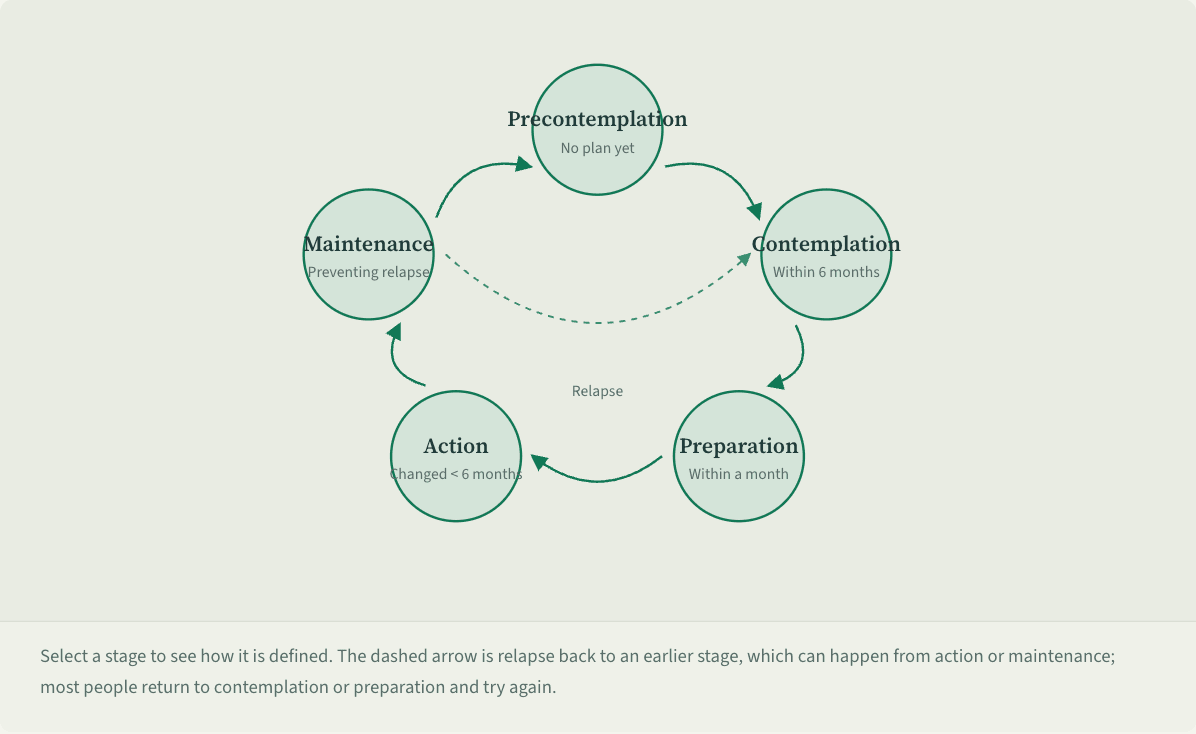
Five circles arranged in a ring, precontemplation, contemplation, preparation, action and maintenance, joined by arrows; a dashed arrow labeled relapse runs from maintenance back to contemplation.
 Save as image (PNG)
Key points
- The usual five stages are precontemplation, contemplation, preparation, action, and maintenance, defined by whether a person intends to act within six months or one month, or how long ago they changed.[2][3]
- The model has changed over time. The 1983 study sorted people into precontemplation, contemplation, action, maintenance, and relapse; preparation and termination stages were added later.[1][2]
- Sliding back is common. Most people who relapse return to contemplation or preparation and try again; in smoking and exercise studies, about 15% fall back to precontemplation.[2][3]
- The model also names ten processes of change used differently by stage: consciousness raising is emphasized in contemplation, counterconditioning and stimulus control in action and maintenance.[1]
An example
Jay knows his late nights hurt his health but has no plan to change (precontemplation). After a checkup he starts weighing it (contemplation), decides to turn off his phone at 11 p.m. starting next week (preparation), and keeps it up for two months (action). A work trip brings the late nights back, and afterward he starts again.
Misreadings and limits
It is often read as a ladder everyone climbs in order, but sliding back to earlier stages is common.[2] Tailoring help to a person’s stage is also unproven: a Cochrane review found stage-based smoking-cessation programs worked about as well as non-staged versions.[4]
Sources
- 1 Prochaska, J. O., & DiClemente, C. C. (1983). Stages and processes of self-change of smoking: Toward an integrative model of change. Journal of Consulting and Clinical Psychology, 51(3), 390–395. doi:10.1037/0022-006X.51.3.390
- 2 Prochaska, J. O., & Velicer, W. F. (1997). The transtheoretical model of health behavior change. American Journal of Health Promotion, 12(1), 38–48. doi:10.4278/0890-1171-12.1.38
- 3 Cancer Prevention Research Center, University of Rhode Island (n.d.). Transtheoretical model: Detailed overview. University of Rhode Island, Cancer Prevention Research Center. View source
- 4 Cahill, K., Lancaster, T., & Green, N. (2010). Stage-based interventions for smoking cessation. Cochrane Database of Systematic Reviews, (11), CD004492. doi:10.1002/14651858.CD004492.pub4
Last checked against sources: October 26, 2026