Motivational interviewing
动机式访谈
Motivational interviewing (MI), developed by William Miller and Stephen Rollnick, is a person-centered, goal-oriented conversation style for addressing Ambivalence about change and strengthening a person’s own motivation and commitment.[2][4]
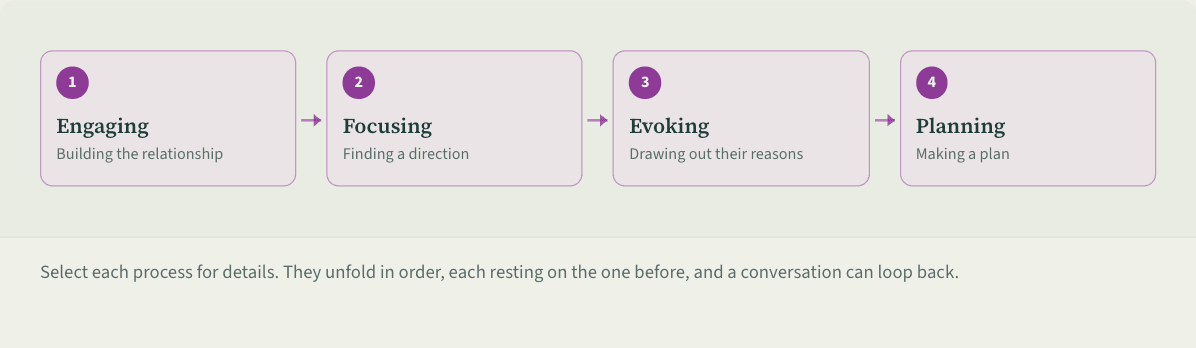
Four connected boxes in sequence, engaging, focusing, evoking and planning, each with a short gloss.
 Save as image (PNG)
Key points
- MI grew out of Miller’s 1983 description of counseling problem drinkers, as an alternative to the confrontational addiction counseling of the time. It later spread to health care and other fields.[1]
- The third edition describes four processes: engaging, focusing, evoking, and planning. The 2023 fourth edition keeps all four but calls them tasks.[2][3]
- MI stresses an underlying spirit. The third edition lists partnership, acceptance, compassion, and evocation; MINT’s current glossary lists empowerment in place of evocation.[2][4]
- By 2009 more than 200 clinical trials had been published, mostly positive. Some were null, and effects varied across sites and clinicians.[1]
An example
Instead of telling Ms. Wang to quit smoking, her doctor asks what she likes about smoking and what worries her about it. After listening, the doctor reflects back the worries she raised and asks where she would start if she decided to change.
Misreadings and limits
MI is often mistaken for a set of techniques for persuading people to change. Its developers stress the opposite: arguing against resistance tends to entrench the status quo, so the reasons for change should come from the person.[1]
Sources
- 1 Miller, W. R., & Rose, G. S. (2009). Toward a theory of motivational interviewing. American Psychologist, 64(6), 527–537. doi:10.1037/a0016830
- 2 Miller, W. R., & Rollnick, S. (2013). Motivational interviewing: Helping people change (3rd ed.). Guilford Press. View source
- 3 Miller, W. R., & Rollnick, S. (2023). Motivational interviewing: Helping people change and grow (4th ed.). Guilford Press. View source
- 4 Motivational Interviewing Network of Trainers (2024). Glossary of motivational interviewing terms (English/Spanish/Portuguese). Motivational Interviewing Network of Trainers (MINT). View source
- 5 Miller, W. R., & Rollnick, S. (n.d.). 动机式访谈法:帮助人们改变(郭道寰、王韶宇、江嘉伟 译). 华东理工大学出版社,ISBN 978-7-5628-3755-8. Chinese edition of [2]; the Chinese names of the four processes and the spirit follow its glossary.
Last checked against sources: October 26, 2026