Highly sensitive person (HSP)
高敏感者
A highly sensitive person scores high on sensory processing sensitivity (SPS). Elaine Aron and Arthur Aron set out the construct in a 1997 paper, and researchers treat it as a temperament trait, not a disorder.[1][3]
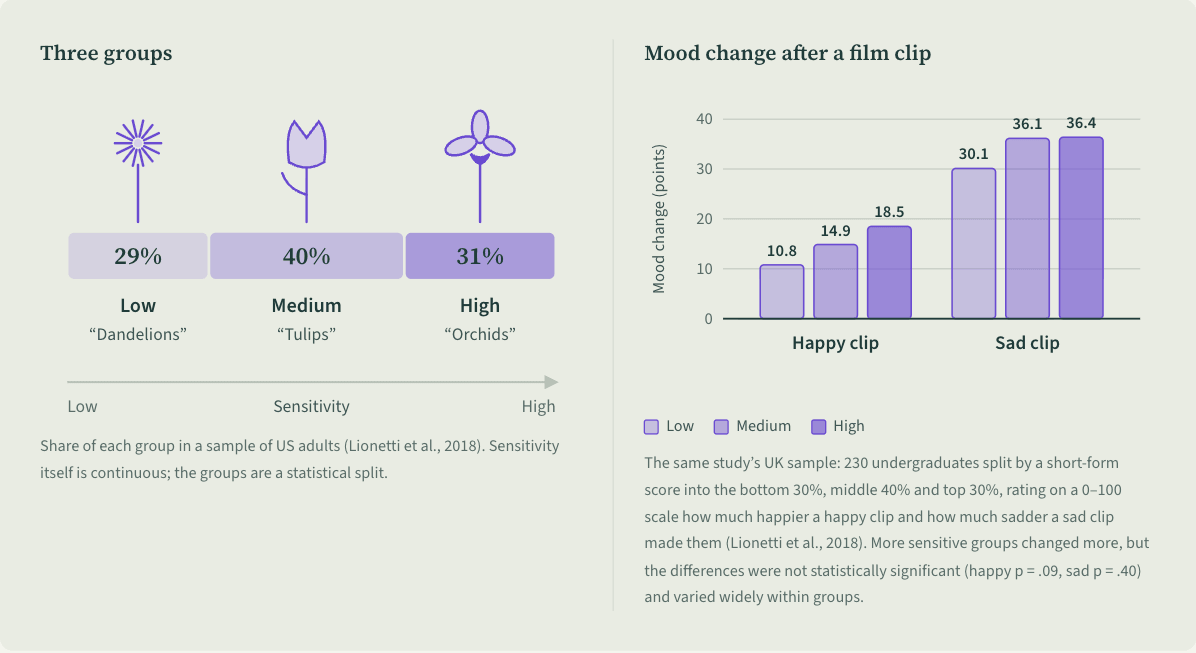
Three groups
Share of each group in a sample of US adults (Lionetti et al., 2018). Sensitivity itself is continuous; the groups are a statistical split.
Mood change after a film clip
The same study’s UK sample: 230 undergraduates split by a short-form score into the bottom 30%, middle 40% and top 30%, rating on a 0–100 scale how much happier a happy clip and how much sadder a sad clip made them (Lionetti et al., 2018). More sensitive groups changed more, but the differences were not statistically significant (happy p = .09, sad p = .40) and varied widely within groups.
Left: a bar running from low to high sensitivity in three segments, low 29% (“dandelions”), medium 40% (“tulips”) and high 31% (“orchids”), each topped by a small drawing of its flower, with a note that sensitivity itself is continuous. Right: a bar chart of mood change on a 0–100 scale. After a happy clip, happiness rose by 10.8, 14.9 and 18.5 points in the low, medium and high groups; after a sad clip, sadness rose by 30.1, 36.1 and 36.4 points. A note says the sample was 230 UK undergraduates and the group differences were not statistically significant.
 Save as image (PNG)
Key points
- Proposed core features include deeper processing of information, stronger emotional reactivity and empathy, greater awareness of subtleties, and being easily overstimulated.[3]
- The Arons built the 27-item Highly Sensitive Person Scale and found sensitivity related to, but not the same as, introversion and emotionality.[1]
- Sensitivity is a continuous, normally distributed trait. One study of US adults found low, medium and high groups of about 29%, 40% and 31%, which the authors called dandelions, tulips and orchids.[2]
- Highly sensitive people may be hit harder by adverse environments and may also benefit more from supportive ones.[3]
An example
After a full day in an open-plan office, Ms. Wang feels drained while her colleagues seem fine. She takes the Highly Sensitive Person Scale, scores high, and starts spending part of her lunch break in a quiet corner.
Misreadings and limits
High sensitivity is not a diagnosis. Current measures rely mostly on self-report questionnaires with mainly negatively worded items, and SPS overlaps moderately with neuroticism, so researchers call for more objective measures.[3]
Sources
- 1 Aron, E. N., & Aron, A. (1997). Sensory-processing sensitivity and its relation to introversion and emotionality. Journal of Personality and Social Psychology, 73(2), 345–368. doi:10.1037/0022-3514.73.2.345
- 2 Lionetti, F., Aron, A., Aron, E. N., Burns, G. L., Jagiellowicz, J., & Pluess, M. (2018). Dandelions, tulips and orchids: Evidence for the existence of low-sensitive, medium-sensitive and high-sensitive individuals. Translational Psychiatry, 8, Article 24. doi:10.1038/s41398-017-0090-6
- 3 Greven, C. U., Lionetti, F., Booth, C., Aron, E. N., Fox, E., Schendan, H. E., Pluess, M., Bruining, H., Acevedo, B., Bijttebier, P., & Homberg, J. (2019). Sensory processing sensitivity in the context of environmental sensitivity: A critical review and development of research agenda. Neuroscience and Biobehavioral Reviews, 98, 287–305. doi:10.1016/j.neubiorev.2019.01.009
Last checked against sources: October 26, 2026