Explanatory style
归因方式
Explanatory style is a person’s habitual pattern in choosing causes for events across many situations. Psychologists Christopher Peterson and Martin Seligman proposed that it shapes how people react emotionally to bad events.[1]
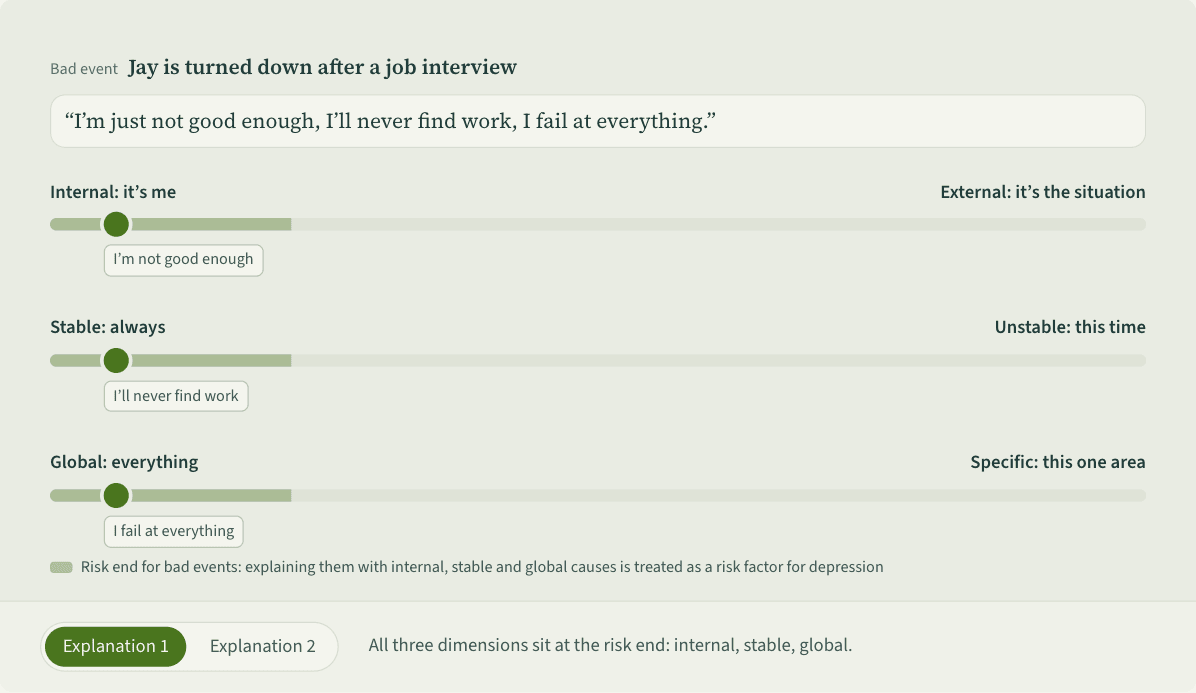
Bad eventJay is turned down after a job interview
“I’m just not good enough, I’ll never find work, I fail at everything.”
“I didn’t prepare enough this time, and this company is unusually demanding.”
- Internal: it’s me External: it’s the situationI’m not good enough Underprepared + demanding company
- Stable: always Unstable: this timeI’ll never find work This time
- Global: everything Specific: this one areaI fail at everything This company
Risk end for bad events: explaining them with internal, stable and global causes is treated as a risk factor for depression
At the top, the bad event, “Jay is turned down after a job interview,” and the current explanation. Below, three scales: internal (it’s me) to external (it’s the situation), stable (always) to unstable (this time), and global (everything) to specific (this one area). The left end of each scale is shaded as the risk end for bad events. Explanation 1, “I’m just not good enough, I’ll never find work, I fail at everything,” sits at the left end of all three. Switched to explanation 2, “I didn’t prepare enough this time, and this company is unusually demanding,” the dot on the internal–external scale moves to the middle (underprepared plus a demanding company) and the other two move to the unstable and specific ends.
 Save as image (PNG)
Key points
- Explanations are described along three dimensions: internal vs external (me or the situation), stable vs unstable, and global vs specific.[1]
- Habitually explaining bad events with internal, stable and global causes is treated as a risk factor for depression. In one study, such students became more depressed after a poor midterm grade.[1]
- The Attributional Style Questionnaire asks people to explain 12 hypothetical events and rate each cause on the three dimensions. Chinese college students’ scores correlated with optimism and life satisfaction.[1][2]
- Some researchers focus on flexibility instead. In a study of 68 college students, the ability to adjust explanations, not a fixed style, was linked to post-traumatic stress symptoms.[3]
An example
Jay is turned down after a job interview. If he thinks, “I’m just not good enough, I’ll never find work, I fail at everything,” his explanation is internal, stable and global. If he thinks, “I didn’t prepare enough this time, and this company is unusually demanding,” it leans unstable and specific.
Misreadings and limits
This style is a risk factor for depression, not a sufficient cause; the authors compared it to smoking and lung cancer. It matters mainly when bad events happen, and the authors acknowledged that each supporting study was open to criticism.[1] See also Learned helplessness.
Sources
- 1 Peterson, C., & Seligman, M. E. P. (1984). Causal explanations as a risk factor for depression: Theory and evidence. Psychological Review, 91(3), 347–374. View source
- 2 袁莉敏, & 张日昇 (2007). 大学生归因方式、气质性乐观与心理幸福感的关系. 心理发展与教育, 23(2), 111–115. View source
- 3 Joseph, J. S., & Gray, M. J. (2011). The utility of measuring explanatory flexibility in PTSD research. Cognitive Therapy and Research, 35, 372–380. doi:10.1007/s10608-010-9301-7
Last checked against sources: October 26, 2026