Social norms
社会规范
What are social norms?
Social norms are shared rules of conduct, sustained by other people’s approval and disapproval and by one’s own shame or guilt; breaking them draws social sanctions, from raised eyebrows to ostracism.[1] Social psychologists distinguish descriptive norms (what most people do) from injunctive norms (what most people approve or disapprove of).[2]
More
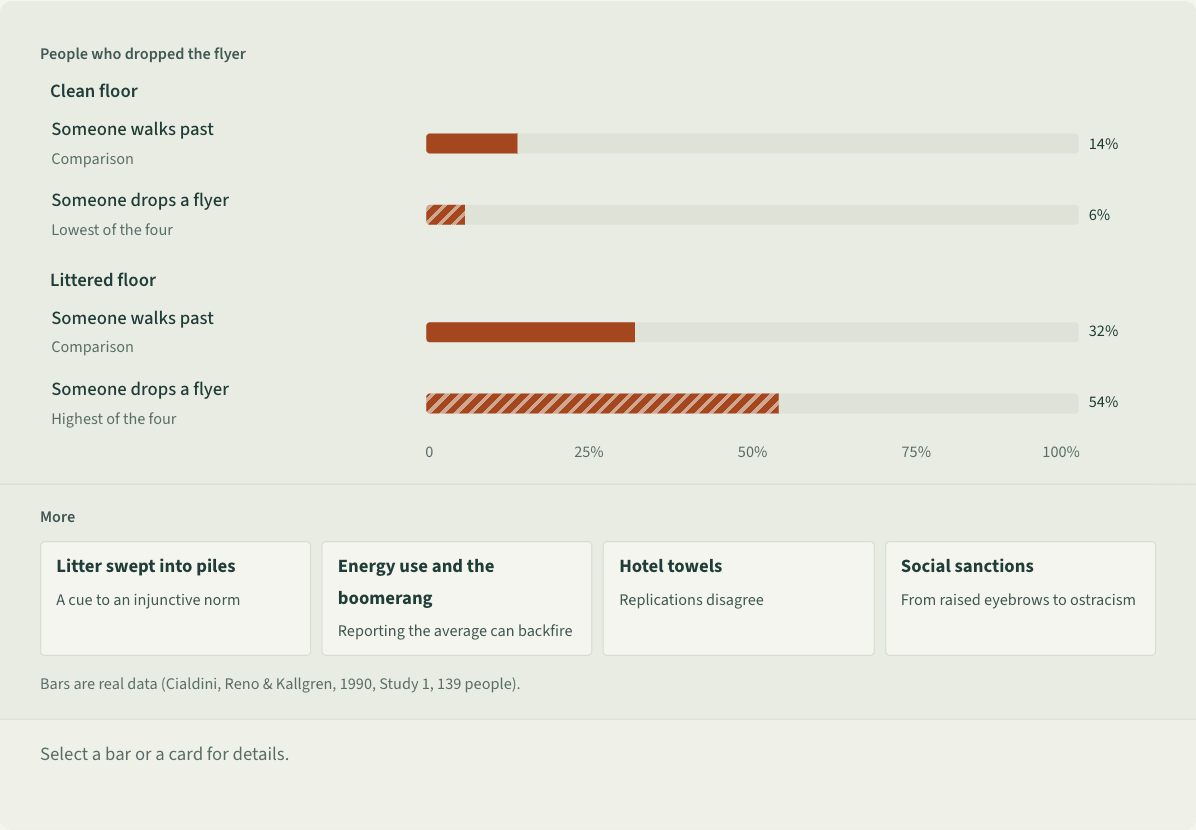
Bars are real data (Cialdini, Reno & Kallgren, 1990, Study 1, 139 people).
 Save as image (PNG)
This figure image is licensed CC BY 4.0: reuse it with credit and a link back to this page. How to reuse
Key points
- Elster set social norms apart from law: legal norms are enforced by specialists whose job it is, social norms by ordinary members of the community. Internalized norms are followed even unobserved.[1]
- In a parking-garage study, 41% of people dropped a windshield flyer on a littered floor, versus 11% on a clean one; after watching someone litter, the gap widened to 54% versus 6%.[2]
- Telling households their neighborhood’s average energy use cut consumption among high users but raised it among low users; adding a message of approval or disapproval removed this boomerang effect.[3]
- In a US hotel, a card saying most guests reuse their towels beat a standard environmental appeal; replications in two German hotels found no such advantage.[4]
An example
When Lin’s housing estate began sorting its trash, a notice in the stairwell said many residents were still sorting it wrong. Later the building management replaced it with “80% of households in this building sort correctly” and thanked careful households in the residents’ group chat. Lin started sorting carefully too.
Misreadings and limits
A common mistake is to fight a behavior by stressing how many people do it, which advertises it as the norm. Cialdini and colleagues warned that drawing attention to a littered setting tends to increase littering;[2] in the energy study, average-use feedback alone led low users to consume more.[3]
Sources
- 1 Elster, J. (1989). Social norms and economic theory. Journal of Economic Perspectives, 3(4), 99–117. doi:10.1257/jep.3.4.99
- 2 Cialdini, R. B., Reno, R. R., & Kallgren, C. A. (1990). A focus theory of normative conduct: Recycling the concept of norms to reduce littering in public places. Journal of Personality and Social Psychology, 58(6), 1015–1026. doi:10.1037/0022-3514.58.6.1015
- 3 Schultz, P. W., Nolan, J. M., Cialdini, R. B., Goldstein, N. J., & Griskevicius, V. (2007). The constructive, destructive, and reconstructive power of social norms. Psychological Science, 18(5), 429–434. doi:10.1111/j.1467-9280.2007.01917.x
- 4 Bohner, G., & Schlüter, L. E. (2014). A room with a viewpoint revisited: Descriptive norms and hotel guests’ towel reuse behavior. PLoS ONE, 9(8), e104086. doi:10.1371/journal.pone.0104086
Last checked against sources: October 28, 2026