Cognitive miser
认知吝啬者
What is a cognitive miser?
The cognitive miser is how Fiske and Taylor’s Social Cognition (1984) described the thinker: with limited capacity to process information, people take shortcuts whenever they can, settling for quick, adequate answers over slow, accurate ones.[1]
Standard
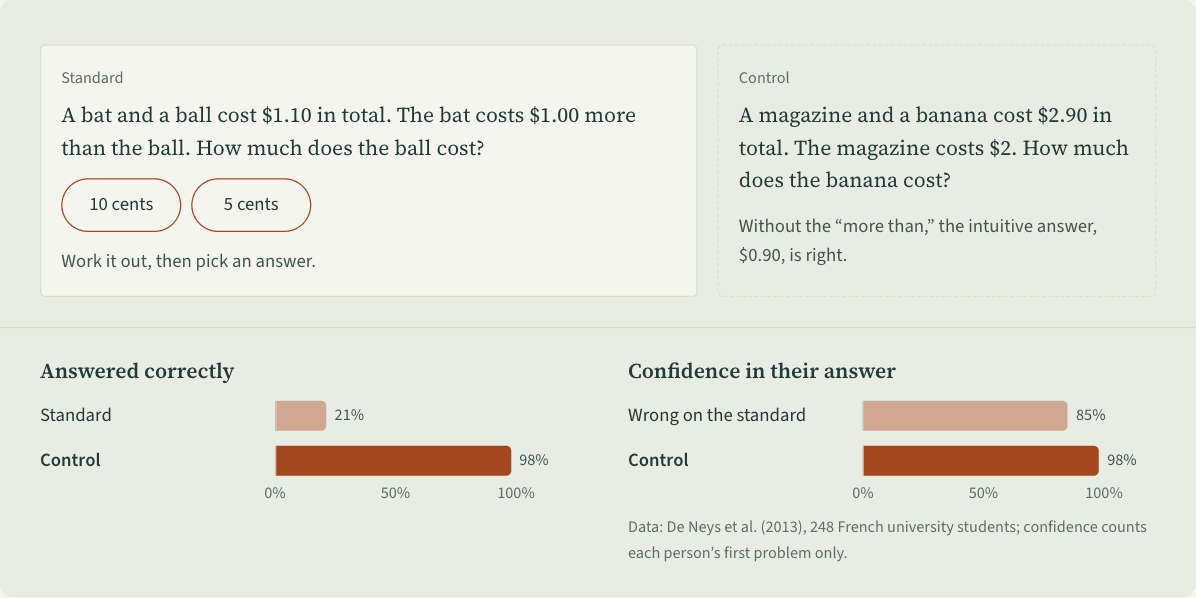
A bat and a ball cost $1.10 in total. The bat costs $1.00 more than the ball. How much does the ball cost?
Work it out, then pick an answer.
Then the bat costs $1.10 and the total is $1.20. It is the answer that comes to mind first: 194 of 195 wrong answers were 10 cents.Right: the bat costs $1.05, and the total is $1.10.Control
A magazine and a banana cost $2.90 in total. The magazine costs $2. How much does the banana cost?
Without the “more than,” the intuitive answer, $0.90, is right.
Left, the standard problem: a bat and a ball cost $1.10 in total and the bat costs $1.00 more than the ball; how much is the ball? Readers can pick 10 cents or 5 cents; 5 cents is right. Right, the control: a magazine and a banana cost $2.90 and the magazine costs $2; how much is the banana? Without the “more than,” the intuitive $0.90 is right. Below, two pairs of bars: answered correctly, standard 21% and control 98%; confidence in their answer, 85% among those wrong on the standard and 98% on the control.
 Save as image (PNG)
This figure image is licensed CC BY 4.0: reuse it with credit and a link back to this page. How to reuse
Key points
- The book presented it as the third view of the thinker, after the consistency seeker and the naive scientist, and credited the label to Taylor (1981).[1]
- The shortcuts include stereotypes and decision heuristics. Observers, for example, judged that the speaker they happened to face, the one who caught their attention, had influenced the conversation more.[2]
- Fiske and Taylor later revised the picture: people are motivated tacticians, sometimes misers and sometimes deeper thinkers, depending on their goals and motives.[2]
- In reasoning research the term means defaulting to cheap, intuitive processing. Only 21% solved the bat-and-ball problem in one study, and high cognitive ability is no guarantee against such errors.[3][4]
An example
Ms. Wang draws up her team’s on-call schedule. Seeing “new hire,” she assumes the newcomers don’t know the process and gives every important shift to veterans without asking what the new people have done. The schedule is quick to make, but it overlooks a newcomer who has run the same kind of project.
Misreadings and limits
The model does not say people are lazy or dim: many shortcuts work well most of the time.[1] People who give the wrong bat-and-ball answer are also less sure of it than of their answer to an easy control version.[4] Nor is it an excuse: in sex-discrimination cases, judging employees by category instead of as individuals was the very problem raised.[2]
Sources
- 1 Fiske, S. T., & Taylor, S. E. (1984). Social cognition. Random House. View source
- 2 Fiske, S. T., & Taylor, S. E. (2020). Social cognition evolves: Illustrations from our work on intergroup bias and on healthy adaptation. Psicothema, 32(3), 291–297. doi:10.7334/psicothema2020.197
- 3 Toplak, M. E., West, R. F., & Stanovich, K. E. (2011). The Cognitive Reflection Test as a predictor of performance on heuristics-and-biases tasks. Memory & Cognition, 39(7), 1275–1289. doi:10.3758/s13421-011-0104-1
- 4 De Neys, W., Rossi, S., & Houdé, O. (2013). Bats, balls, and substitution sensitivity: Cognitive misers are no happy fools. Psychonomic Bulletin & Review, 20(2), 269–273. doi:10.3758/s13423-013-0384-5
Last checked against sources: October 27, 2026