Mass psychogenic illness
群体性心因性疾病
What is mass psychogenic illness?
Mass psychogenic illness is the rapid spread of symptoms through a close-knit group with no matching organic cause; the symptoms arise unconsciously and are not faked.[1] Those affected usually share a belief that something external, such as a strange odor, has made them ill.[2]
One outbreak: a Tennessee high school, 1998
Two types
Events, counts and shares from Jones et al. (2000); bars drawn to scale, the rest schematic.
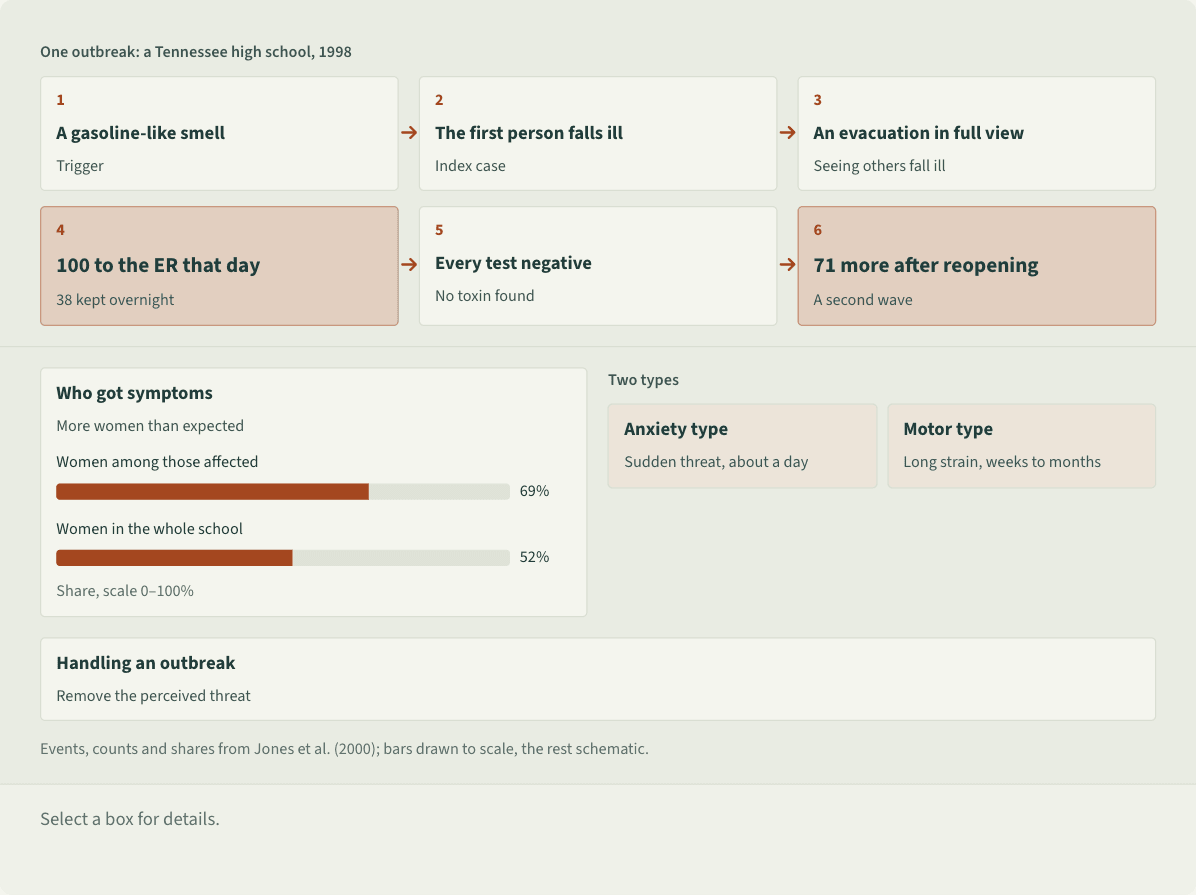
At the top, labeled one outbreak: a Tennessee high school, 1998, six cards joined by arrows: a gasoline-like smell; the first person falls ill (a teacher with headache and nausea); an evacuation in full view (ambulances taking people away); 100 emergency room visits that day, 38 kept overnight; every test negative; 71 more emergency visits the day after the school reopened. Beside them, a card on who got symptoms with two bars drawn to scale from 0 to 100%: women were 69% of the first 186 people affected and 52% of the school’s students and staff. Below, two cards side by side: the anxiety type (a sudden threat, usually over within a day) and the motor type (long strain, twitching and dissociation, lasting weeks or months). At the bottom, a card on handling outbreaks.
 Save as image (PNG)
This figure image is licensed CC BY 4.0: reuse it with credit and a link back to this page. How to reuse
Key points
- The anxiety type follows a sudden perceived threat, often an odor, and usually clears within a day; the motor type builds under long strain, with twitching and dissociation, lasting weeks or months.[1][3]
- Typical features: rapid onset and recovery, mostly female cases and a closed group, with spread by sight, sound and rumor; people who saw someone fall ill were likelier to develop symptoms.[1][2]
- At a Tennessee high school in 1998, a teacher smelled “gasoline” and felt ill; 100 people went to the emergency room that day and 71 more after reopening. Tests found no toxin.[2]
- “Hysteria” comes from the Greek for uterus and has long carried a pejorative ring;[4] calling an outbreak psychogenic tends to provoke shame and anger, so doctors hesitate to say so.[2]
An example
In Jay’s office, someone mentions a sharp smell. Lin turns dizzy and nauseous, and a few coworkers who see her start to feel tight-chested and tingly. Everyone moves outside, and within twenty minutes most feel better. Building management tests the air and finds no harmful gas. Only doctors and the authorities can say what caused it.[2]
Misreadings and limits
A common claim is that one stressed person falls ill first and passes it on. Outbreaks often start with one person, but the stress or threat usually weighs on the whole group,[2] and that person may even have a real physical illness.[3] No personality type marks those affected; anyone can react this way in the right setting.[1] Some outbreaks were later traced to real toxins.[1]
Sources
- 1 Bartholomew, R. E., & Wessely, S. (2002). Protean nature of mass sociogenic illness: From possessed nuns to chemical and biological terrorism fears. British Journal of Psychiatry, 180(4), 300–306. doi:10.1192/bjp.180.4.300
- 2 Jones, T. F., Craig, A. S., Hoy, D., Gunter, E. W., Ashley, D. L., Barr, D. B., Brock, J. W., & Schaffner, W. (2000). Mass psychogenic illness attributed to toxic exposure at a high school. New England Journal of Medicine, 342(2), 96–100. doi:10.1056/NEJM200001133420206
- 3 Bartholomew, R. E., Wessely, S., & Rubin, G. J. (2012). Mass psychogenic illness and the social network: Is it changing the pattern of outbreaks?. Journal of the Royal Society of Medicine, 105(12), 509–512. doi:10.1258/jrsm.2012.120053
- 4 North, C. S. (2015). The classification of hysteria and related disorders: Historical and phenomenological considerations. Behavioral Sciences, 5(4), 496–517. doi:10.3390/bs5040496
Last checked against sources: October 28, 2026