Pleasure principle
快乐原则
What is the pleasure principle?
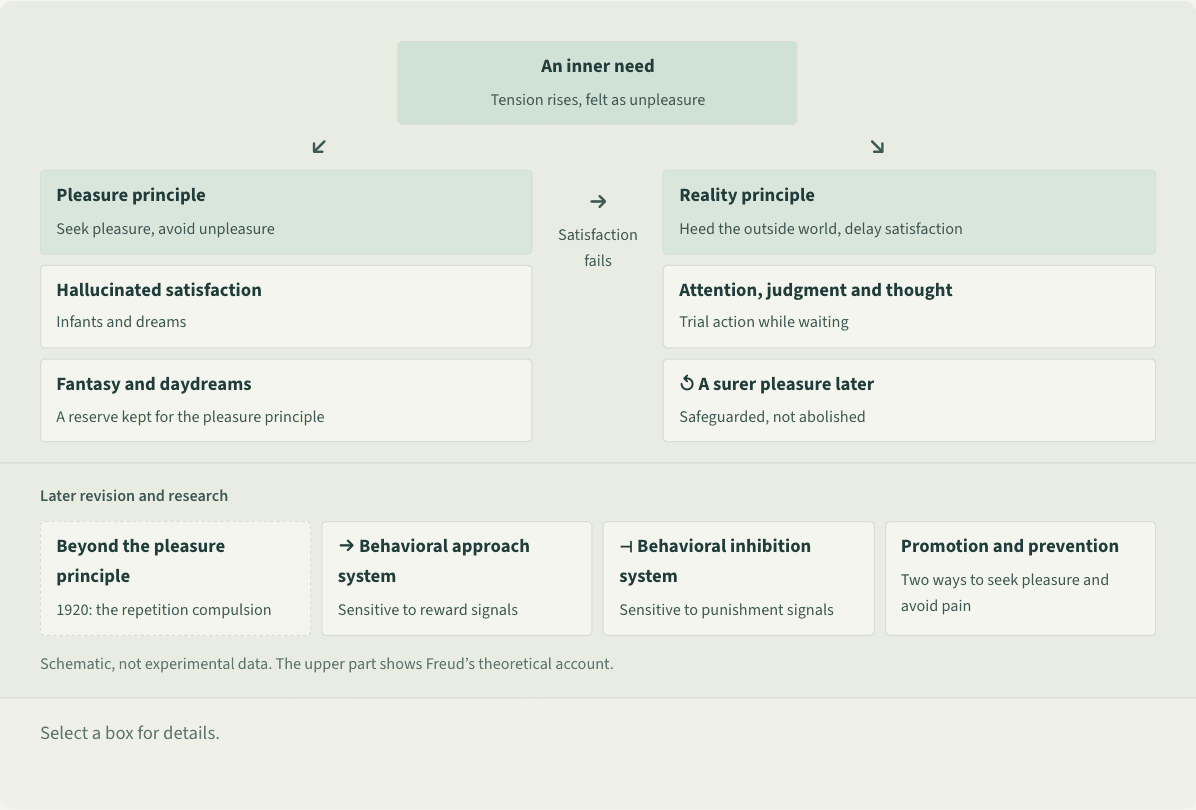
The pleasure principle is Freud’s term for the basic tendency of mental life to seek pleasure and avoid unpleasure, pressing for immediate gratification of instinctual impulses.[1][3] It dominates the id and childhood; the opposing reality principle represents the outside world and requires gratification to be given up, modified or postponed.[3]
→Satisfaction fails
Later revision and research
Schematic, not experimental data. The upper part shows Freud’s theoretical account.
Schematic, top to bottom. At the top, a card: an inner need, tension rising and felt as unpleasure. Below it the figure splits into two columns. Left: the pleasure principle, seek pleasure and avoid unpleasure, with two cards beneath it, hallucinated satisfaction in infants and dreams, and fantasy and daydreams as a reserve kept for the pleasure principle. An arrow labeled satisfaction fails points from the left column to the right. Right: the reality principle, take the outside world into account and delay satisfaction, followed by attention, judgment and thought as trial action while waiting, and a surer pleasure later, the pleasure principle safeguarded rather than abolished. At the bottom, labeled later revision and research, four cards: beyond the pleasure principle, the repetition compulsion of 1920; the behavioral approach system, sensitive to reward signals; the behavioral inhibition system, sensitive to punishment signals; and promotion versus prevention, two ways of seeking pleasure and avoiding pain.
 Save as image (PNG)
This figure image is licensed CC BY 4.0: reuse it with credit and a link back to this page. How to reuse
Key points
- In 1911 Freud wrote that the earliest, primary processes obey it: they strive for pleasure and draw back from what might cause unpleasure, which is repression. Dreams are among its remnants.[1]
- The reality principle does not dethrone the pleasure principle but safeguards it: an uncertain momentary pleasure is given up for a surer one later.[1] Attention, judgment and thought develop in the process.[1]
- In Beyond the Pleasure Principle (1920) Freud conceded it is only a strong tendency.[2] Dreams in traumatic neurosis that keep returning to the event led him to posit a repetition compulsion.[2]
- Gray proposed separate systems for approach and avoidance: a behavioral approach system, sensitive to reward signals, drives movement toward goals; a behavioral inhibition system, sensitive to punishment signals, holds behavior back.[3]
An example
The night before an exam, Lin keeps scrolling on her phone. Remembering the 8 a.m. start, she sets an alarm, goes to bed, and plans a movie with friends for the weekend after. In Freud’s terms she has not given up pleasure but traded a momentary one for a surer one later: the reality principle at work.
Misreadings and limits
“Seek pleasure, avoid pain” is often treated as a formula that explains all behavior. Freud himself later conceded that the pleasure principle does not govern every mental process.[2] Higgins argues that people do approach pleasure and avoid pain, but understanding motivation means looking at how it works, such as a promotion focus on accomplishments and aspirations versus a prevention focus on safety and responsibilities.[4]
Sources
- 1 Freud, S. (1925). Formulations regarding the two principles in mental functioning (M. N. Searl, Trans.; original work published 1911). Collected papers (Vol. 4, pp. 13–21). Hogarth Press and the Institute of Psycho-Analysis. View source
- 2 Freud, S. (1922). Beyond the pleasure principle (C. J. M. Hubback, Trans.; original work published 1920). International Psycho-Analytical Press. View source
- 3 American Psychological Association (2018–2023). Pleasure principle; Reality principle; Hedonism; Reinforcement sensitivity theory; Behavioral approach system; Behavioral inhibition system; Regulatory focus theory. APA Dictionary of Psychology (regulatory focus theory updated November 15, 2023; other entries April 19, 2018). View source
- 4 Higgins, E. T. (1997). Beyond pleasure and pain. American Psychologist, 52(12), 1280–1300. doi:10.1037/0003-066X.52.12.1280
Last checked against sources: October 28, 2026