Cognitive distortions
认知扭曲
Cognitive distortions are consistent errors in how people process information that bias their reading of events, as in all-or-nothing or catastrophic thinking. Cognitive therapy links them to emotional disorders such as depression.[1][2]
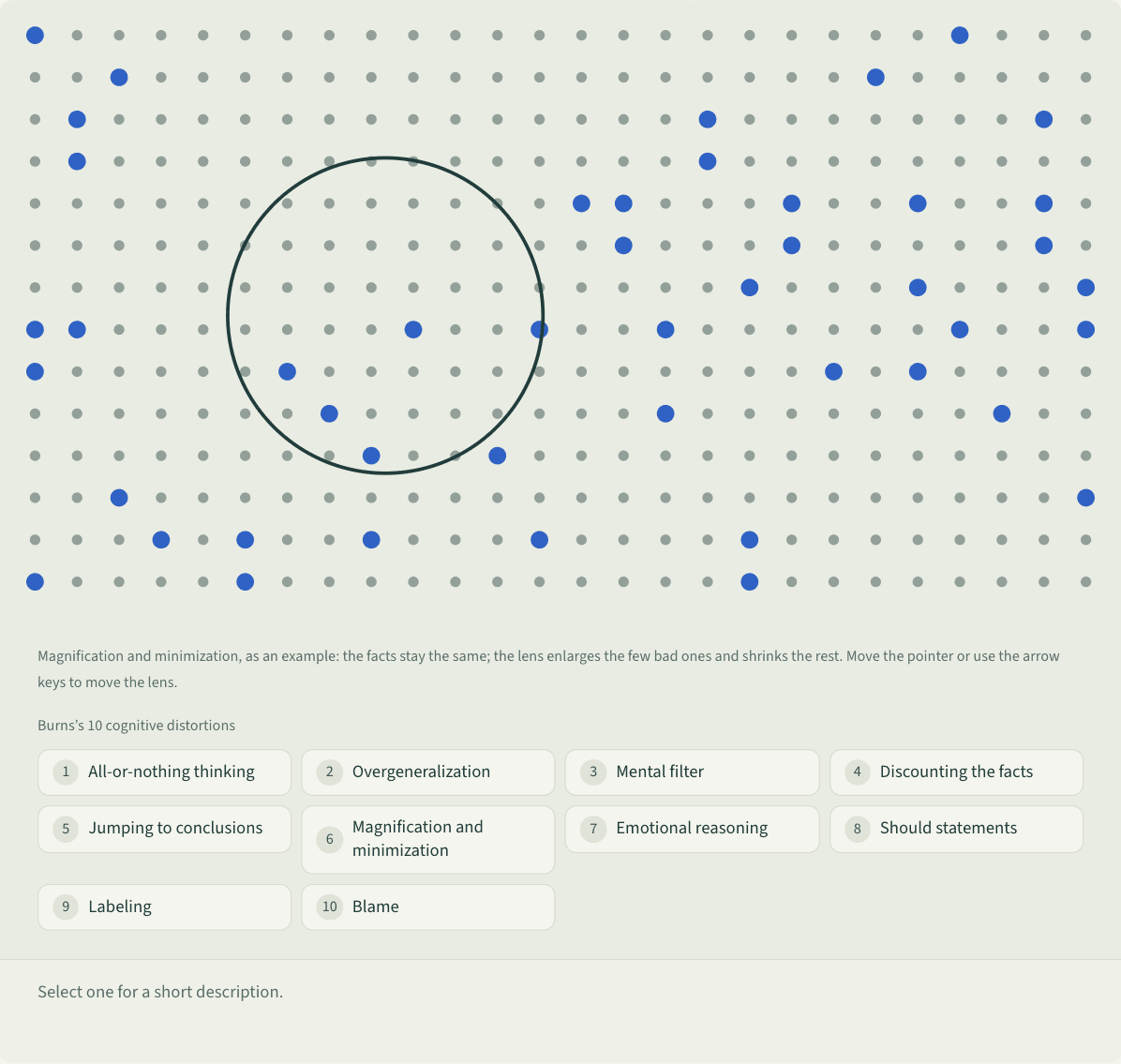
Magnification and minimization, as an example: the facts stay the same; the lens enlarges the few bad ones and shrinks the rest. Move the pointer or use the arrow keys to move the lens.
Burns’s 10 cognitive distortions
An even field of small gray dots with a few colored ones. A round lens moves over it; inside the lens the colored dots grow and the gray ones shrink. Below are ten buttons: all-or-nothing thinking, overgeneralization, mental filter, discounting the facts, jumping to conclusions, magnification and minimization, emotional reasoning, should statements, labeling and blame.
 Save as image (PNG)
Key points
- The term comes from Aaron Beck’s 1963 study of the thinking of depressed patients in psychotherapy, which linked distorted ideas to depressed mood.[1]
- David Burns’s book Feeling Good listed 10, including all-or-nothing thinking, mental filter, jumping to conclusions, should statements and labeling.[3]
- Lists vary by author: Beck proposed six types, Burns listed 10, and several categories overlap.[2][3]
- In Cognitive behavioral therapy, the categories work as signposts that help clients spot the error in a thought, then test and correct it.[2]
An example
Lin gets one figure wrong in a presentation and keeps thinking, “I blew the whole thing, and my manager must think I’m useless.” The first half is all-or-nothing thinking; the second is mind reading. She writes both in a thought record and checks each against the evidence.
Misreadings and limits
A cognitive distortion is not the same as a negative thought. Burns notes that healthy negative feelings need no treatment and that overly positive distortions can be just as harmful. The aim is more accurate thinking, not forced optimism.[3]
Sources
- 1 Beck, A. T. (1963). Thinking and depression: I. Idiosyncratic content and cognitive distortions. Archives of General Psychiatry, 9(4), 324–333. View source
- 2 DiTomasso, R. A., & Poteau, S. R. (2017). Cognitive distortions. The SAGE encyclopedia of abnormal and clinical psychology. SAGE Publications. doi:10.4135/9781483365817.n288
- 3 Burns, D. D. (2014). Secrets of self-esteem #2. Feeling Good: The website of David D. Burns, MD. View source
Last checked against sources: October 26, 2026