Deductive and inductive reasoning
演绎推理与归纳推理
What are deductive and inductive reasoning?
A valid deduction yields a conclusion that must be true if its premises are true.[1] An induction yields a conclusion that goes beyond the information in its premises: it may well be true, but nothing guarantees it, as when past experience is used to predict the next case.[2]
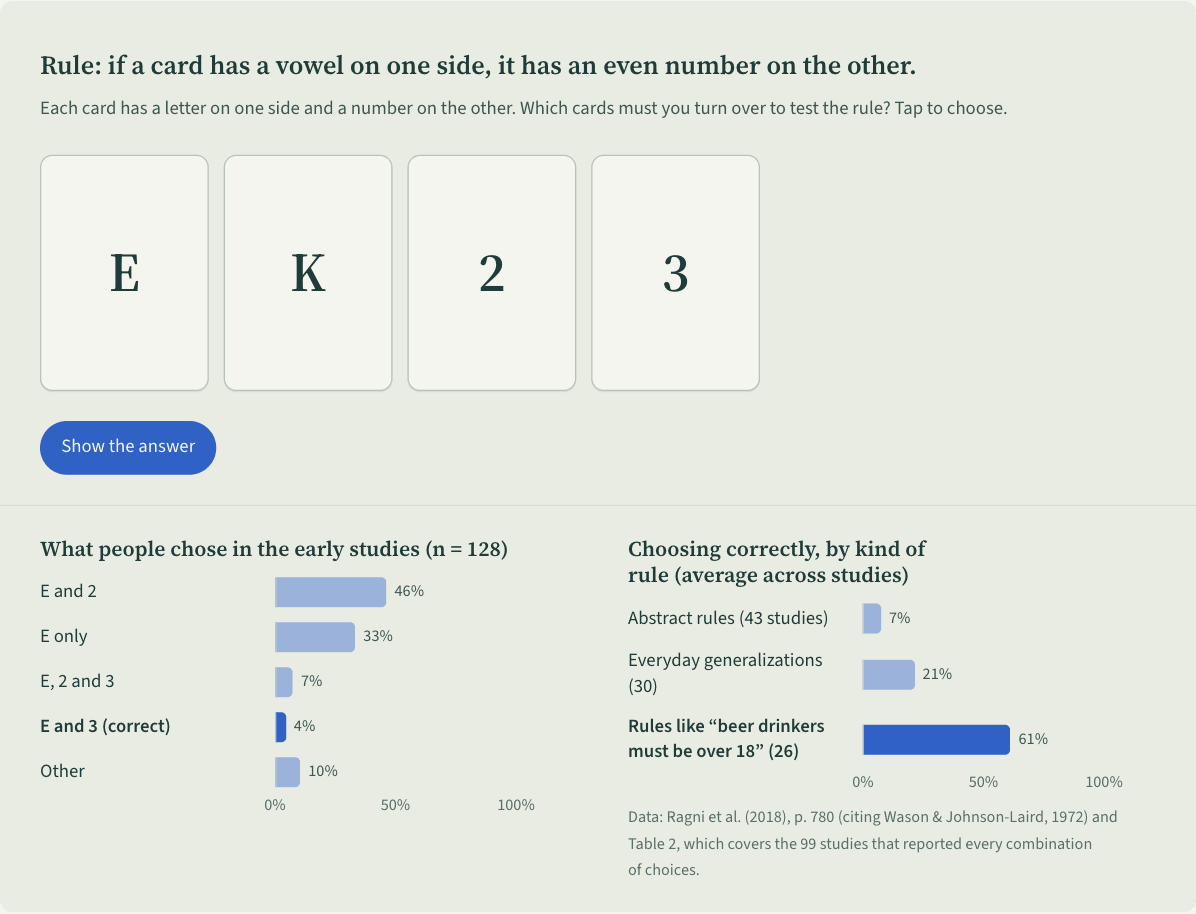
Rule: if a card has a vowel on one side, it has an even number on the other.
Each card has a letter on one side and a number on the other. Which cards must you turn over to test the rule? Tap to choose.
-
Turn it An odd number on the back would break the rule.
-
Leave it The rule says nothing about consonants.
-
Leave it Whatever is on the back fits the rule. Turning it looks for support, not a test.
-
Turn it A vowel on the back would break the rule. This is the card most people miss.
At the top, the rule “if a card has a vowel on one side, it has an even number on the other” and four cards, E, K, 2 and 3. Readers can pick cards and then see the answer: E and 3 must be turned, because only their backs could break the rule; K and 2 need not be. Below left, the choices of 128 people in the early studies: E and 2, 46%; E only, 33%; E, 2 and 3, 7%; E and 3 (correct), 4%; other, 10%. Below right, the average share choosing correctly by kind of rule: abstract rules 7% (43 studies), everyday generalizations 21% (30), rules like “beer drinkers must be over 18” 61% (26).
 Save as image (PNG)
This figure image is licensed CC BY 4.0: reuse it with credit and a link back to this page. How to reuse
Key points
- Validity concerns the link between premises and conclusion, not whether the premises are true. A valid argument from a false premise can reach a false conclusion; neither kind of reasoning guarantees truth.[1][2]
- Wason’s selection task pairs cards E, K, 2, 3 with the rule “vowel on one side, even number on the other.” Only E and 3 need turning; early on, 4% saw that.[3]
- Most people intuitively turn the cards that match the rule. Across 43 abstract versions only 7% picked the possible counterexample; with rules like “beer drinkers must be over 18,” 61% did.[3]
- Induction is only as good as its sample. People generalize about a whole outgroup from one or two members, and keep doing so even when told the member was atypical.[4]
An example
Jay’s subway has run late three Mondays in a row, so he decides it is always late on Mondays: induction, and it may be wrong. Ms. Wang knows the line closes for maintenance every Monday and that today is Monday, so it is closed today: deduction, certain if the premises are true.
Misreadings and limits
Textbooks and dictionaries often sum it up as deduction running from the general to the particular and induction from the particular to the general. That is a simplification: induction can go from particular to particular, and deduction from general to general. The real difference is whether the conclusion must follow from the premises.[2]
Sources
- 1 Johnson-Laird, P. N. (1999). Deductive reasoning. Annual Review of Psychology, 50, 109–135. doi:10.1146/annurev.psych.50.1.109
- 2 Johnson-Laird, P. N. (1994). A model theory of induction. International Studies in the Philosophy of Science, 8(1), 5–29. doi:10.1080/02698599408573474
- 3 Ragni, M., Kola, I., & Johnson-Laird, P. N. (2018). On selecting evidence to test hypotheses: A theory of selection tasks. Psychological Bulletin, 144(8), 779–796. doi:10.1037/bul0000146
- 4 Jhangiani, R., & Tarry, H. (2022). Biases in attribution. Principles of social psychology (1st international H5P ed.), section 5.3. BCcampus. View source
Last checked against sources: October 27, 2026