Mehrabian’s 7-38-55 rule
梅拉宾法则
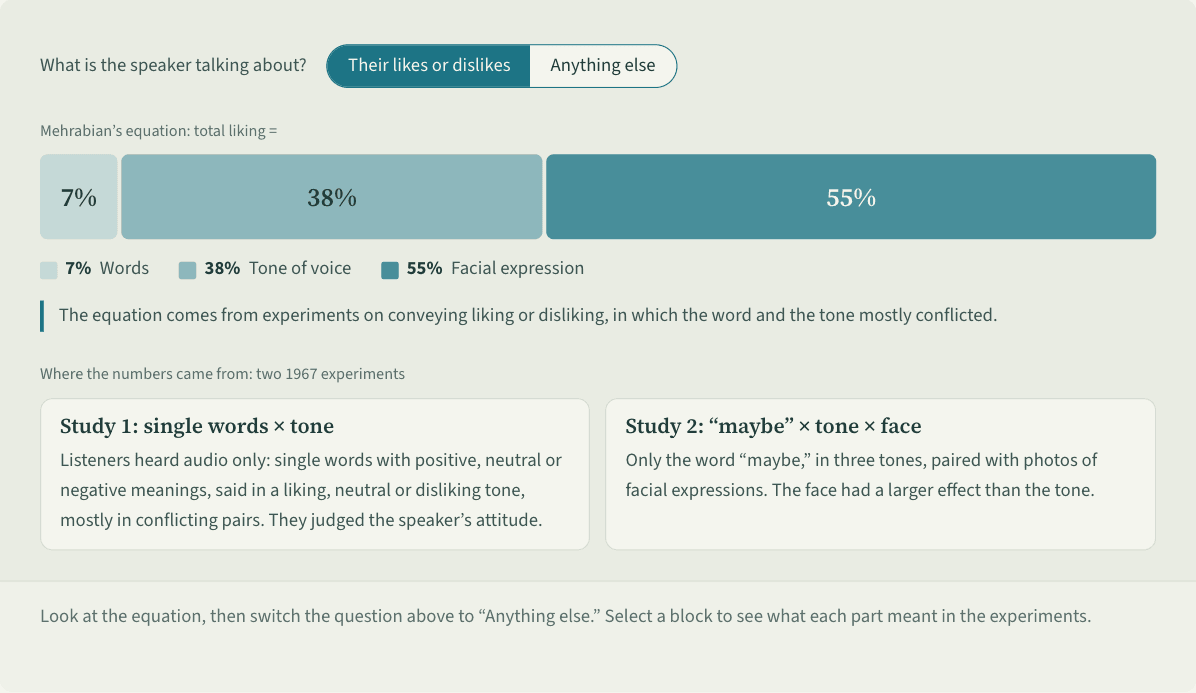
The 7-38-55 rule comes from psychologist Albert Mehrabian: when people convey liking or disliking, the listener’s overall sense of liking is weighted about 7% words, 38% tone of voice and 55% facial expression.[1]
Mehrabian’s equation: total liking =
- 7% Words
- 38% Tone of voice
- 55% Facial expression
The equation comes from experiments on conveying liking or disliking, in which the word and the tone mostly conflicted.
Mehrabian himself states that unless a speaker is talking about their feelings or attitudes, these ratios do not apply.
Where the numbers came from: two 1967 experiments
Study 1: single words × tone
Listeners heard audio only: single words with positive, neutral or negative meanings, said in a liking, neutral or disliking tone, mostly in conflicting pairs. They judged the speaker’s attitude.
Study 2: “maybe” × tone × face
Only the word “maybe,” in three tones, paired with photos of facial expressions. The face had a larger effect than the tone.
A bar in three segments: words 7%, tone of voice 38%, facial expression 55%. A switch above asks “What is the speaker talking about?” with the options “Their likes or dislikes” and “Anything else.” With “Anything else” selected, the bar turns gray, “Does not apply” appears over it, and Mehrabian’s own caveat is quoted: unless a speaker is talking about their feelings or attitudes, the ratios do not apply. Two cards below: Study 1, single words in different tones, audio only; Study 2, the word “maybe” in three tones paired with photos of faces, where the face had a larger effect than the tone.
 Save as image (PNG)
Key points
- The figures come from two 1967 experiments. In the first, listeners heard single words, such as “honey” and “maybe,” spoken in a liking, neutral or disliking tone.[2]
- The second experiment used only the word “maybe,” paired with photos of facial expressions. The face had a larger effect than the tone.[2]
- In most trials the word and the tone conflicted, and participants judged the speaker’s attitude, not the content of a message.[2]
- It is unclear exactly how the three coefficients were derived, and one analysis notes that the studies do not justify applying them to all communication.[2]
An example
Lin says, “Fine, I have no objection,” while frowning and speaking stiffly. Jay trusts the face and tone over the words, which is close to the situation Mehrabian studied. When Lin later explains the expense-claim process, though, almost all the information is in the words, and the 7% figure does not apply.
Misreadings and limits
The usual misreading is that “93% of communication is nonverbal.” Mehrabian himself states that the ratios come from experiments on conveying likes and dislikes and do not apply unless the speaker is talking about feelings or attitudes.[1] The experiments also used single words.[2]
Sources
- 1 Mehrabian, A. (1981). Silent messages: Implicit communication of emotions and attitudes (2nd ed.). Wadsworth. View source
- 2 Florida International University (n.d.). How much social meaning is nonverbal?. Florida International University faculty pages. View source
Last checked against sources: October 26, 2026