Satir communication stances
萨提亚沟通姿态
Satir’s communication stances are the ways family therapist Virginia Satir described people coping under stress: four incongruent stances (placating, blaming, super-reasonable and irrelevant) and congruent communication.[1][3]
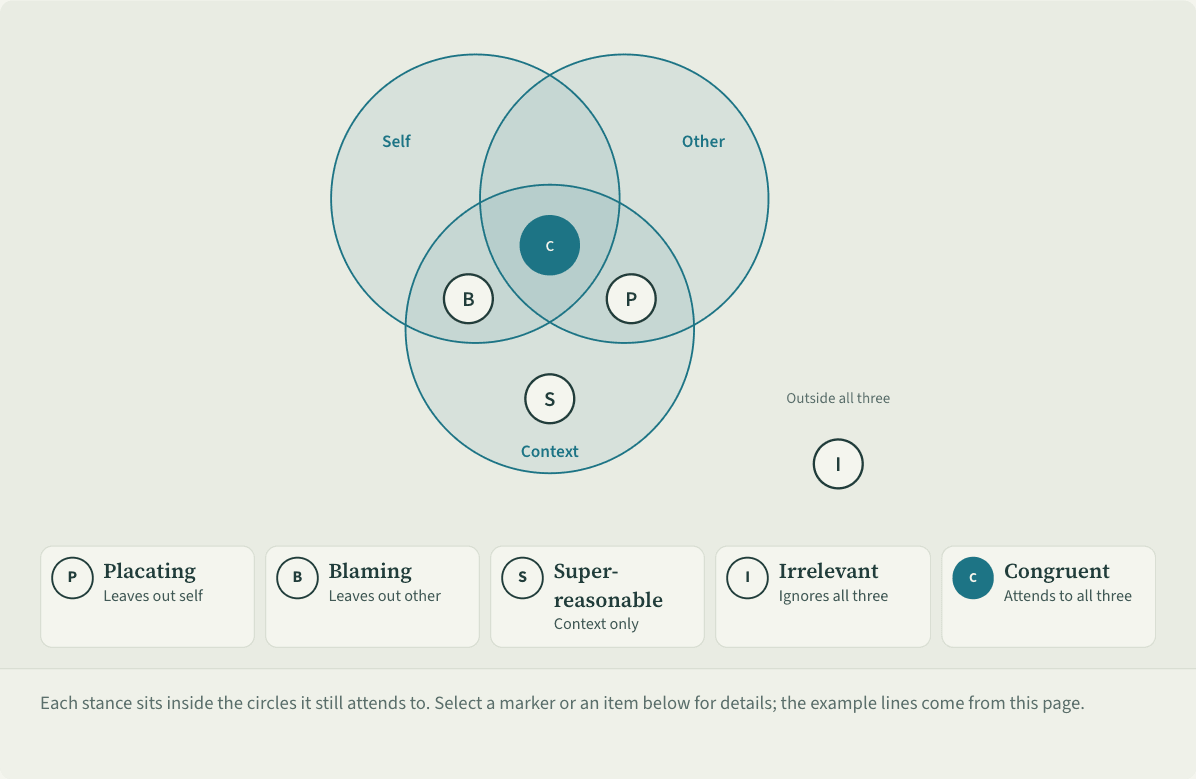
Three overlapping circles labeled Self, Other and Context. Five round markers sit in different regions: Placating where Other and Context overlap without Self; Blaming where Self and Context overlap without Other; Super-reasonable inside Context only; Congruent at the center where all three meet; Irrelevant outside all three. A key below says what each leaves out: placating leaves out self, blaming leaves out the other, super-reasonable attends to context only, irrelevant ignores all three, congruent attends to all three.
 Save as image (PNG)
Key points
- The stances differ in whether a person takes self, other and context into account when communicating. Congruent communication attends to all three.[2][3]
- Placating attends to the other person and the context but leaves out the self. Blaming attends to self and context but leaves out the other.[2][3]
- Super-reasonable attends only to context and rules, setting aside everyone’s feelings. Irrelevant (distracting) ignores all three, changing the subject or escaping.[3]
- The Satir model treats them as ways of coping under stress. In the Satir iceberg they form the coping layer just below behavior.[3]
An example
Jay is late for a date and his girlfriend is upset. Placating: “It’s all my fault, I’m useless.” Blaming: “You always find something to complain about.” Super-reasonable: a lecture on rush-hour traffic. Irrelevant: “So, what’s for dinner?” Congruent: “I kept you waiting half an hour. I’m sorry. I’ll leave earlier next time.”
Misreadings and limits
The stances describe ways of coping under stress and should not be used as fixed personality labels. The Satir network’s own annotated bibliography cites a review finding little empirical support for Satir’s work.[4]
Sources
- 1 Satir, V., Banmen, J., Gerber, J., & Gomori, M. (1991). The Satir model: Family therapy and beyond. Science and Behavior Books. View source
- 2 Hardin, M. A. (n.d.). Congruence. Virginia Satir Global Network. View source
- 3 张静 (2015). 萨提亚模式在初中生人际冲突团体心理辅导课中的巧妙运用. 中小学心理健康教育. View source
- 4 Virginia Satir Global Network (2024). Annotated bibliography (version 51). Virginia Satir Global Network. View source
Last checked against sources: October 26, 2026