Thomas–Kilmann conflict modes
托马斯-基尔曼冲突模式
The Thomas–Kilmann conflict modes are the five conflict-handling styles in the Thomas–Kilmann Conflict Mode Instrument (TKI), introduced by Kenneth Thomas and Ralph Kilmann in 1974 and arranged on two dimensions, assertiveness and cooperativeness.[1][3]
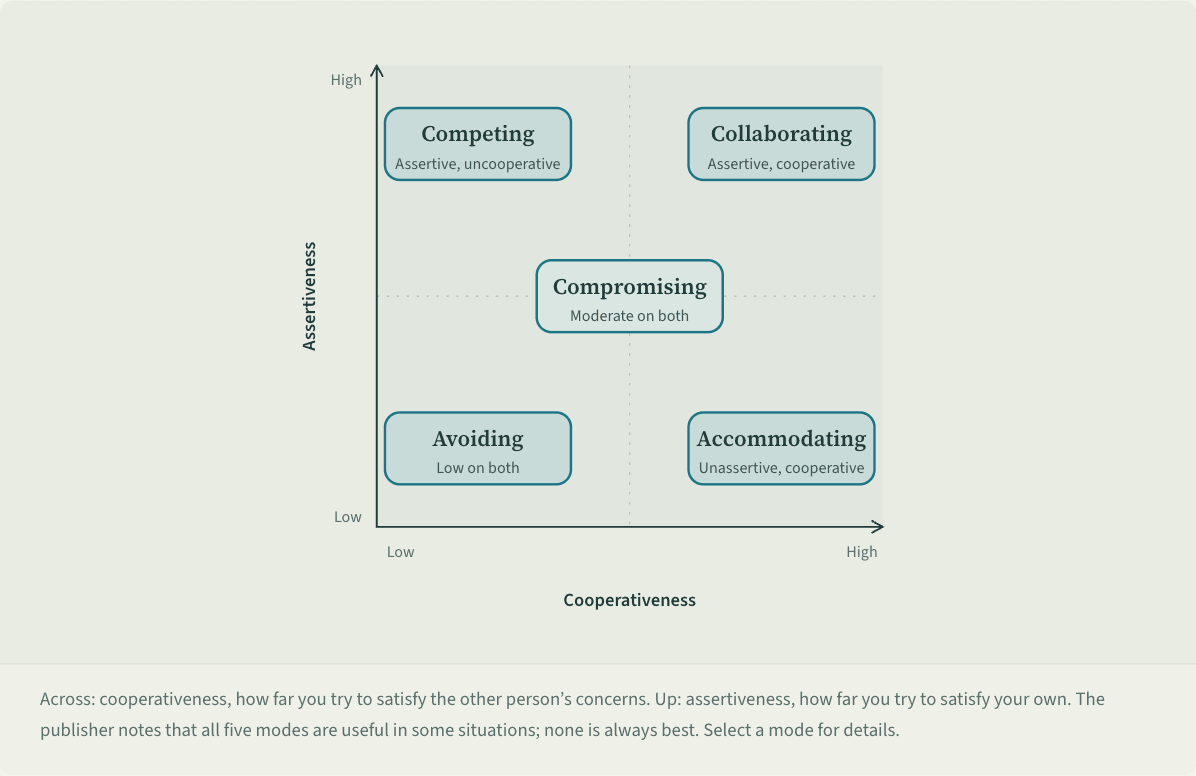
A chart with cooperativeness from low to high across and assertiveness from low to high upward. Top left: Competing (assertive, uncooperative). Top right: Collaborating (high on both). Center: Compromising. Bottom left: Avoiding (low on both). Bottom right: Accommodating (unassertive, cooperative).
 Save as image (PNG)
Key points
- Assertiveness is how far a person tries to satisfy their own concerns. Cooperativeness is how far they try to satisfy the other person’s concerns.[1]
- Competing is assertive and uncooperative. Accommodating is unassertive and cooperative. Avoiding is low on both, leaving the conflict unaddressed.[1][3]
- Collaborating is high on both, working together toward a solution that fully satisfies both sides. Compromising sits in the middle, seeking a partly satisfying, mutually acceptable solution.[1][3]
- The report presents results as percentiles compared with a norm sample of 8,000 employed US adults.[2]
An example
A project team argues over a deadline. Jay insists on the original plan (competing), Lin stops talking (avoiding), and Ms. Wang suggests both sides give a little and push it back two days (compromising). Later the team splits the work differently, keeping the date and easing the load (collaborating).
Misreadings and limits
A common misreading treats the result as a fixed personality or assumes collaborating is always best. The publisher’s report says all five modes are useful in some situations and that effectiveness depends on the situation and on how skillfully a mode is used.[2]
Sources
- 1 Kilmann Diagnostics (n.d.). An overview of the Thomas-Kilmann Conflict Mode Instrument (TKI). Kilmann Diagnostics. View source
- 2 Thomas, K. W., & Kilmann, R. H. (2007). Thomas-Kilmann Conflict Mode Instrument profile and interpretive report (sample). CPP, Inc.. View source
- 3 CPP, Inc. (2010). 托馬斯-基爾曼衝突模式評量剖析和解釋性報告(TKI 剖析和解釋性報告). CPP, Inc. / The Myers-Briggs Company. View source
Last checked against sources: October 26, 2026