Persona and shadow
人格面具与阴影
What are the persona and the shadow in Jung’s psychology?
Persona and shadow are paired concepts in Carl Jung’s analytical psychology. The persona is the face a person presents to others to fit in with society;[1][3] the shadow holds traits, desires or emotions the conscious ego cannot accept, kept hidden in the unconscious, whether negative or positive.[2]
More
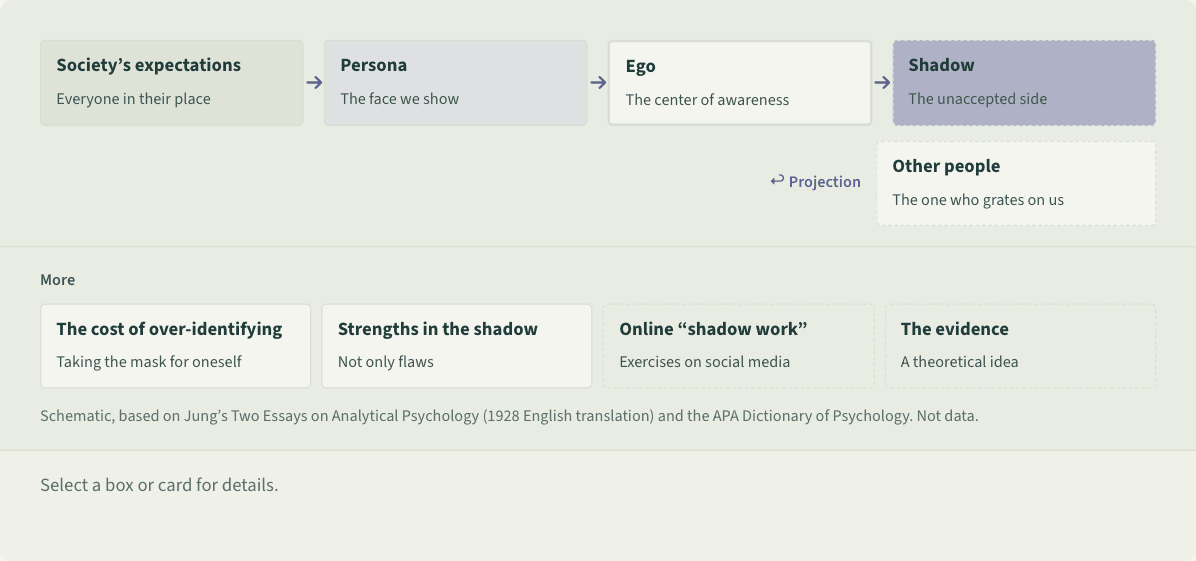
Schematic, based on Jung’s Two Essays on Analytical Psychology (1928 English translation) and the APA Dictionary of Psychology. Not data.
Schematic. A row of four boxes, left to right: society’s expectations (everyone is expected to play an assigned role); the persona (the face shown to others, which both makes an impression and hides one’s true nature); the ego (the center of consciousness); and the shadow (a dashed box: what the ego cannot accept, kept in the unconscious). A curved arrow loops from the shadow back to the left, to a box labeled other people, marked projection: what is unconscious is cast onto others, as when someone is seen as a devil. Below, four cards: the cost of over-identifying (taking oneself for the mask and paying in private with irritability and moods); strengths in the shadow (what is rejected may be positive); online “shadow work” (self-help exercises on social media, with parallels in other therapies); and the evidence (none for a biological basis of archetypes). A note says the figure is a schematic, not data.
 Save as image (PNG)
This figure image is licensed CC BY 4.0: reuse it with credit and a link back to this page. How to reuse
Key points
- Jung said the persona both makes a definite impression on others and hides a person’s true nature, and that both functions are needed; the trouble starts when people identify with the mask.[1]
- Those who build too good a persona, he argued, often pay in private with irritability, moods or fears; identifying too closely with a social role is a common source of neurosis.[1]
- He wrote that what is unconscious gets projected: seeing someone as a “devil” means the other person offers a hook for it, and that the one projecting has something of it too.[1]
- The shadow is classed as an archetype,[2] and the claim that archetypes are biologically based lacks evidence; newer views trace them to experience and culture.[3]
An example
With clients, Ms. Wang is all smiles and never says no, yet at home she snaps over small things. What she can least stand is her coworker Jay’s bluntness. On Jung’s reading, being endlessly agreeable is her persona, and the directness that grates on her may be a side of herself she keeps down.
Misreadings and limits
Online “shadow work” sells accepting the shadow as a shortcut to self-improvement. Bretherton notes that similar exercises already exist in cognitive behavioral therapy and other approaches, without Jung’s whole framework. But overwhelming shame, rage or terror calls for friends or a therapist, and people with trauma need some recovery first.[4]
Sources
- 1 Jung, C. G. (1928). Two essays on analytical psychology (H. G. Baynes & C. F. Baynes, Trans.). Baillière, Tindall and Cox. Internet Archive (Digital Library of India scan). View source
- 2 American Psychological Association (2018). Shadow. APA dictionary of psychology (updated April 19, 2018). View source
- 3 Spielman, R. M., Jenkins, W. J., & Lovett, M. D. (2020). 11.3 Neo-Freudians: Adler, Erikson, Jung, and Horney. Psychology 2e. OpenStax. View source
- 4 Bretherton, R. (2023). Shadow work: Why you should be cautious of the TikTok self-help trend. The Conversation (October 10, 2023). View source
Last checked against sources: October 28, 2026