Collective unconscious
集体无意识
What is the collective unconscious?
The collective unconscious is Carl Jung’s idea that beneath the personal unconscious, built from each person’s own experience, lies a layer that everyone shares and no one acquires individually.[1] He held that its archetypes, or primordial images, surface as similar themes in folklore, literature and dreams across cultures.[2][3]
Jung’s claims and the evidence
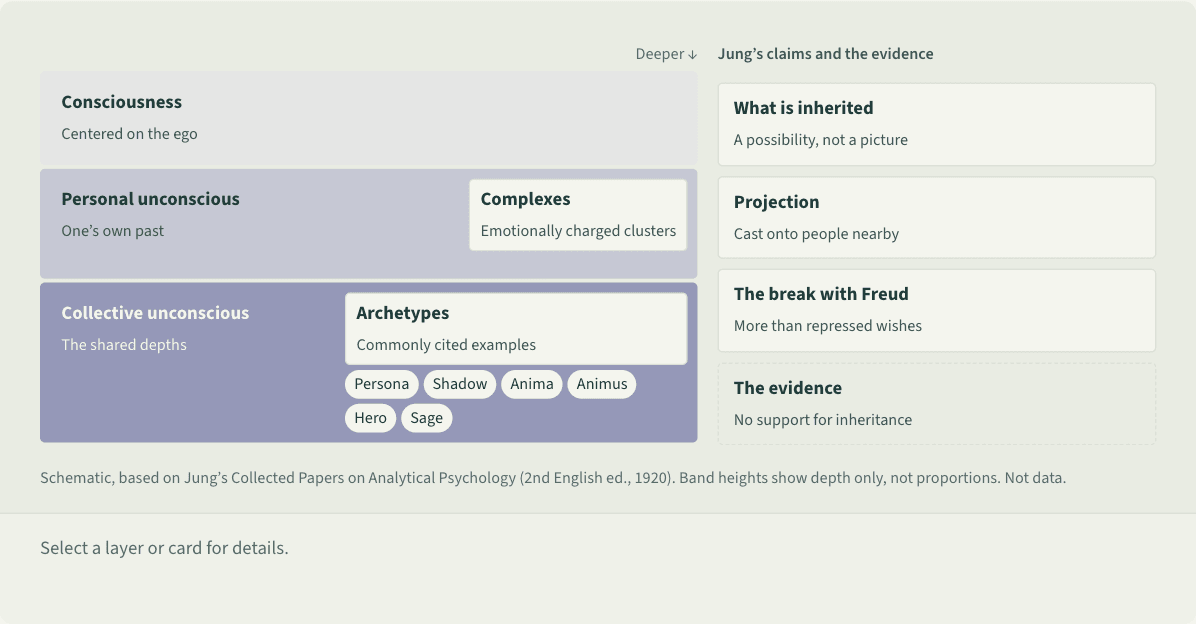
Schematic, based on Jung’s Collected Papers on Analytical Psychology (2nd English ed., 1920). Band heights show depth only, not proportions. Not data.
Schematic. On the left, three horizontal bands stacked top to bottom, with a downward arrow labeled deeper. The top band is consciousness, centered on the ego and holding recent impressions. The middle band is the personal unconscious, holding forgotten or repressed personal experiences and perceptions that never reached awareness; inside it is a label, complexes, meaning linked, emotionally charged ideas. The bottom band is the collective unconscious, shared by everyone and unrelated to personal experience; inside it is a label, archetypes, surrounded by commonly cited examples: persona, shadow, anima, animus, hero and sage. On the right, four cards: what is inherited (Jung said it is the possibility of forming images, not ready-made pictures); projection (these images are often cast onto people nearby, as excessive admiration or contempt); the break with Freud (Freud’s unconscious centered on repressed childhood wishes; Jung added an impersonal layer); and the evidence (there is none for inherited archetypes). A note says the figure is a schematic: band heights show depth only, not data.
 Save as image (PNG)
This figure image is licensed CC BY 4.0: reuse it with credit and a link back to this page. How to reuse
Key points
- Jung described three layers: consciousness holds recent impressions; the personal unconscious holds forgotten or repressed experiences and emotionally charged complexes; the collective unconscious holds primordial images and mythic themes.[1]
- He stressed that what is inherited is not ready-made images but the possibility of forming them.[1] Commonly cited archetypes include the persona and shadow, anima, animus and hero.[2]
- Jung summarized Freud’s unconscious as limited to repressed childhood wishes. To it he added subliminal perceptions, the germs of future conscious contents, and an impersonal layer.[1][3]
- No evidence shows archetypes are inherited; the genome does not encode symbolic information.[3] Even the Jungian scholar Roesler finds no firm scientific basis for symbolic patterns like the hero myth reaching everyone.[4]
An example
Reading bedtime stories to her daughter, Lin notices that fairy tales from many countries feature a wise figure who guides the hero. Jung would see an archetype of the collective unconscious at work. A critic would first ask whether the stories spread between cultures, or grew out of experiences most people share.
Misreadings and limits
The phrase is often used for a crowd that goes along without thinking. That is not what Jung meant: he described a layer of the unconscious, unrelated to personal experience, that is present in every individual mind. It is a claim about the structure of each psyche, not about group behavior.[1]
Sources
- 1 Jung, C. G. (1920). Collected papers on analytical psychology (C. E. Long, Ed.; 2nd ed., reprinted). Baillière, Tindall and Cox. Project Gutenberg eBook #48225. View source
- 2 American Psychological Association (2018). Archetype. APA dictionary of psychology (updated April 19, 2018). View source
- 3 Spielman, R. M., Jenkins, W. J., & Lovett, M. D. (2020). 11.3 Neo-Freudians: Adler, Erikson, Jung, and Horney. Psychology 2e. OpenStax. View source
- 4 Roesler, C. (2012). Are archetypes transmitted more by culture than biology? Questions arising from conceptualizations of the archetype. Journal of Analytical Psychology, 57(2), 223–246. doi:10.1111/j.1468-5922.2011.01963.x
Last checked against sources: October 28, 2026