Defense mechanisms
防御机制
What are defense mechanisms?
Defense mechanisms are unconscious mental processes that ease anxiety, painful emotion and inner conflict; repression, for example, keeps distressing thoughts out of awareness.[1][2] Freud proposed the idea in 1894,[2] and his daughter Anna Freud set it out systematically in a 1936 book.[1][3]
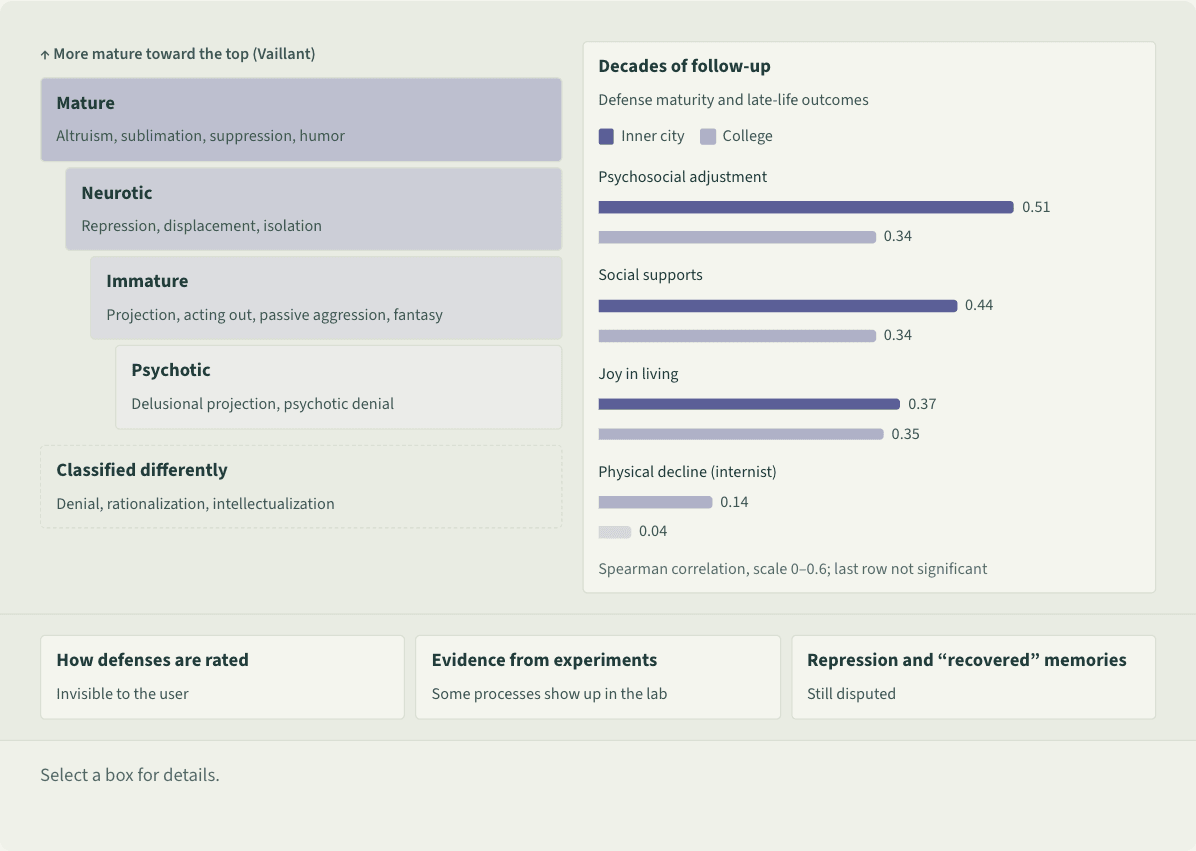
More mature toward the top (Vaillant)
Schematic. On the left, a four-step ladder, bottom to top: psychotic defenses (delusional projection, psychotic denial); immature defenses (projection, acting out, passive aggression, fantasy); neurotic defenses (repression, displacement, isolation); mature defenses (altruism, sublimation, suppression, humor), with a note that maturity rises toward the top. Below the ladder, a card headed classified differently lists denial, rationalization and intellectualization. On the right, a bar chart titled decades of follow-up shows correlations between defense maturity and late-life outcomes, one bar each for the inner-city and college groups: psychosocial adjustment 0.51 and 0.34, social supports 0.44 and 0.34, joy in living 0.37 and 0.35, and physical decline rated by an internist 0.14 and 0.04, not significant. At the bottom, three cards: how defenses are rated, evidence from experiments, and repression and recovered memories.
 Save as image (PNG)
This figure image is licensed CC BY 4.0: reuse it with credit and a link back to this page. How to reuse
Key points
- Common examples: repression (blocking painful thoughts), projection (attributing your own impulses to others), rationalization (a respectable reason for what you did) and sublimation (turning impulses toward valued pursuits).[1]
- Vaillant ranks defenses in four levels of maturity: psychotic, immature, neurotic and mature. DSM-IV included a similar scale as a proposed diagnostic axis.[2]
- In Harvard’s Study of Adult Development, men whose defenses were more mature at ages 20–47 had better late-life adjustment, social support and joy in living, but not less physical decline.[2]
- Experiments support some defensive processes; people describe themselves more positively after a threat.[3] But defenses are hard to rate reliably, and Vaillant concedes the evidence is mainly clinical.[2]
An example
Lin misses out on the internship she wanted and tells friends, “That company isn’t that great anyway.” In defense-mechanism terms, finding a respectable reason for a disappointment without realizing it is rationalization. It can ease the sting for a while, but one remark cannot show it is a defense; she may simply mean it.
Misreadings and limits
Repression is often pictured as sealing away a traumatic memory that can be recovered intact years later. A review by Otgaar and colleagues argues the evidence offered for this has more plausible explanations. In one early study, after three suggestive interviews 25% of participants “recalled” being lost as a child when they never were, and suggested “memories” can lead to false accusations.[4]
Sources
- 1 Bailey, R., & Pico, J. (2023). Defense mechanisms. In StatPearls (last update May 22, 2023). StatPearls Publishing; NCBI Bookshelf NBK559106. View source
- 2 Vaillant, G. E. (2011). Involuntary coping mechanisms: A psychodynamic perspective. Dialogues in Clinical Neuroscience, 13(3), 366–370. doi:10.31887/DCNS.2011.13.2/gvaillant
- 3 Westen, D. (1998). The scientific legacy of Sigmund Freud: Toward a psychodynamically informed psychological science. Psychological Bulletin, 124(3), 333–371. doi:10.1037/0033-2909.124.3.333
- 4 Otgaar, H., Howe, M. L., Patihis, L., Merckelbach, H., Lynn, S. J., Lilienfeld, S. O., & Loftus, E. F. (2019). The return of the repressed: The persistent and problematic claims of long-forgotten trauma. Perspectives on Psychological Science, 14(6), 1072–1095. doi:10.1177/1745691619862306
Last checked against sources: October 28, 2026