Jungian dream analysis
荣格的释梦理论
How did Jung interpret dreams?
Carl Jung held that dreams compensate for the conscious mind: thoughts and tendencies undervalued or ignored while awake come forward in sleep.[1] He read dream images as symbols, not disguises, gathering the dreamer’s associations and then adding parallels from myth and ancient symbolism.[1]
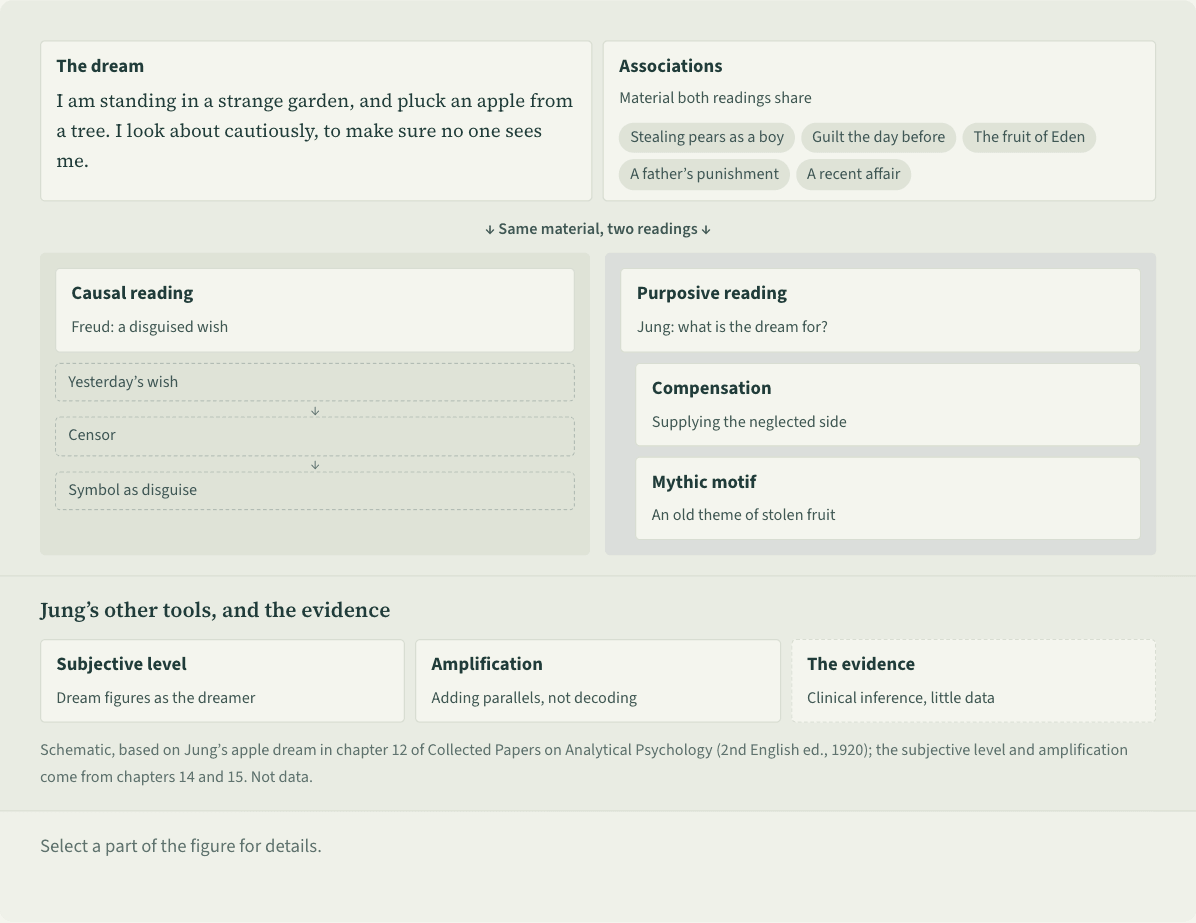
Same material, two readings
- Yesterday’s wish
- Censor
- Symbol as disguise
Jung’s other tools, and the evidence
Schematic, based on Jung’s apple dream in chapter 12 of Collected Papers on Analytical Psychology (2nd English ed., 1920); the subjective level and amplification come from chapters 14 and 15. Not data.
Schematic, top to bottom. At the top is the dream: a young man stands in a strange garden, picks an apple from a tree and looks around to make sure no one sees him. Below are his associations: stealing pears from someone’s garden as a boy; feeling oddly guilty while chatting with a woman acquaintance the day before; the forbidden fruit of Eden; harsh punishment from his father for a childhood misdeed; a recent affair with a housemaid. The associations feed two columns labeled same material, two readings. The left column, the causal reading (Freud): a wish unfulfilled the day before, disguised by a censor as a symbol, with symbols tending toward fixed meanings. The right column, the purposive reading (Jung): what the dream is for; compensation, supplying the guilt the young man overlooked awake; a mythic motif, apple theft also found in Eden and other myths, from which Jung inferred a collective unconscious. Three cards along the bottom: the subjective level, treating dream figures as parts of the dreamer; amplification, enlarging a symbol with parallels found by the dreamer and the analyst; the evidence, with textbooks noting that Jung’s dream theory lacks empirical support and content studies linking dreams to waking concerns.
 Save as image (PNG)
This figure image is licensed CC BY 4.0: reuse it with credit and a link back to this page. How to reuse
Key points
- In one of Jung’s cases, a young man untroubled by his love affair dreamed of furtively picking an apple. Jung read the dream as supplying the guilt he ignored awake.[1]
- Beneath the personal unconscious he posited a collective unconscious whose archetypes, such as the hero or the sage, appear in dreams and myths.[1][2] Their claimed inheritance lacks evidence.[2]
- Where Freud traced a dream to a repressed wish, Jung asked what it was for. He often read it on the subjective level, treating every figure as part of the dreamer.[1]
- Textbooks note that Jung’s dream ideas lack empirical support.[3] Domhoff argues that content studies, which keep linking dreams to waking concerns, contradict compensation.[4]
An example
Jay is easygoing at work and never argues, yet he dreams of shouting at a stranger who blocks his way. Following Jung, an analyst would first ask what the stranger brings to mind, then treat the stranger as part of Jay: the dream may be supplying the frustration he swallows by day.
Misreadings and limits
Online guides give each “archetypal” image a fixed meaning, in the manner of dream books. Jung said that from his standpoint symbols have no fixed meaning, and that dreams compensate for consciousness rather than offering superior knowledge.[1] He conceded that no science could prove such readings right; their worth lay in their value for life.[1]
Sources
- 1 Jung, C. G. (1920). Collected papers on analytical psychology (C. E. Long, Ed.; 2nd ed., reprinted). Baillière, Tindall and Cox. Project Gutenberg eBook #48225. View source
- 2 Spielman, R. M., Jenkins, W. J., & Lovett, M. D. (2020). 11.3 Neo-Freudians: Adler, Erikson, Jung, and Horney. Psychology 2e. OpenStax. View source
- 3 Spielman, R. M., Jenkins, W. J., & Lovett, M. D. (2020). 4.3 Stages of sleep. Psychology 2e. OpenStax. View source
- 4 Domhoff, G. W. (2000). Moving dream theory beyond Freud and Jung. Paper presented to the symposium “Beyond Freud and Jung?”, Graduate Theological Union, Berkeley, CA. DreamResearch.net. View source
Last checked against sources: October 27, 2026