Eye movement desensitization and reprocessing
眼动脱敏与再加工
A structured trauma therapy created by Francine Shapiro. Guided by a therapist, the client recalls a traumatic memory while following alternating side-to-side stimulation, most often eye movements, to reduce the distress the memory causes.[1][4]
1
Recall the traumatic memory
Guided by the therapist
2
While following side-to-side stimulation
Most often the eyes track the therapist’s hand from side to side
A schematic, not the full treatment protocol
WHO guidelines (2013)
For PTSD, both trauma-focused CBT and EMDR are recommended. Both aim to reduce subjective distress and strengthen adaptive thoughts about the traumatic event.
Unlike trauma-focused CBT, EMDR does not require:
- Detailed accounts of the event
- Directly challenging beliefs
- Extended exposure
- Homework
What the eye movements add
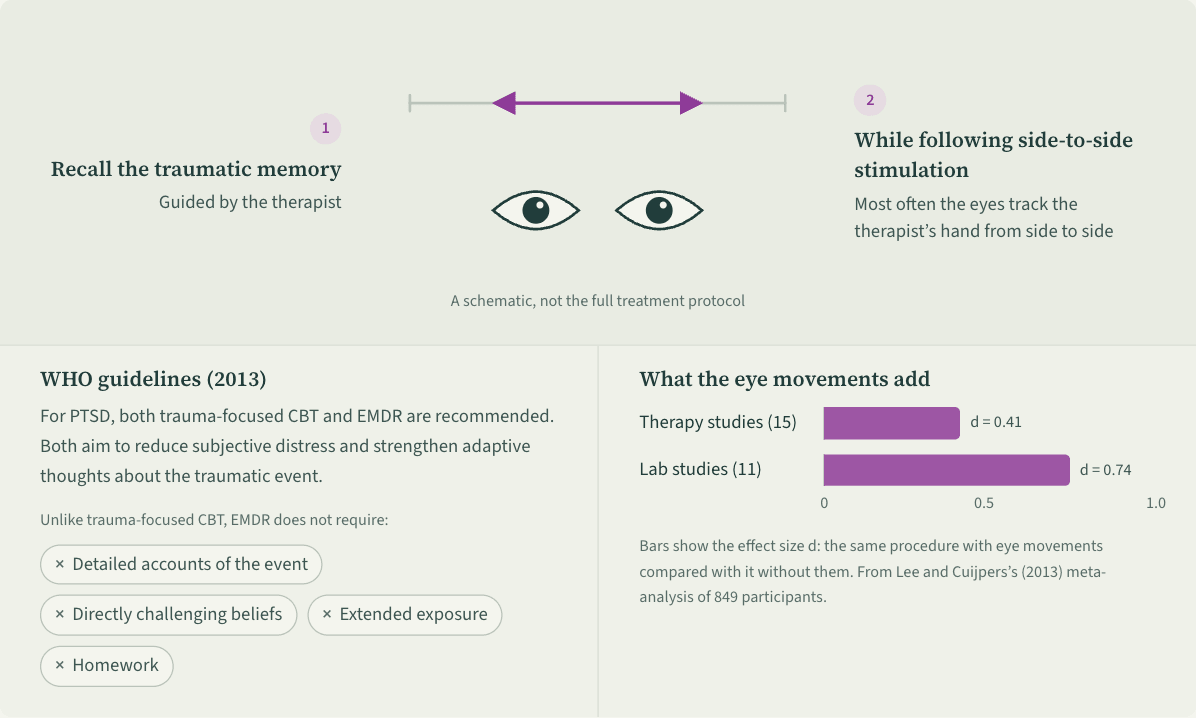
Bars show the effect size d: the same procedure with eye movements compared with it without them. From Lee and Cuijpers’s (2013) meta-analysis of 849 participants.
Top: an animated schematic. A dot moves back and forth along a horizontal track and a pair of eyes below follows it; the left label reads “recall the traumatic memory” and the right “while following side-to-side stimulation.” A pause button stops the motion. Bottom left, the WHO 2013 guideline: both approaches aim to reduce distress and strengthen adaptive thoughts; unlike trauma-focused CBT, EMDR does not require detailed descriptions of the event, direct challenging of beliefs, extended exposure or homework. Bottom right, two bars showing the added effect of eye movements compared with the same procedure without them: d = 0.41 in therapy studies and d = 0.74 in laboratory studies (Lee and Cuijpers, 2013 meta-analysis).
 Save as image (PNG)
Key points
- Shapiro developed eye movement desensitization (EMD) in 1987, published the first study in 1989 and renamed the method EMDR in 1991.[1][4]
- WHO guidelines from 2013 recommend trauma-focused CBT or EMDR for children, adolescents and adults with PTSD.[2]
- Unlike trauma-focused CBT, EMDR does not require detailed descriptions of the event, direct challenging of beliefs, extended exposure or homework.[2]
- A Chinese review notes that bilateral stimulation is only one of EMDR’s components; the method draws on cognitive, behavioral, psychoanalytic and physiological approaches.[4]
An example
After a car crash, Ms. Wang’s heart races whenever she hears brakes screech. In EMDR sessions, guided by her therapist, she recalls the crash while her eyes follow the therapist’s hand from side to side. Over several sessions, recalling it becomes noticeably less tense.
Misreadings and limits
A common question is whether the eye movements themselves matter. A meta-analysis found a moderate added effect of eye movements in therapy studies (d = 0.41) and a larger one in lab studies.[3] The WHO recommendation is specific to PTSD.[2]
Sources
- 1 Shapiro, F. (1989). Efficacy of the eye movement desensitization procedure in the treatment of traumatic memories. Journal of Traumatic Stress, 2(2), 199–223. doi:10.1007/BF00974159
- 2 World Health Organization (2013). Guidelines for the management of conditions specifically related to stress. World Health Organization. View source
- 3 Lee, C. W., & Cuijpers, P. (2013). A meta-analysis of the contribution of eye movements in processing emotional memories. Journal of Behavior Therapy and Experimental Psychiatry, 44(2), 231–239. doi:10.1016/j.jbtep.2012.11.001
- 4 Sun, H., & Yang, Y. (2004). 眼动脱敏与再加工治疗现状 [The psychotherapy of eye movement desensitization and reprocessing]. 中国临床心理学杂志 (Chinese Journal of Clinical Psychology), 12(3), 324–326. View source
Last checked against sources: October 26, 2026