Dialectical behavior therapy
辩证行为治疗
A form of cognitive behavioral treatment developed by Marsha Linehan, first for people who were chronically suicidal and diagnosed with borderline personality disorder. It teaches skills for managing emotions, tolerating distress and handling relationships.[1]
-
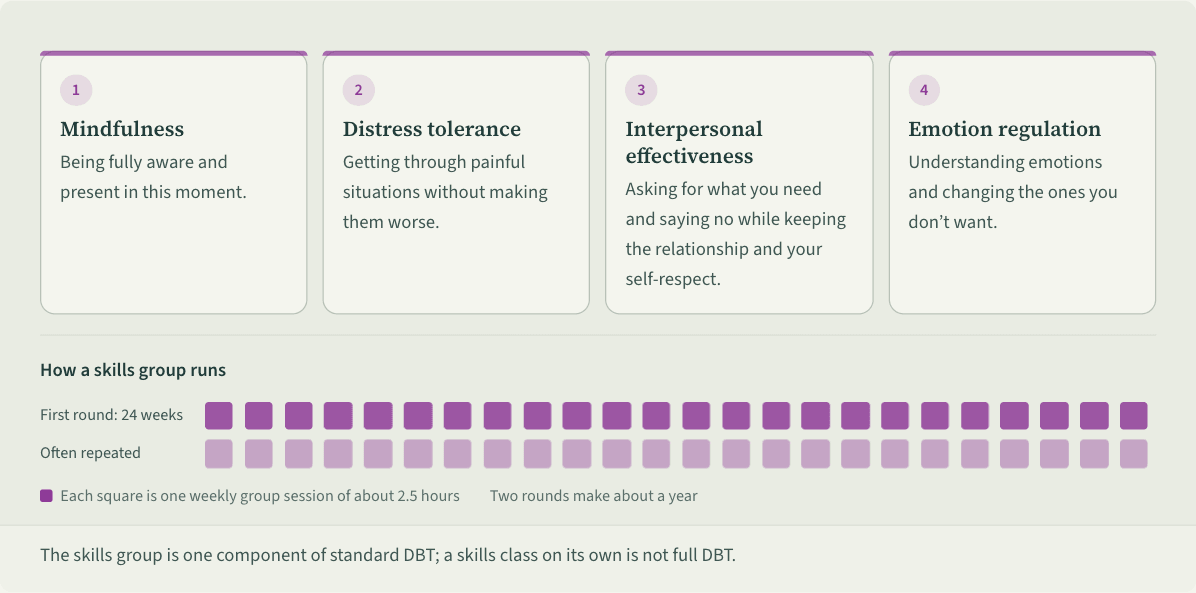
Mindfulness
Being fully aware and present in this moment.
-
Distress tolerance
Getting through painful situations without making them worse.
-
Interpersonal effectiveness
Asking for what you need and saying no while keeping the relationship and your self-respect.
-
Emotion regulation
Understanding emotions and changing the ones you don’t want.
How a skills group runs
Each square is one weekly group session of about 2.5 hours Two rounds make about a year
The skills group is one component of standard DBT; a skills class on its own is not full DBT.
Four tiles at the top: mindfulness (being fully aware and present), distress tolerance (getting through painful situations without making them worse), interpersonal effectiveness (asking for what you need and saying no while keeping relationships and self-respect), and emotion regulation (understanding and changing unwanted emotions). Below, two rows of 24 small squares, each a weekly group session of about 2.5 hours: the first row is the first round, the second a repeat, together about a year. A note says the skills group is one component of standard DBT.
 Save as image (PNG)
Key points
- Skills training has four modules: mindfulness, distress tolerance, interpersonal effectiveness and emotion regulation.[1]
- Skills groups meet weekly for about 2.5 hours on a 24-week curriculum, often repeated to make a one-year program. Skills training is one component of standard DBT.[1]
- In a randomized trial of 101 women with borderline personality disorder and recent suicidal behavior, DBT halved the risk of a suicide attempt versus community treatment by experts and cut dropout.[2]
- According to the Linehan Institute, later research found it also helps with substance use disorders, depression, PTSD and eating disorders.[1]
An example
When Jay argues with his family, he wants to throw things. In a DBT skills group he practices pausing and letting his body settle for a few minutes until the urge passes, then asking for what he needs in the way the group rehearsed.
Misreadings and limits
A skills class alone is not full DBT.[1] A Cochrane review found that psychotherapies, mostly DBT and mentalization-based treatment (MBT), reduced borderline personality disorder severity more than usual care (moderate-certainty evidence), but evidence on self-harm and psychosocial functioning was low certainty.[3]
Sources
- 1 Linehan Institute (n.d.). What is DBT skills?. Linehan Institute. View source
- 2 Linehan, M. M., Comtois, K. A., Murray, A. M., Brown, M. Z., Gallop, R. J., Heard, H. L., Korslund, K. E., Tutek, D. A., Reynolds, S. K., & Lindenboim, N. (2006). Two-year randomized controlled trial and follow-up of dialectical behavior therapy vs therapy by experts for suicidal behaviors and borderline personality disorder. Archives of General Psychiatry, 63(7), 757–766. doi:10.1001/archpsyc.63.7.757
- 3 Storebø, O. J., Stoffers-Winterling, J. M., Völlm, B. A., Kongerslev, M. T., Mattivi, J. T., Jørgensen, M. S., Faltinsen, E., Todorovac, A., Sales, C. P., Callesen, H. E., Lieb, K., & Simonsen, E. (2020). Psychological therapies for people with borderline personality disorder. Cochrane Database of Systematic Reviews, 2020(5), CD012955. doi:10.1002/14651858.CD012955.pub2
Last checked against sources: October 26, 2026