Biopsychosocial model
生物-心理-社会医学模式
What is the biopsychosocial model?
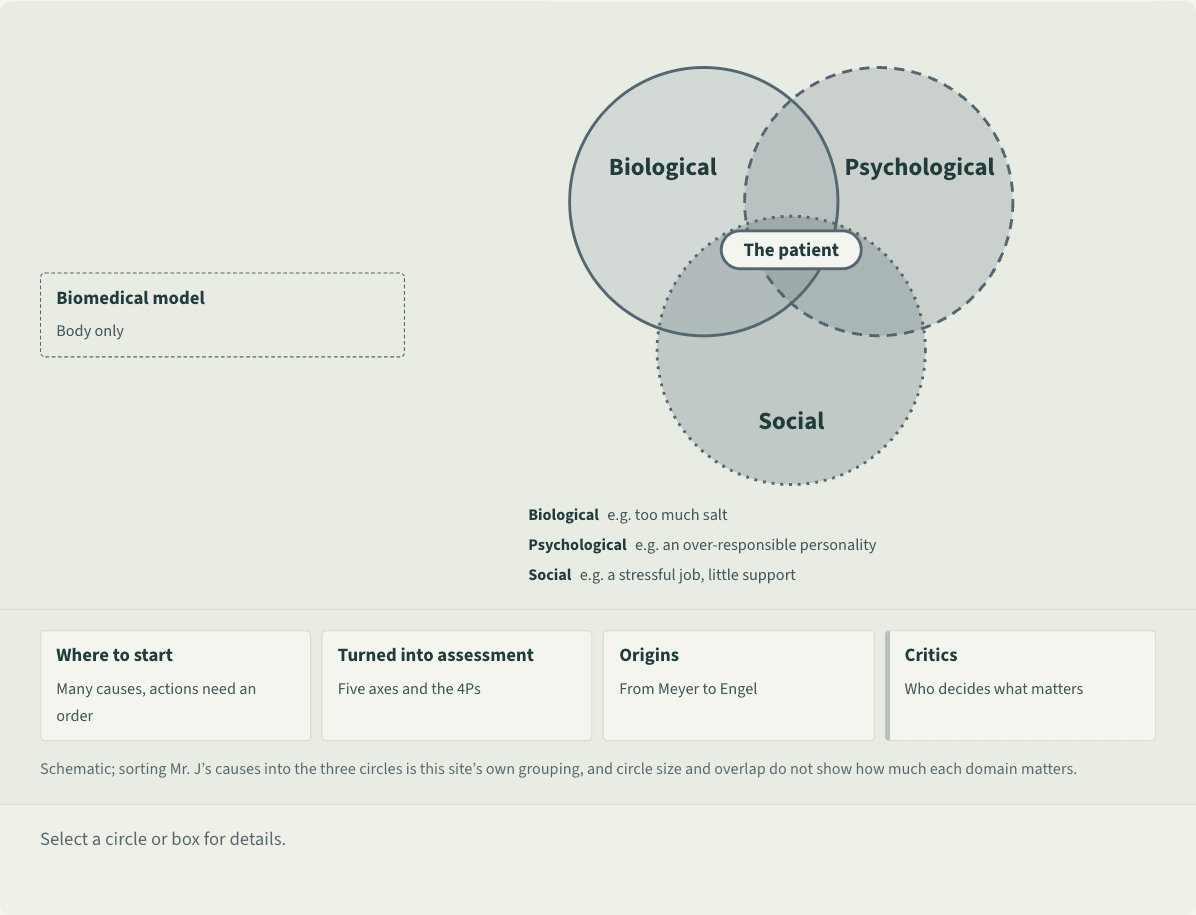
The biopsychosocial model is a medical model proposed by George Engel in 1977. He argued that the dominant biomedical model left no room for the psychological, social and behavioral dimensions of illness, and that clinicians must attend to its biological, psychological and social dimensions together.[1][2]
Schematic; sorting Mr. J’s causes into the three circles is this site’s own grouping, and circle size and overlap do not show how much each domain matters.
 Save as image (PNG)
This figure image is licensed CC BY 4.0: reuse it with credit and a link back to this page. How to reuse
Key points
- Engel faulted the biomedical model for splitting mind from body, ignoring what cells and molecules cannot explain and treating patients as objects; he held subjective experience can be studied scientifically.[2]
- Engel’s 1980 case was a heart attack patient: the arrhythmia that followed, he suggested, might stem not just from damaged heart muscle but from lacking confidence in the doctor.[4]
- DSM-III’s five-axis diagnosis and the 4P case formulation both tried to turn it into an assessment format; both have largely fallen out of use, and DSM-5 dropped the axes.[3]
- It had forerunners: Adolf Meyer read symptoms against a patient’s whole life course, and Grinker used the word before Engel, who extended the approach to all of medicine.[3][4]
An example
A checkup shows Jay’s blood pressure is high. Besides asking how salty he eats, the doctor asks about work and sleep: newly promoted, he often works past midnight and has dropped weekend basketball with friends. They agree he will cut salt, keep regular bedtimes and play again, then recheck in a month before deciding on medication.
Misreadings and limits
Its value lies in applying medical knowledge to each patient, not in discovering new laws of causation.[2] Critics say it offers no rule for which domain to prioritize in a given case, inviting arbitrary choices, and that even as psychiatry’s orthodoxy it has not stopped biomedical approaches from dominating research.[4]
Sources
- 1 Engel, G. L. (1977). The need for a new medical model: A challenge for biomedicine. Science, 196(4286), 129–136. doi:10.1126/science.847460
- 2 Borrell-Carrió, F., Suchman, A. L., & Epstein, R. M. (2004). The biopsychosocial model 25 years later: Principles, practice, and scientific inquiry. Annals of Family Medicine, 2(6), 576–582. doi:10.1370/afm.245
- 3 Owen, G. (2023). What is formulation in psychiatry?. Psychological Medicine, 53(5), 1700–1707. doi:10.1017/S0033291723000016
- 4 Benning, T. B. (2015). Limitations of the biopsychosocial model in psychiatry. Advances in Medical Education and Practice, 6, 347–352. doi:10.2147/AMEP.S82937
Last checked against sources: October 28, 2026