Diagnostic and Statistical Manual (DSM)
精神障碍诊断与统计手册(DSM)
What is the DSM (Diagnostic and Statistical Manual of Mental Disorders)?
The Diagnostic and Statistical Manual of Mental Disorders (DSM) is the American Psychiatric Association’s classification of mental disorders. For each disorder it sets out diagnostic criteria (which symptoms, for how long, and what must first be ruled out) with descriptive text.[1] The current edition, DSM-5-TR, came out in 2022.[1]
DSM (American Psychiatric Association)
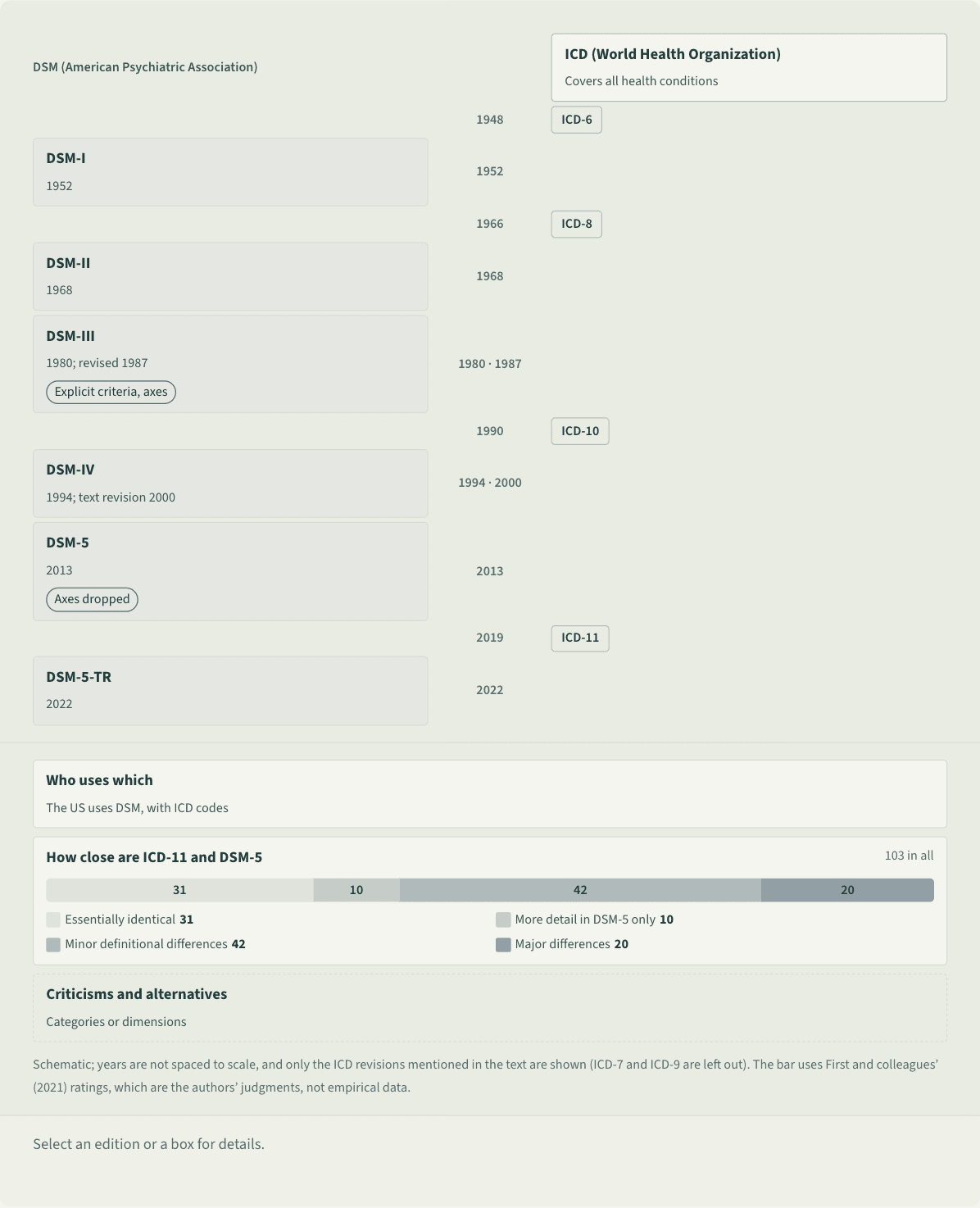
1948 ICD-6 1952 1966 ICD-8 1968 1980 · 1987 1990 ICD-10 1994 · 2000 2013 2019 ICD-11 2022Schematic; years are not spaced to scale, and only the ICD revisions mentioned in the text are shown (ICD-7 and ICD-9 are left out). The bar uses First and colleagues’ (2021) ratings, which are the authors’ judgments, not empirical data.
Schematic; spacing between years is not to scale. A top-to-bottom timeline with years in the middle column, DSM editions on the left and ICD revisions on the right: 1948 ICD-6; 1952 DSM-I; 1966 ICD-8; 1968 DSM-II; 1980 DSM-III, revised 1987; 1990 ICD-10; 1994 DSM-IV, text revision 2000; 2013 DSM-5; 2019 ICD-11; 2022 DSM-5-TR. DSM-III is tagged explicit criteria, multiaxial diagnosis; DSM-5 is tagged axes dropped. Below, a box titled who uses which: the US uses DSM, with codes taken from ICD. Next, a horizontal bar titled how close ICD-11 and DSM-5 are, splitting 103 shared disorders into essentially identical 31, more detail in DSM-5 only 10, minor definitional differences 42 and major differences 20. At the bottom, a box titled criticisms and alternatives: categories or dimensions.
 Save as image (PNG)
This figure image is licensed CC BY 4.0: reuse it with credit and a link back to this page. How to reuse
Key points
- DSM-III (1980) was the first to give every disorder explicit diagnostic criteria, and it introduced multiaxial diagnosis; DSM-5 (2013) dropped the axes.[3][4]
- DSM-5-TR has what the APA calls 20 disorder chapters, plus two on adverse effects of medication and other conditions that may need clinical attention.[2] It added prolonged grief disorder.[1]
- In the US, DSM diagnoses carry ICD-10-CM codes.[1] Of 103 disorders found in both DSM-5 and ICD-11, one comparison rated 31 essentially identical and 20 as differing in major ways.[4]
- Critics note that most symptoms vary by degree, so firm categories blur and comorbidity is common. In 2009 NIMH launched RDoC, a research framework that does not start from DSM categories.[3]
An example
Jay finds a list online headed “DSM-5 criteria for depression,” checks himself against it, decides he meets half of them and starts to worry. At his appointment the doctor explains that criteria like these are for professionals to apply, weighing history, duration and other possible causes; they are not a self-check list.[1]
Misreadings and limits
A common belief is that the DSM is the global standard. It is used mainly in the United States: countries report health statistics with WHO’s ICD, and in a 44-country survey 70% of psychiatrists mostly used ICD-10 in daily work.[3] DSM criteria are meant for trained professionals using clinical judgment, not as a self-check list.[1]
Sources
- 1 American Psychiatric Association (n.d.). About DSM-5-TR. Psychiatry.org. View source
- 2 American Psychiatric Association (2022). The organization of DSM-5-TR [Fact sheet]. Psychiatry.org. View source
- 3 Clark, L. A., Cuthbert, B., Lewis-Fernández, R., Narrow, W. E., & Reed, G. M. (2017). Three approaches to understanding and classifying mental disorder: ICD-11, DSM-5, and the National Institute of Mental Health’s Research Domain Criteria (RDoC). Psychological Science in the Public Interest, 18(2), 72–145. doi:10.1177/1529100617727266
- 4 First, M. B., Gaebel, W., Maj, M., Stein, D. J., Kogan, C. S., Saunders, J. B., Poznyak, V. B., Gureje, O., Lewis-Fernández, R., Maercker, A., Brewin, C. R., Cloitre, M., Claudino, A., Pike, K. M., Baird, G., Skuse, D., Krueger, R. B., Briken, P., Burke, J. D., … Reed, G. M. (2021). An organization- and category-level comparison of diagnostic requirements for mental disorders in ICD-11 and DSM-5. World Psychiatry, 20(1), 34–51. doi:10.1002/wps.20825
Last checked against sources: October 28, 2026