Somatic symptom disorder
躯体症状障碍
What is somatic symptom disorder?
Somatic symptom disorder means distressing bodily symptoms combined with excessive attention to them, such as persistent worry about their seriousness or frequent medical visits, not eased by tests or reassurance, lasting months and disrupting life.[1][3] ICD-11’s counterpart, bodily distress disorder, is largely similar.[1][3]
Diagnostic core
How the name changed
Schematic, not a self-test. The timeline shows order only, not scale.
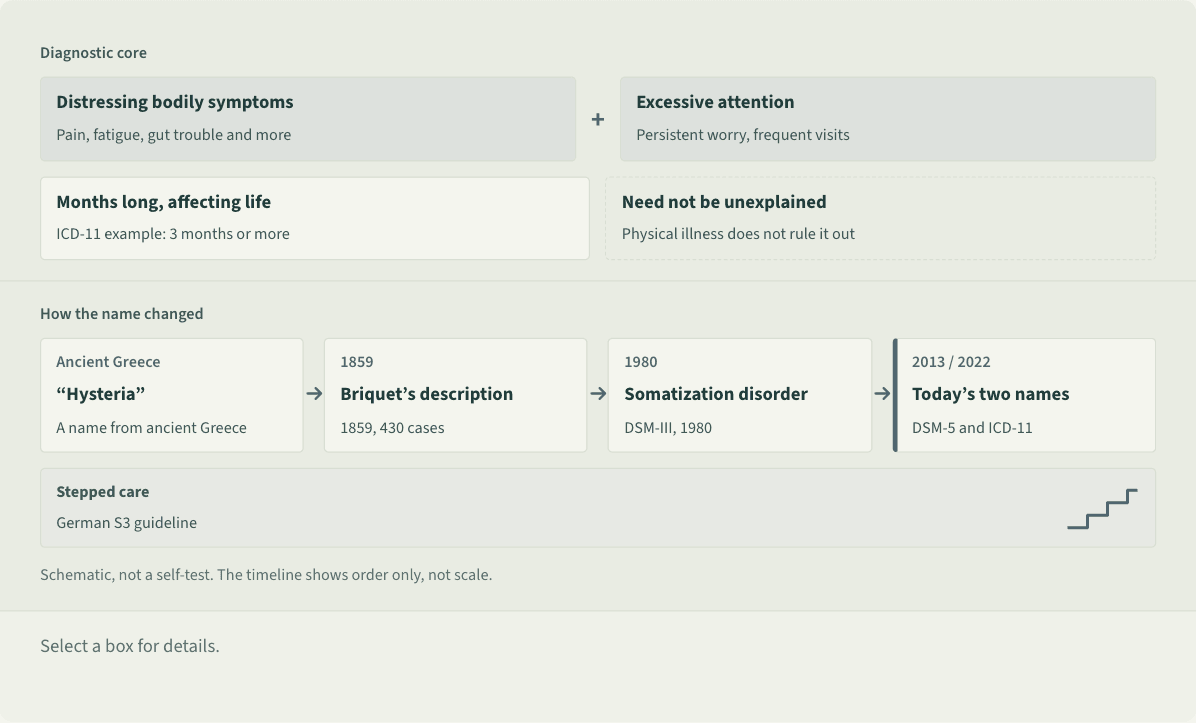
Schematic, not a self-test. At the top, labeled diagnostic core, two cards joined by a plus sign: distressing bodily symptoms (often pain, fatigue, gut and breathing symptoms) plus excessive attention (persistent worry and frequent medical visits that tests and reassurance do not ease). Below them, a card for lasting months and affecting life (ICD-11 gives 3 months or more as an example, DSM-5 requires over 6 months), and a dashed card saying symptoms need not be unexplained (a physical illness does not rule it out). In the middle, labeled how the name changed, a timeline that shows order only: ancient Greek hysteria; Briquet’s systematic description in 1859; DSM-III’s somatization disorder in 1980; DSM-5’s somatic symptom disorder in 2013 and ICD-11’s bodily distress disorder, in effect from 2022. At the bottom, a card for stepped care, based on the German S3 guideline.
 Save as image (PNG)
This figure image is licensed CC BY 4.0: reuse it with credit and a link back to this page. How to reuse
Key points
- DSM-5 requires a symptomatic state lasting over six months with excessive thoughts, anxiety or behavior. Symptoms need not be medically unexplained, and a physical illness does not rule it out.[3]
- In 1859 Briquet defined “hysteria” as medically unexplained symptoms across many organ systems; DSM-III renamed the syndrome somatization disorder in 1980.[2]
- No reliable prevalence exists, as no population survey has used standard diagnostic interviews. Questionnaire estimates average about 12.9% in the general population and 35% in general medical settings.[3]
- Germany’s S3 guideline on functional somatic symptoms recommends stepped care: regular scheduled visits, fewer repeat tests done only for reassurance, more activity and self-management. CBT has evidence behind it.[4]
An example
Ms. Wang’s stomach pain has come and gone for most of a year; an endoscopy and ultrasound found nothing serious. She still searches her symptoms online daily, fears a missed illness, has tried four hospitals in six months, sleeps poorly and skips meetups with friends. A doctor or mental health professional can assess whether this goes beyond ordinary worry.[1]
Misreadings and limits
It is not faking, and it does not mean “it’s all in your head”: the symptoms are real and can coexist with physical illness.[1][3] Critics also call the criteria overinclusive, risking overdiagnosis.[3] This page is not for self-diagnosis. If bodily symptoms and worry last for months and clearly disrupt life, a doctor or mental health professional can help.
If you need help now
If you’re struggling to cope or having thoughts of harming yourself:
- US and Canada: call or text 988 (24/7)
- UK and Ireland: Samaritans, 116 123 (free, 24/7)
- Australia: Lifeline, 13 11 14 (24/7)
- Elsewhere: findahelpline.com
If you’re in immediate danger, call your local emergency number.
Psyfield is not a crisis service. Numbers checked October 2026.
Sources
- 1 World Health Organization (2025). 6C20 Bodily distress disorder. ICD-11 for mortality and morbidity statistics (2025-01 release). View source
- 2 North, C. S. (2015). The classification of hysteria and related disorders: Historical and phenomenological considerations. Behavioral Sciences, 5(4), 496–517. doi:10.3390/bs5040496
- 3 Löwe, B., Levenson, J., Depping, M., Hüsing, P., Kohlmann, S., Lehmann, M., Shedden-Mora, M., Toussaint, A., Uhlenbusch, N., & Weigel, A. (2022). Somatic symptom disorder: A scoping review on the empirical evidence of a new diagnosis. Psychological Medicine, 52(4), 632–648. doi:10.1017/S0033291721004177
- 4 Roenneberg, C., Sattel, H., Schaefert, R., Henningsen, P., & Hausteiner-Wiehle, C. (2019). Functional somatic symptoms. Deutsches Ärzteblatt International, 116(33–34), 553–560. doi:10.3238/arztebl.2019.0553
Last checked against sources: October 28, 2026