Yale-Brown Obsessive Compulsive Scale (Y-BOCS)
耶鲁-布朗强迫量表(Y-BOCS)
What is the Yale-Brown Obsessive Compulsive Scale (Y-BOCS)?
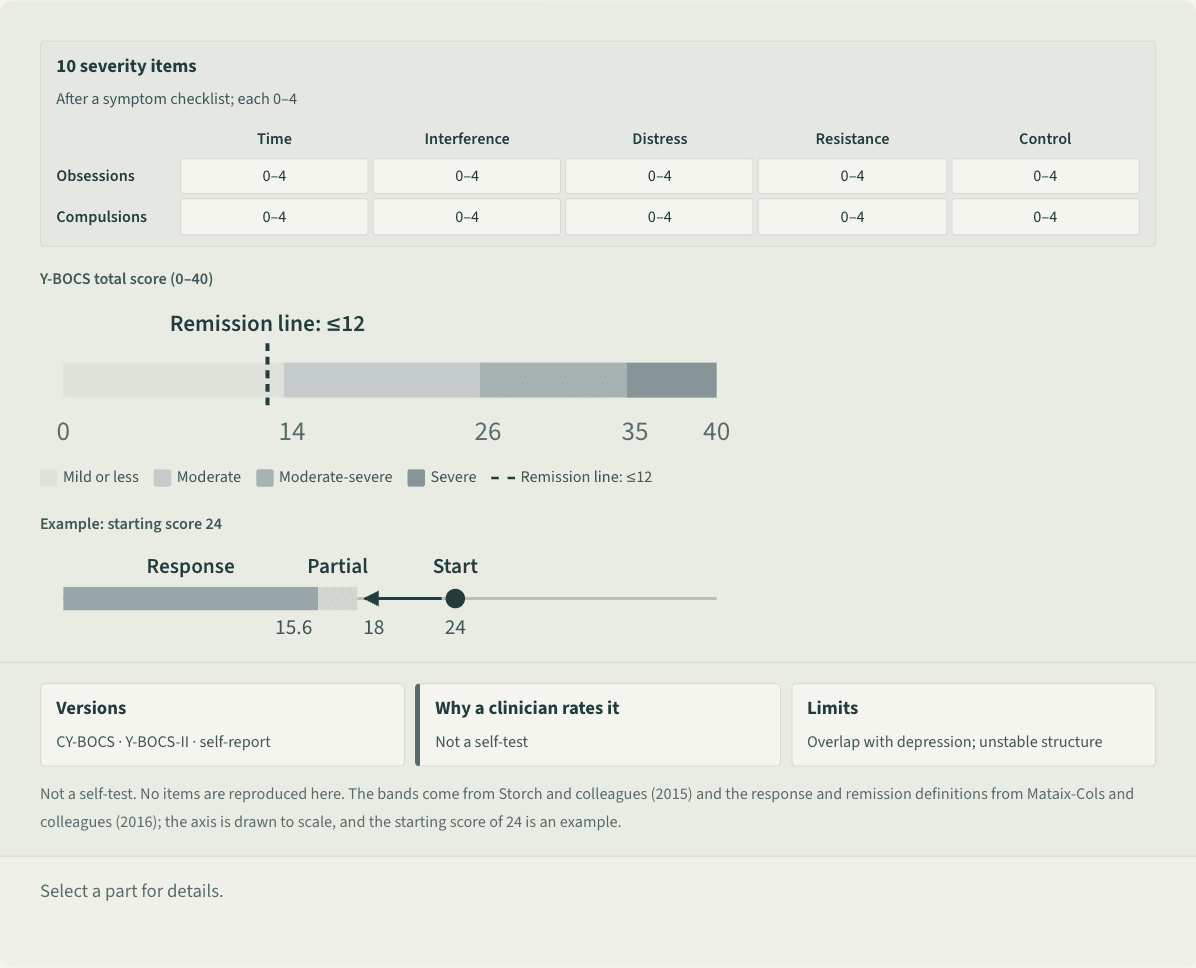
The Yale-Brown Obsessive Compulsive Scale (Y-BOCS), published by Goodman and colleagues in 1989, rates the severity of obsessive-compulsive symptoms in a semi-structured interview with a clinician.[1][2] It has a symptom checklist and 10 severity items, each scored 0–4, for a total of 0–40.[1][4]
Y-BOCS total score (0–40)
Example: starting score 24
Not a self-test. No items are reproduced here. The bands come from Storch and colleagues (2015) and the response and remission definitions from Mataix-Cols and colleagues (2016); the axis is drawn to scale, and the starting score of 24 is an example.
Data figure, not a self-test, with no items shown. At the top, a small table with two rows, obsessions and compulsions, and five columns, time, interference, distress, resistance and control, each cell scored 0 to 4. In the middle, a horizontal axis from 0 to 40 divided to scale into four bands: 0 to 13 mild or less, 14 to 25 moderate, 26 to 34 moderate-severe, 35 to 40 severe, with a dashed line at 12 labeled remission line, 12 or below. Below, an example axis: a starting score of 24, a 25% drop at 18 and a 35% drop at 15.6, with partial response marked between them and response below 15.6. At the bottom, three boxes: versions, why a clinician rates it, and limits.
 Save as image (PNG)
This figure image is licensed CC BY 4.0: reuse it with credit and a link back to this page. How to reuse
Key points
- Five items cover obsessions and five cover compulsions, rating time taken, interference, distress, resistance and control over the past week; the type of symptom does not affect the score.[1][2]
- Using global severity ratings of 954 adult patients in Brazil, one study derived bands: 0–13 mild, 14–25 moderate, 26–34 moderate-severe and 35–40 severe.[2]
- An international consensus defines response as a drop of at least 35% from baseline with a much-improved global rating, and remission as 12 or below with a near-normal global rating.[3]
- Children are assessed with the parallel CY-BOCS. The second edition, Y-BOCS-II, scores items 0–5, counts avoidance and replaces the item on resisting obsessions.[4]
An example
Ms. Wang spends hours each day rechecking the gas valve and is in therapy. Before treatment, her therapist goes through the Y-BOCS with her about the past week: 24 points. Twelve weeks later she scores 14, a drop of about 42%. Combined with how much better she is overall, that meets the definition of treatment response.[3]
Misreadings and limits
Online versions of the Y-BOCS are often used as self-tests for OCD. It was built for clinicians, who rate it from an interview and their observations; it measures severity, and a score is not a diagnosis.[1][4] Self-report versions suit only initial screening.[4] This page is not for self-diagnosis. If obsessions or rituals take up much time or cause distress, seek a professional assessment.
Sources
- 1 Goodman, W. K., Price, L. H., Rasmussen, S. A., Mazure, C., Fleischmann, R. L., Hill, C. L., Heninger, G. R., & Charney, D. S. (1989). The Yale-Brown Obsessive Compulsive Scale: I. Development, use, and reliability. Archives of General Psychiatry, 46(11), 1006–1011. doi:10.1001/archpsyc.1989.01810110048007
- 2 Storch, E. A., De Nadai, A. S., Conceição do Rosário, M., Shavitt, R. G., Torres, A. R., Ferrão, Y. A., Miguel, E. C., Lewin, A. B., & Fontenelle, L. F. (2015). Defining clinical severity in adults with obsessive–compulsive disorder. Comprehensive Psychiatry, 63, 30–35. doi:10.1016/j.comppsych.2015.08.007
- 3 Mataix-Cols, D., Fernández de la Cruz, L., Nordsletten, A. E., Lenhard, F., Isomura, K., & Simpson, H. B. (2016). Towards an international expert consensus for defining treatment response, remission, recovery and relapse in obsessive-compulsive disorder. World Psychiatry, 15(1), 80–81. doi:10.1002/wps.20299
- 4 Rapp, A. M., Bergman, R. L., Piacentini, J., & McGuire, J. F. (2016). Evidence-based assessment of obsessive–compulsive disorder. Journal of Central Nervous System Disease, 8, 13–29. doi:10.4137/JCNSD.S38359
Last checked against sources: October 28, 2026