Beck Depression Inventory (BDI)
贝克抑郁量表(BDI)
What is the Beck Depression Inventory (BDI)?
The Beck Depression Inventory (BDI) is a self-report measure of depressive symptoms published by Aaron Beck and colleagues in 1961.[1] The current BDI-II (1996) has 21 items, each scored 0–3 for the past two weeks, giving a total of 0–63 that rates symptom severity.[1][2]
BDI-II total score (0–63)
Best cut-offs for detecting major depression (range across studies)
Not a self-test. No items are reproduced here; the bands, mean and cut-offs come from Wang and Gorenstein’s (2013) review, and the axis is drawn to scale.
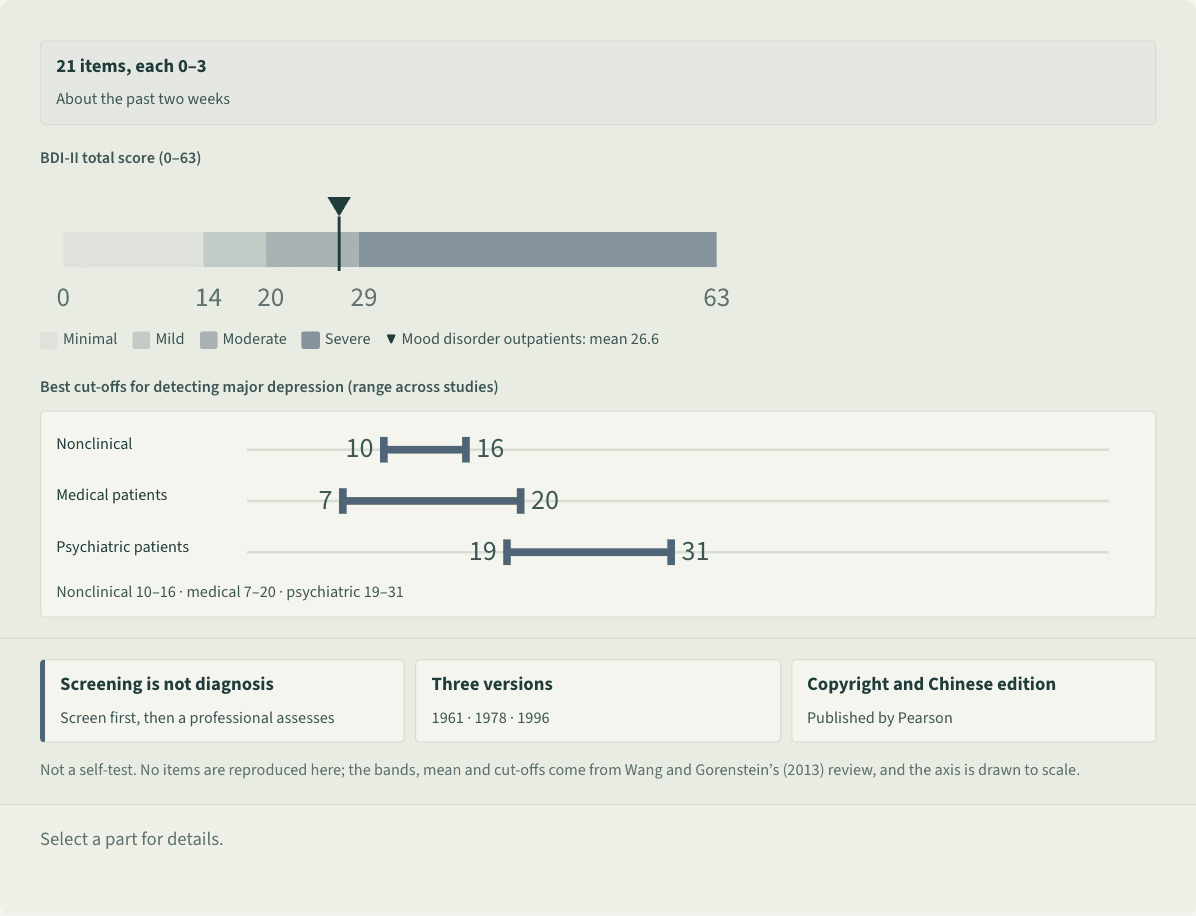
Data figure, not a self-test, with no items shown. At the top, a box: 21 items, each scored 0 to 3, about the past two weeks. In the middle, a horizontal axis from 0 to 63 divided to scale into four bands: 0 to 13 minimal or none, 14 to 19 mild, 20 to 28 moderate, 29 to 63 severe, with a marker at 26.6 labeled mean of outpatients with mood disorders. Under the axis, three lines show ranges of best cut-offs for detecting major depression: nonclinical samples 10 to 16, medical patients 7 to 20, psychiatric patients 19 to 31. At the bottom, three boxes: screening is not diagnosis; three versions, 1961, 1978 and 1996; copyright and the Chinese edition.
 Save as image (PNG)
This figure image is licensed CC BY 4.0: reuse it with credit and a link back to this page. How to reuse
Key points
- The original BDI treated negative, distorted thinking as the core of depression. BDI-II replaced four items to match DSM-IV depressive episodes and follows no particular theory.[1][2]
- Based on the scores of 500 outpatients, the manual gives rough bands: 0–13 minimal or none, 14–19 mild, 20–28 moderate and 29–63 severe.[1]
- A review of 118 studies found internal consistency of about 0.9. The best screening cut-off varies by group: 10–16 in nonclinical samples, 19–31 in psychiatric ones.[1]
- BDI-II is copyrighted and must be bought from its publisher, Pearson; it covers ages 13 to 80.[1][2] In Taiwan a licensed Chinese edition is published by the Chinese Behavioral Science Corporation.[3]
An example
On her first visit to a hospital mental health clinic, Ms. Wang fills in a BDI-II in the waiting room, and her total falls in the “moderate” band. The doctor does not treat that as a verdict but asks about her sleep, work and home life over the past two weeks before deciding whether further assessment is needed.[1]
Misreadings and limits
BDI-II is not a diagnostic tool: a high score calls for further assessment, and a low score does not rule out depression.[1] This page and online versions are not for self-diagnosis. The scale includes an item on suicidal thoughts;[1] if you have such thoughts, seek help now. Low mood lasting two weeks or more and disrupting daily life warrants seeing a doctor soon.
If you need help now
If you’re struggling to cope or having thoughts of harming yourself:
- US and Canada: call or text 988 (24/7)
- UK and Ireland: Samaritans, 116 123 (free, 24/7)
- Australia: Lifeline, 13 11 14 (24/7)
- Elsewhere: findahelpline.com
If you’re in immediate danger, call your local emergency number.
Psyfield is not a crisis service. Numbers checked October 2026.
Sources
- 1 Wang, Y.-P., & Gorenstein, C. (2013). Psychometric properties of the Beck Depression Inventory-II: A comprehensive review. Revista Brasileira de Psiquiatria, 35(4), 416–431. doi:10.1590/1516-4446-2012-1048
- 2 Pearson (n.d.). BDI–2: Beck Depression Inventory. Pearson Assessments. View source
- 3 中國行為科學社 (n.d.). Beck(貝克系列):貝克憂鬱量表第二版(BDI-II)中文版. 中國行為科學社. View source
Last checked against sources: October 28, 2026