4P case formulation
4P 个案概念化
What is the 4P case formulation?
The 4P case formulation sorts the factors behind a person’s difficulties into predisposing, precipitating, perpetuating and protective, and looks for each in biological, psychological and social domains, to explain why a problem arose and persists and to guide treatment.[1][2]
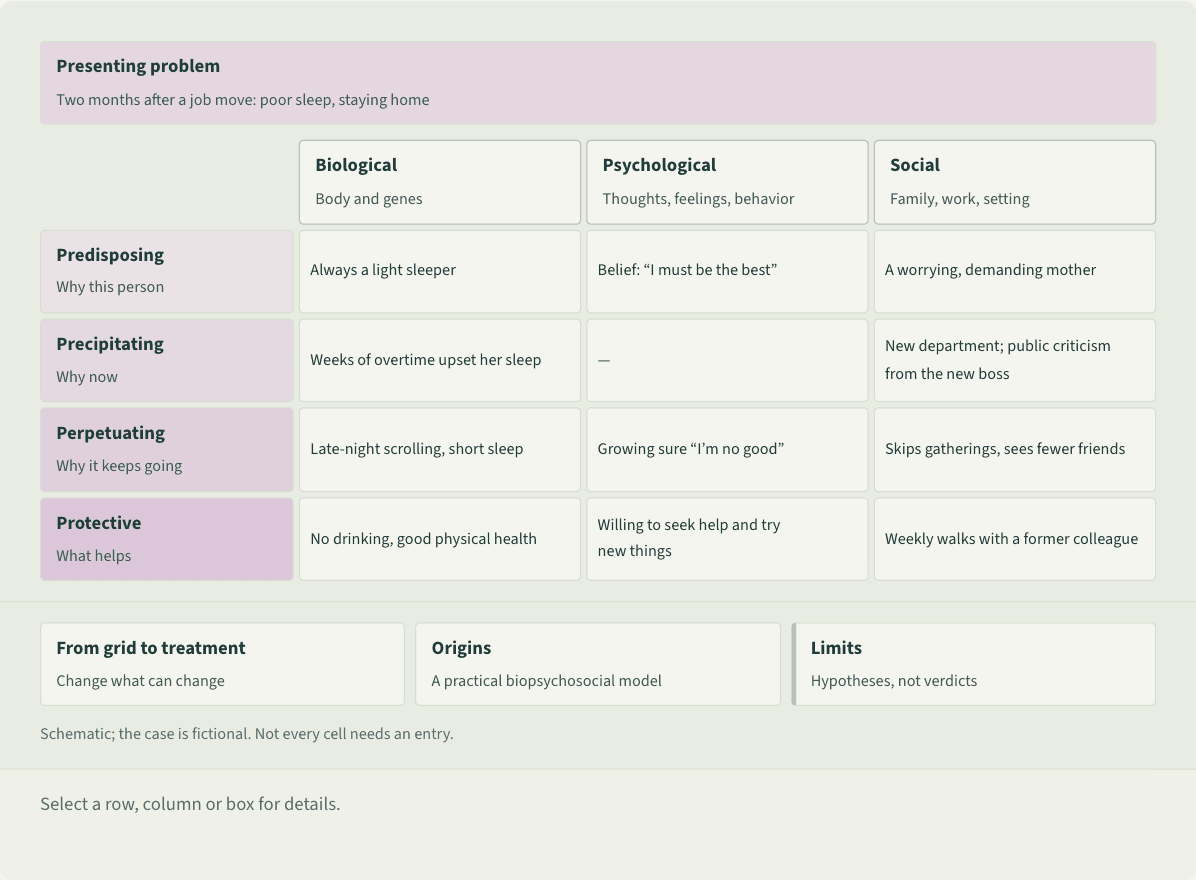
Biological Always a light sleeper
Psychological Belief: “I must be the best”
Social A worrying, demanding mother
Biological Weeks of overtime upset her sleep
Psychological —
Social New department; public criticism from the new boss
Biological Late-night scrolling, short sleep
Psychological Growing sure “I’m no good”
Social Skips gatherings, sees fewer friends
Biological No drinking, good physical health
Psychological Willing to seek help and try new things
Social Weekly walks with a former colleague
Schematic; the case is fictional. Not every cell needs an entry.
Schematic. A top box, presenting problem: two months after a job move, poor sleep and not wanting to go out. Below, a grid with columns biological, psychological and social, and rows predisposing, precipitating, perpetuating and protective. Predisposing: always a light sleeper; the belief “I must be the best”; a worrying, demanding mother. Precipitating: weeks of overtime that upset her sleep; nothing; a new department and public criticism from the new boss. Perpetuating: late-night scrolling and short sleep; growing sure “I’m no good”; skipping gatherings and seeing fewer friends. Protective: no drinking and good physical health; willing to seek help and try new things; weekly walks with a former colleague. Three boxes below: from grid to treatment, origins, and limits.
 Save as image (PNG)
This figure image is licensed CC BY 4.0: reuse it with credit and a link back to this page. How to reuse
Key points
- Predisposing factors are the background that makes a difficulty more likely, such as family history, trauma, attachment history and core beliefs; precipitating factors are major events or stressors before onset.[2]
- Perpetuating factors keep difficulties going, such as ongoing substance use, avoidance or withdrawal, insomnia and attentional biases; protective factors are strengths and supports that soften the impact.[2]
- The four Ps are crossed with biological, psychological and social domains in a grid; treatment targets what can change, builds up protective factors and notes causes that cannot change.[1]
- When 115 practitioners formulated the same case, they mostly agreed on descriptive elements, agreed less as more theory-driven inference was needed, and only 44% of formulations were rated good enough.[3]
An example
Two months into a new department, Ms. Wang sleeps badly and stays home. With her therapist she fills in a 4P grid: a worrying mother and her own “I must be the best” (predisposing); public criticism from her new boss (precipitating); skipped gatherings and late-night scrolling (perpetuating); weekly walks with a former colleague (protective).
Misreadings and limits
A 4P grid holds hypotheses to test, not established causes: many factors have unknown or small effects and come from group studies that may not fit the person in front of you.[1] Agreement between clinicians formulating the same case ranges from slight to substantial, and training and experience help.[4]
Sources
- 1 Owen, G. (2023). What is formulation in psychiatry?. Psychological Medicine, 53(5), 1700–1707. doi:10.1017/S0033291723000016
- 2 Macneil, C. A., Hasty, M. K., Conus, P., & Berk, M. (2012). Is diagnosis enough to guide interventions in mental health? Using case formulation in clinical practice. BMC Medicine, 10, 111. doi:10.1186/1741-7015-10-111
- 3 Kuyken, W., Fothergill, C. D., Musa, M., & Chadwick, P. (2005). The reliability and quality of cognitive case formulation. Behaviour Research and Therapy, 43(9), 1187–1201. doi:10.1016/j.brat.2004.08.007
- 4 Flinn, L., Braham, L., & das Nair, R. (2015). How reliable are case formulations? A systematic literature review. British Journal of Clinical Psychology, 54(3), 266–290. doi:10.1111/bjc.12073
Last checked against sources: October 28, 2026