Flow
心流
Flow is the experience of being fully absorbed in an activity whose challenge matches one’s skills.[2][3] The concept comes from psychologist Mihaly Csikszentmihalyi, whose 1990 book calls it optimal experience.[1][2]
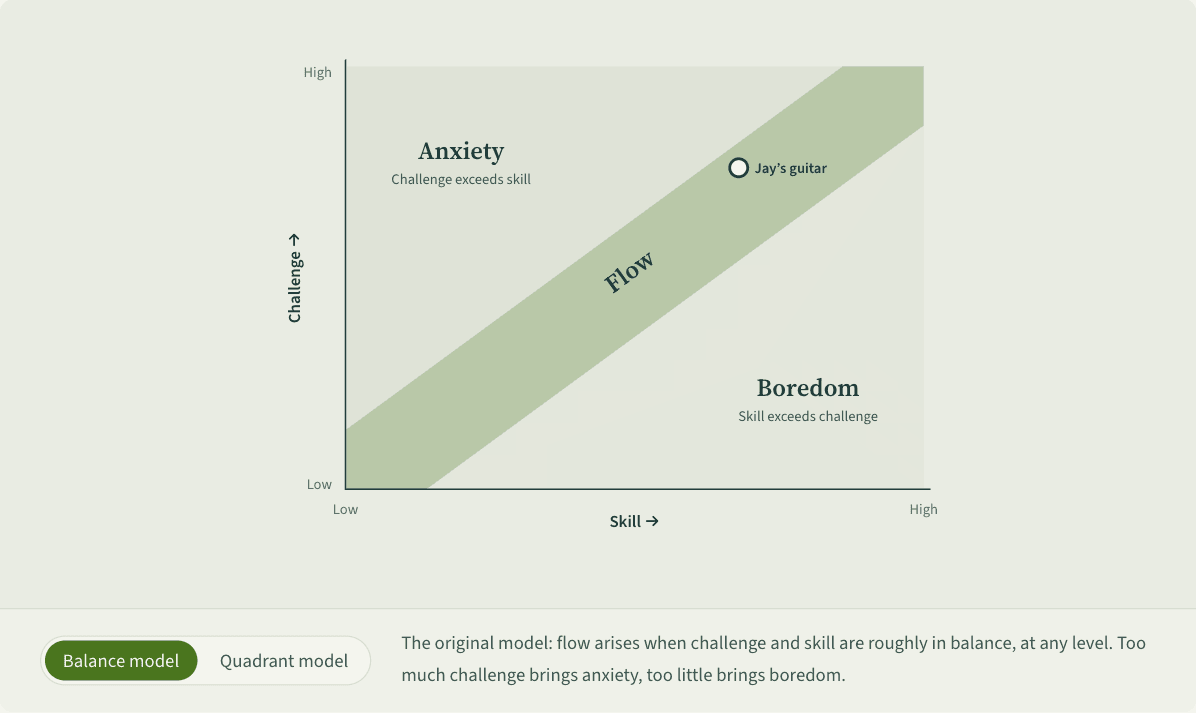
Skill runs along the horizontal axis and challenge up the vertical, both from low to high. In the balance model, a band along the diagonal is flow; above it, where challenge exceeds skill, is anxiety; below it, where skill exceeds challenge, is boredom. Switched to the quadrant model, the chart splits into four boxes: flow top right where both are high, anxiety top left, boredom bottom right, and apathy bottom left where both are low. A dot marks Jay practicing a piece slightly harder than usual; it falls in flow in both models. A note adds that eight-channel models refine this and that tests support the balance idea only partly.
 Save as image (PNG)
Key points
- Typical features include clear goals, immediate feedback, intense concentration, merging of action and awareness, loss of self-consciousness and an altered sense of time.[3]
- Early models held that a balance of challenge and skill produces flow; later quadrant and eight-channel models require both to be high as well.[2]
- Researchers measure flow with interviews, questionnaires and the experience sampling method (ESM).[3]
- Tests support the balance idea only partly: when a task feels important, flow can stay high even when skill exceeds difficulty.[2]
An example
Jay spends a weekend afternoon on a guitar piece slightly harder than usual. He works through one passage again and again and looks up to find two hours gone. A piece that is too easy bores him; one that is far too hard makes him anxious.
Misreadings and limits
A common misreading is that flow means relaxation, or that matching difficulty to ability guarantees it. Later models tie flow to high challenge and high skill, studies support the balance idea only partly, and factors such as how important the task feels also matter.[2]
Sources
- 1 Csikszentmihalyi, M. (1990). Flow: The psychology of optimal experience. Harper & Row. View source
- 2 Engeser, S., & Rheinberg, F. (2008). Flow, performance and moderators of challenge-skill balance. Motivation and Emotion. doi:10.1007/s11031-008-9102-4
- 3 任俊, 施静, & 马甜语 (2009). Flow研究概述. 心理科学进展, 17(1), 210–217. View source
Last checked against sources: October 26, 2026