Positive psychology
积极心理学
Positive psychology is the branch of psychology that studies the positive side of human nature, such as strengths and virtues, and the conditions that make life worth living.[2] Martin Seligman and Mihaly Csikszentmihalyi set out the program in a 2000 American Psychologist article.[1]
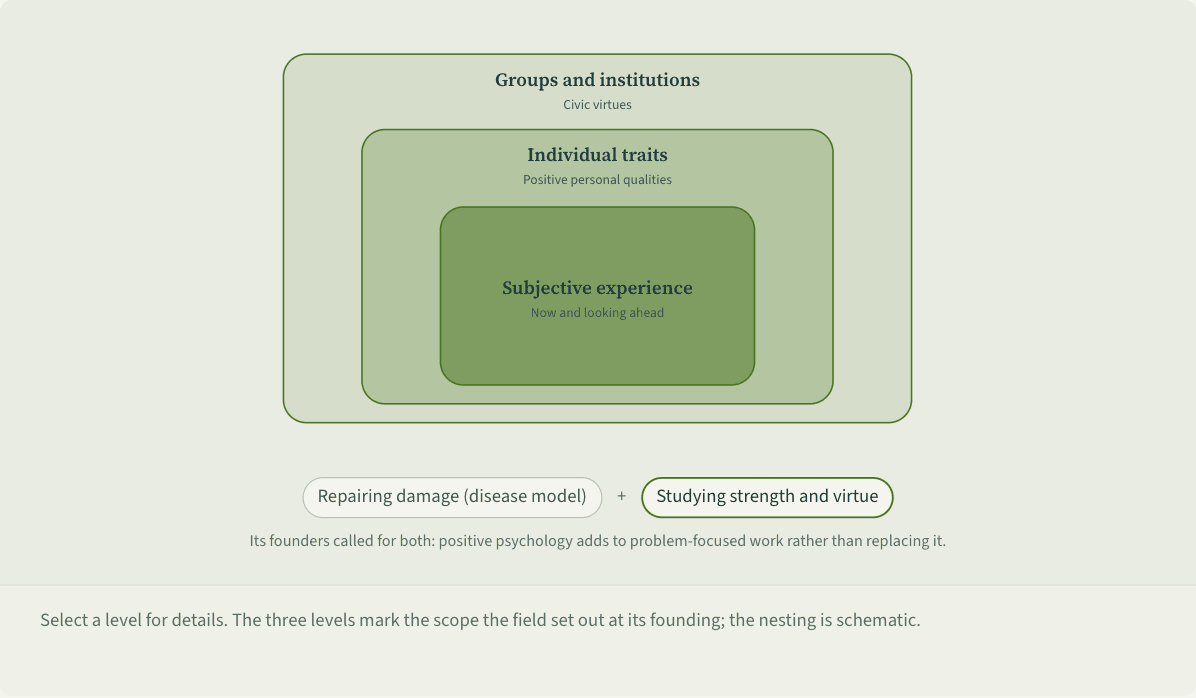
Its founders called for both: positive psychology adds to problem-focused work rather than replacing it.
Three nested rounded boxes. Innermost, subjective experience: happiness and flow in the present, hope and optimism about the future. Middle, individual traits: courage, interpersonal skill, perseverance, honesty. Outermost, groups and institutions: civic virtues and the institutions that move people toward better citizenship. Below, two labels, “repairing damage (disease model)” and “studying strength and virtue,” joined by a plus sign, with the note that the founders called for both: positive psychology adds to problem-focused work rather than replacing it.
 Save as image (PNG)
Key points
- It works at three levels: valued subjective experiences (such as happiness and Flow), positive individual traits (such as courage and perseverance), and civic virtues and institutions.[1]
- Its founders argued that since World War II psychology had focused on repairing damage within a disease model, and that strength and virtue deserve study too.[1]
- It is meant to complement, not replace, problem-focused psychology: the aim is to study people’s positive strengths and qualities as well as their problems.[3]
An example
Lin’s company used to offer counseling only after employees ran into difficulties. Its new program adds another track: helping people identify what they do well and enjoy, and noticing which work arrangements keep teams engaged.
Misreadings and limits
A common misreading equates positive psychology with always staying upbeat and avoiding negative feelings. Its founders proposed studying strengths alongside pathology, not instead of it.[1] Critics have also pointed to a narrow research scope and too few convincing longitudinal studies.[3]
Sources
- 1 Seligman, M. E. P., & Csikszentmihalyi, M. (2000). Positive psychology: An introduction. American Psychologist, 55(1), 5–14. doi:10.1037/0003-066X.55.1.5
- 2 李金珍, 王文忠, & 施建农 (2003). 积极心理学:一种新的研究方向. 心理科学进展, 11(3), 321–327. View source
- 3 任俊, & 叶浩生 (2006). 当代积极心理学运动存在的几个问题. 心理科学进展, 14(5), 787–794. View source
Last checked against sources: October 26, 2026