Hedonic adaptation
享乐适应
Hedonic adaptation is the tendency for emotional reactions to good or bad events to fade over time, so that happiness drifts back toward its earlier level. In 1971 Brickman and Campbell likened it to a “hedonic treadmill.”[2]
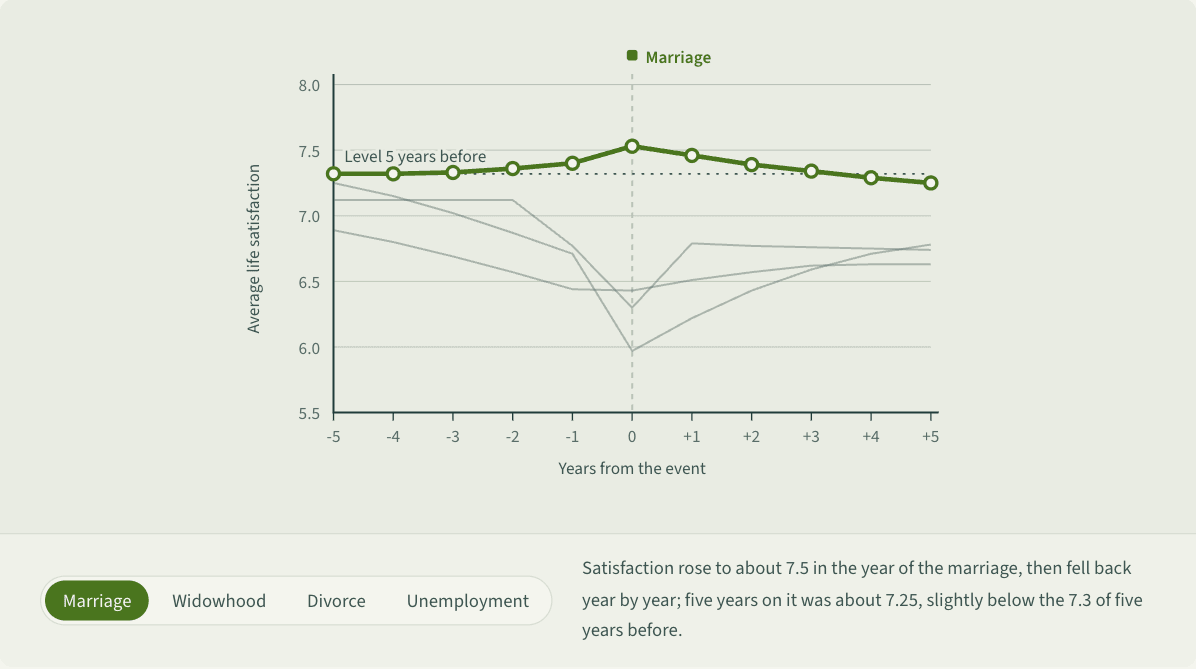
A line chart. The horizontal axis runs from 5 years before to 5 years after an event, marked by a dashed line at zero; the vertical axis is average life satisfaction, showing only the range 5.5 to 8. Four events can be selected: the selected one is drawn in color with a dotted line at its level five years before, and the other three are gray. Marriage: about 7.3, rising to 7.5 in the year of the marriage and falling back to 7.25 five years on. Widowhood: falling year by year from 7.25 to 6.0 in the year of the loss, then recovering to about 6.8. Divorce: falling from 6.9 to 6.4, then recovering to about 6.6. Unemployment: about 7.1 before, 6.3 in the year of the job loss, then level at about 6.75.
 Save as image (PNG)
Key points
- Adaptation happens mainly to constant or repeated conditions, which helps explain why stable life circumstances add little to lasting happiness; see Happiness pie (50-10-40).[3]
- A widely cited 1978 study found lottery winners were no happier than controls. Its samples were small: 22 winners, 22 controls and 29 people paralyzed in accidents.[1]
- Often overlooked: the paralyzed group was clearly less happy. A later reanalysis put the gap with controls at about 0.75 standard deviations.[2]
- Adaptation is not always complete. After widowhood, unemployment, divorce or severe disability, life satisfaction can stay below its earlier level for years.[2]
An example
Jay moves into a bigger apartment and feels happy every time he comes home. Six months later the extra space feels ordinary, his mood is back where it was before the move, and he starts browsing listings in a nicer neighborhood.
Misreadings and limits
A common misreading is that everyone has a fixed happiness set point and always returns to it. A 2006 revision found that set points are usually above neutral, differ between people and can change, and that people vary widely in how fast and how fully they adapt; some never do.[2]
Sources
- 1 Brickman, P., Coates, D., & Janoff-Bulman, R. (1978). Lottery winners and accident victims: Is happiness relative?. Journal of Personality and Social Psychology, 36(8), 917–927. doi:10.1037/0022-3514.36.8.917
- 2 Diener, E., Lucas, R. E., & Scollon, C. N. (2006). Beyond the hedonic treadmill: Revising the adaptation theory of well-being. American Psychologist, 61(4), 305–314. doi:10.1037/0003-066X.61.4.305
- 3 Lyubomirsky, S., Sheldon, K. M., & Schkade, D. (2005). Pursuing happiness: The architecture of sustainable change. Review of General Psychology, 9(2), 111–131. doi:10.1037/1089-2680.9.2.111
Last checked against sources: October 26, 2026