Ultimate attribution error
终极归因错误
What is the ultimate attribution error?
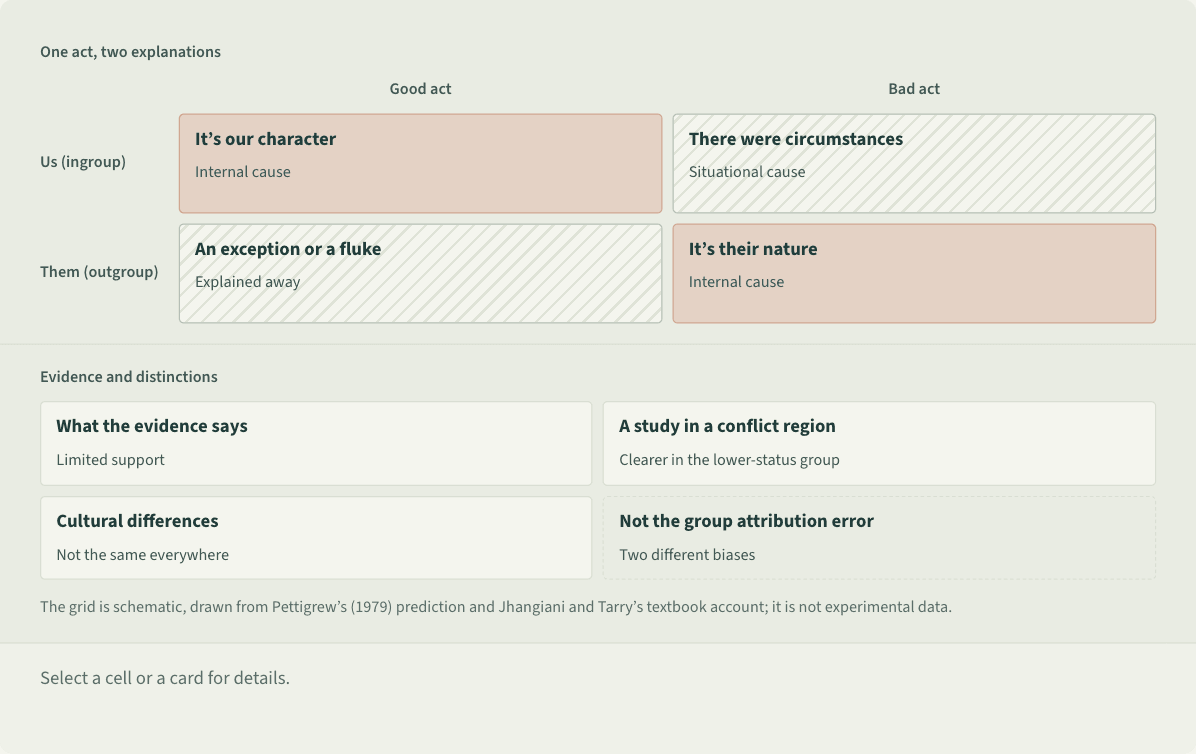
The ultimate attribution error is a group-serving pattern of explanation: an ingroup’s good acts are credited to character and its bad acts to circumstance, while an outgroup’s bad acts are seen as its nature and its good acts as exceptions, luck or the situation.[1][3] Thomas Pettigrew named it in 1979.[1]
One act, two explanations
Evidence and distinctions
The grid is schematic, drawn from Pettigrew’s (1979) prediction and Jhangiani and Tarry’s textbook account; it is not experimental data.
The upper half is a 2×2 grid titled “One act, two explanations.” Columns are “good act” and “bad act”; rows are “us (ingroup)” and “them (outgroup).” We do good: it’s our character. We do bad: there were circumstances. They do good: an exception or a fluke, explained away. They do bad: it’s their nature. Below, a small label “Evidence and distinctions” and four cards: what the evidence says (limited support); a study in a conflict region (clearer in the lower-status group); cultural differences (not the same everywhere); not the group attribution error (two different biases). A note says the grid is schematic, not experimental data.
 Save as image (PNG)
This figure image is licensed CC BY 4.0: reuse it with credit and a link back to this page. How to reuse
Key points
- Pettigrew’s original prediction concerned prejudiced people: an outgroup member’s good act would be explained away as an exception, luck or special advantage, unusual effort, or the situation.[1]
- Hewstone’s 1990 review of 19 studies found ingroup-favoring attributions in most, but only on some dimensions, giving limited support to Pettigrew’s prediction.[2]
- Strongest findings: ingroup good acts got more internal credit and bad acts less; outgroup failure was blamed on low ability, outgroup success on luck, effort or an easy task.[2]
- In violent confrontations, each side tends to explain the same acts differently.[3] In a Northern Ireland study, only pupils from the lower-status group explained matching acts in their own group’s favor.[4]
An example
Lin’s department and the one next door are racing to finish a joint project. When a colleague in her own department is late, Lin says he has family matters this week; when someone next door is late, she says that lot is always slow. When the other department finishes early, she says they got lucky with easy tasks.
Misreadings and limits
A common mistake is to confuse it with the fundamental attribution error, which overweights character in explaining other people’s behavior whatever their group, or with the group attribution error, which generalizes from a few members to a whole outgroup. Here the same act gets opposite explanations depending on the actor’s group.[3]
Sources
- 1 Pettigrew, T. F. (1979). The ultimate attribution error: Extending Allport’s cognitive analysis of prejudice. Personality and Social Psychology Bulletin, 5(4), 461–476. doi:10.1177/014616727900500407
- 2 Hewstone, M. (1990). The ‘ultimate attribution error’? A review of the literature on intergroup causal attribution. European Journal of Social Psychology, 20(4), 311–335. doi:10.1002/ejsp.2420200404
- 3 Jhangiani, R., & Tarry, H. (2022). Biases in attribution. Principles of social psychology (1st international H5P ed.), section 5.3. BCcampus. View source
- 4 Hunter, J. A., & Stringer, M. (1999). Attributional bias and identity in a conflict region: The moderating effects of status. Current Research in Social Psychology, 4(9), 160–175. View source
Last checked against sources: October 28, 2026