Systemic discrimination
系统性歧视
What is systemic discrimination?
Systemic discrimination is discrimination embedded in institutions’ operating procedures, laws and policies, favoring some groups and restricting opportunities for others.[1] It can occur without discriminatory intent, when rules applied equally to everyone are built in ways that favor one group.[2]
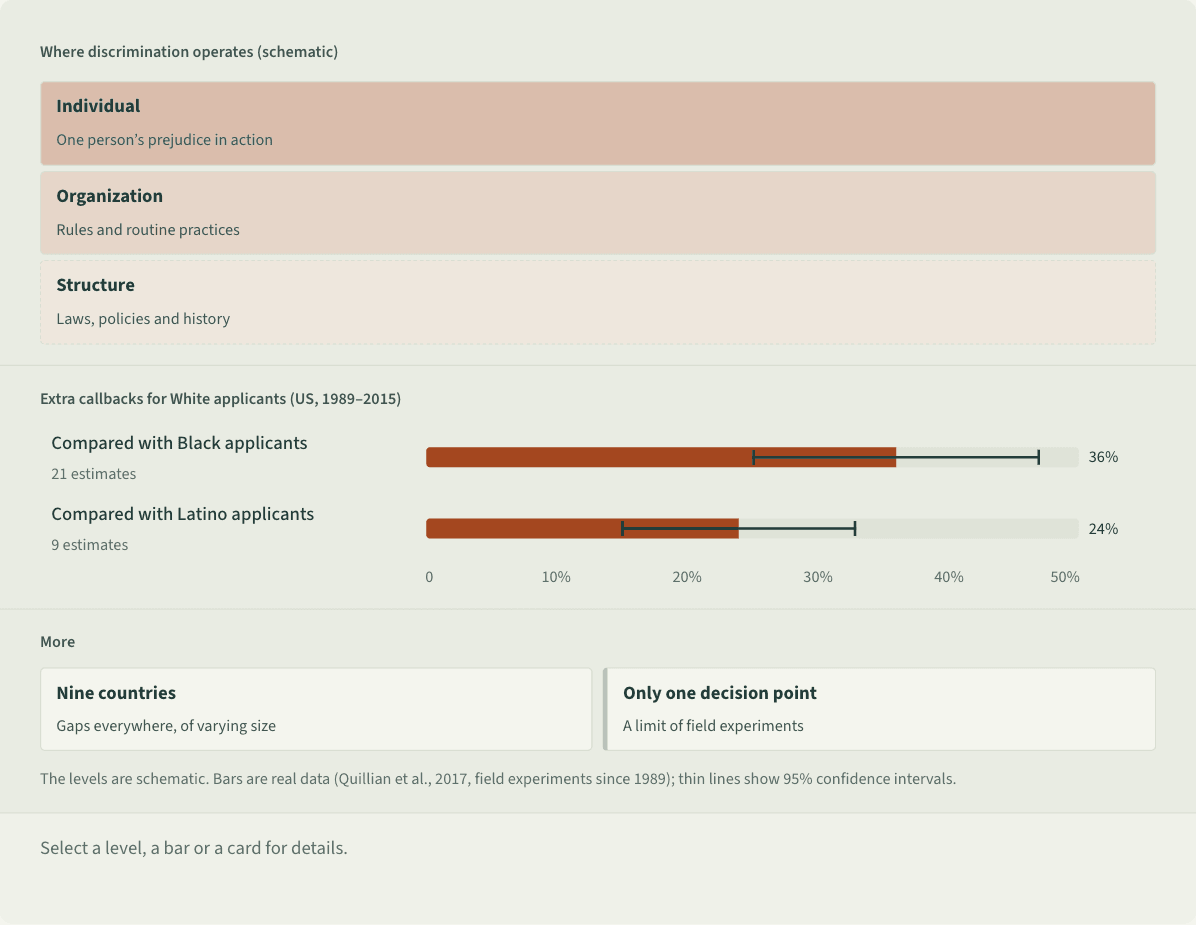
Where discrimination operates (schematic)
More
The levels are schematic. Bars are real data (Quillian et al., 2017, field experiments since 1989); thin lines show 95% confidence intervals.
At the top, three stacked bands titled “Where discrimination operates (schematic),” shading from dark to light: individual (one person’s prejudice put into action); organization (rules and routine practices); structure (laws, policies and history). In the middle, two bars drawn to scale from 0 to 50%, titled “Extra callbacks for White applicants (US, 1989–2015)”: 36% more than Black applicants, 95% confidence interval 25–47%; 24% more than Latino applicants, interval 15–33%. Below, two cards: nine countries in Europe and North America (gaps everywhere, of varying size); only one decision point is measured (a limit of field experiments). A note says the levels are schematic and the bars are Quillian and colleagues’ 2017 data.
 Save as image (PNG)
This figure image is licensed CC BY 4.0: reuse it with credit and a link back to this page. How to reuse
Key points
- Researchers separate differential treatment, being treated unequally because of one’s group, from disparate impact, where one set of rules applied to everyone still favors one group.[2]
- Hiring through employee referrals is an example: whatever the employer’s own attitudes, it tends to reproduce the existing workforce and keep out groups already underrepresented.[2]
- Structural accounts point to three sources: gaps left by past discrimination, ostensibly neutral current policies, and disadvantage that accumulates across domains and over the life course.[2]
- In US hiring field experiments since 1989, White applicants got 36% more callbacks than equally qualified Black applicants, with no decline;[3] all nine countries studied showed gaps.[4]
An example
Ms. Wang’s company fills most jobs through employee referrals and pays a bonus for each one. Years later, going through the staff list, she finds that nearly every new hire comes from the same few schools and hometown circles, and few outside applicants reach an interview. Nobody set out to exclude anyone, yet openings keep circulating among acquaintances.
Misreadings and limits
Two misreadings are common. One takes a claim of systemic discrimination to mean that everyone in the system is prejudiced, when the concept explicitly covers unintended disadvantage.[2] The other treats any group gap as proof of discrimination; gaps can have other causes, and more direct tests such as field experiments are needed.[2][4]
Sources
- 1 American Psychological Association (2023). Inclusive language guide (2nd ed.). American Psychological Association. View source
- 2 Pager, D., & Shepherd, H. (2008). The sociology of discrimination: Racial discrimination in employment, housing, credit, and consumer markets. Annual Review of Sociology, 34, 181–209. doi:10.1146/annurev.soc.33.040406.131740
- 3 Quillian, L., Pager, D., Hexel, O., & Midtbøen, A. H. (2017). Meta-analysis of field experiments shows no change in racial discrimination in hiring over time. Proceedings of the National Academy of Sciences, 114(41), 10870–10875. doi:10.1073/pnas.1706255114
- 4 Quillian, L., Heath, A., Pager, D., Midtbøen, A. H., Fleischmann, F., & Hexel, O. (2019). Do some countries discriminate more than others? Evidence from 97 field experiments of racial discrimination in hiring. Sociological Science, 6, 467–496. doi:10.15195/v6.a18
Last checked against sources: October 28, 2026