Satir iceberg
萨提亚冰山
The Satir iceberg is a metaphor from the Satir model: visible behavior is the tip above the waterline, and below it lie the inner experiences that drive it, such as feelings, perceptions, expectations and yearnings.[1][3]
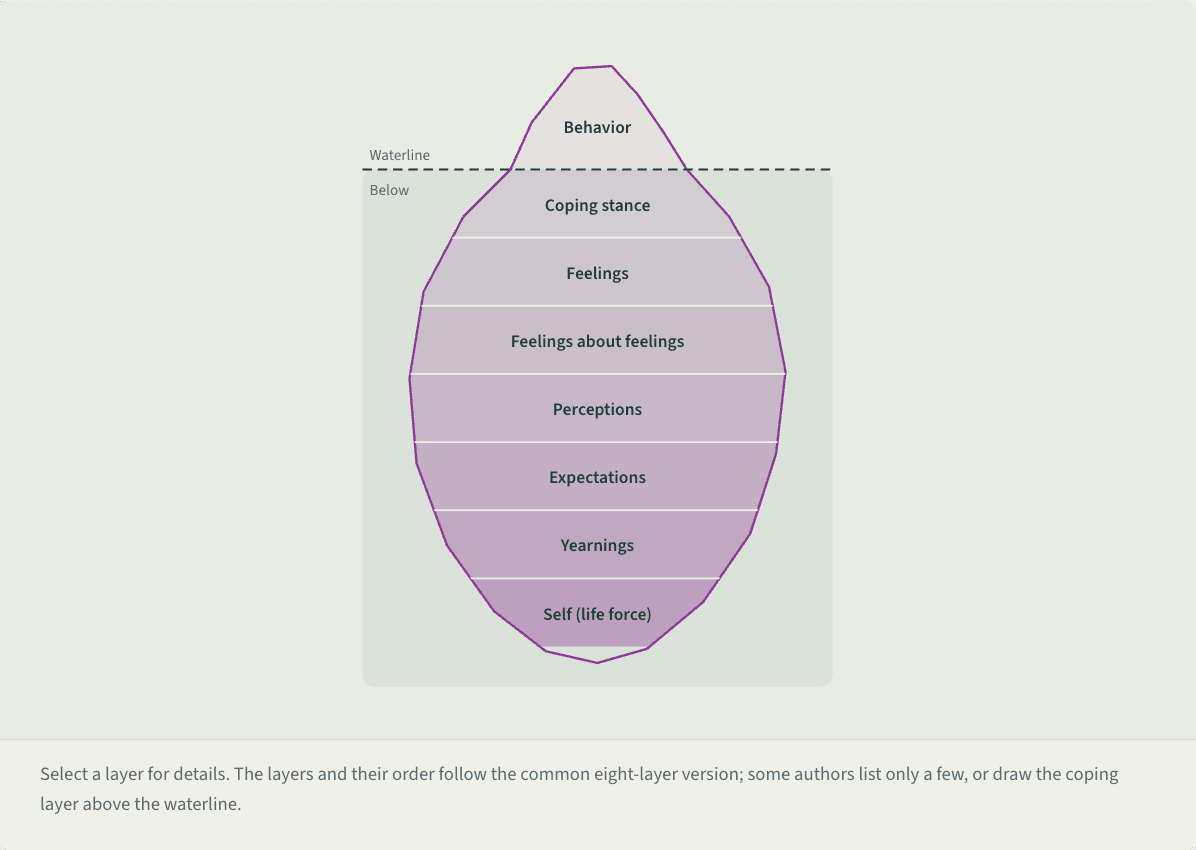
An iceberg sliced into eight horizontal layers that darken with depth. Above the waterline only the tip shows, labeled Behavior. Below the waterline, from top to bottom: Coping stance, Feelings, Feelings about feelings, Perceptions, Expectations, Yearnings, Self (life force).
 Save as image (PNG)
Key points
- A common version has eight layers, top to bottom: behavior, coping stance, feelings, feelings about feelings, perceptions, expectations, yearnings, and the self (life force) at the base.[2]
- The coping layer holds the Satir communication stances: placating, blaming, super-reasonable and irrelevant.[2]
- In counseling it is used to explore downward from visible behavior to the inner experience that drives defensive reactions.[3]
- Authors do not all use the same layers. Some versions list only a few, such as coping, feelings, perceptions, expectations and yearnings.[3]
An example
Ms. Wang always jumps in first at meetings, and coworkers think she is showing off. Seen through the iceberg, the tip is her jumping in; below it may be anxiety about being overlooked, a belief that staying quiet means being sidelined, and a yearning to be recognized.
Misreadings and limits
The iceberg is a clinical metaphor for conversation and self-reflection, not a measured psychological structure, and Satir’s work as a whole has little empirical support.[4] It is also different from Freud’s iceberg of consciousness (see Levels of consciousness).
Sources
- 1 Satir, V., Banmen, J., Gerber, J., & Gomori, M. (1991). The Satir model: Family therapy and beyond. Science and Behavior Books. View source
- 2 张静 (2015). 萨提亚模式在初中生人际冲突团体心理辅导课中的巧妙运用. 中小学心理健康教育. View source
- 3 Loeschen, S. (2020). Family therapy using the Satir process. Socialinis darbas. Patirtis ir metodai, 26(2). doi:10.7220/2029-5820.26.2.3
- 4 Virginia Satir Global Network (2024). Annotated bibliography (version 51). Virginia Satir Global Network. View source
Last checked against sources: October 26, 2026